



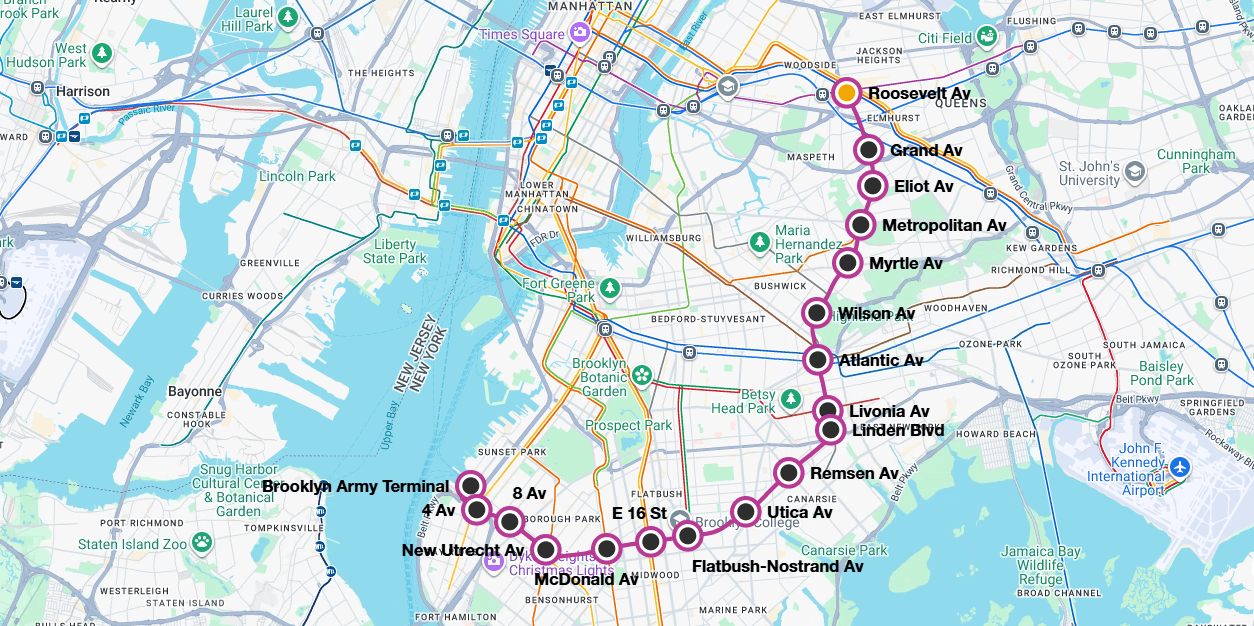
The future railway line that will connect Brooklyn and Queens could work without drivers. It is the proposal contained in a report published yesterday, Wednesday 21 October, by the Effective Transit Alliance (ETA), a public transport organization. The document asks the Metropolitan Transportation Authority (MTA), the New York Metro Agency, to change the Interborough Express project before final decisions are taken on its construction.
The Interborough Express, also known as IBX, is one of the city’s main infrastructure projects. It predicts a 23-kilometre long line, with 18 stations, connecting the Brooklyn Army Terminal, Bay Ridge, Roosevelt Avenue, Jackson Heights, Queens. The route will largely use an existing rail corridor, currently intended for freight transport.
The most important news is the links. The line will allow to change with 17 metro lines, 51 buses and the Long Island Rail Road, making it easier to move between neighborhoods that are now connected mainly by direct routes to Manhattan. According to the MTA, the journey between the two terminus will last about 32 minutes and the service could reach 160 thousand passengers per day.
The current project, with an estimated cost of 5.5 billion dollars, includes a light metro, similar to a modern tram, with drivers on board. The Effective Transit Alliance offers an automated light meter, a fully automated light rail, with separate tracks from road traffic and electronic systems controlled trains.
The difference is not only about staff. Without the need to have a driver on each convoy, according to the authors of the report, it would be economically easier to circulate small and frequent trains, even in the evening hours and in periods of less affluence. The proposal also includes the installation of protection doors on the docks, which would only open on the arrival of trains.
The central point is the capacity of the line. The first estimates of the MTA, dating back to 2022, provided about 87 thousand passengers per day. The next projections went up to 160 thousand. According to the simulations illustrated by Streetsblog, with trains every five minutes the question could approach 200 thousand passengers, while even greater frequencies could make it grow further.
The Director of the Effective Transit Alliance, Blair Lorenzo, argues that automation would also allow to contain construction costs. Shorter trains, but more frequent, would require smaller docks, reducing the space needed for some stations. However, the choice should be made now: converting a traditional line into a fully automatic system could require much more expensive interventions.
Driverless trains would not be an absolute novelty for New York. The AirTrain connecting the airport terminals JFK already works with an automated system. Similar solutions are also used in Vancouver and Montreal, where SkyTrain and Réseau express métropolitain lines operate without drivers on board.
The main obstacle could be trade union. The Transport Workers Union Local 100, which represents many metro workers, has long opposed the reduction of personnel on trains. The union argues that the presence of operators is important for the safety of passengers and for the management of the unexpected. The question is already at the heart of a comparison with the MTA on the use of only one employee in the convoys of the existing lines.
There is then a substantial difference between the automation of a new line and the current metro line. The IBX would have specially designed rails, stations and systems. It would therefore not be necessary to adapt infrastructures built decades ago and used by different technologies trains.
The project does not change for the moment. The MTA, interviewed by Streetsblog, reported that she is examining the report. The agency officially continues to predict a light metro line and is preparing the draft of the environmental impact study, expected by the end of 2026. It will follow a phase of public consultation, during which residents and organizations can submit observations.
The Interborough Express also remains a project to be fully funded. Of the 5.5 billion needed, about half is already planned in the MTA investment plan. Construction and opening will still take several years.
The comparison on automation then arrives at a stage in which the main features of the new line must still be defined. The question is mainly about what will happen after opening: building a link capable of transporting 160 thousand people a day, or predicting from the beginning infrastructures capable of sustaining a higher demand without having to be rebuilt.
L’articolo The new line between Brooklyn and Queens could have driverless trains proviene da IlNewyorkese.