



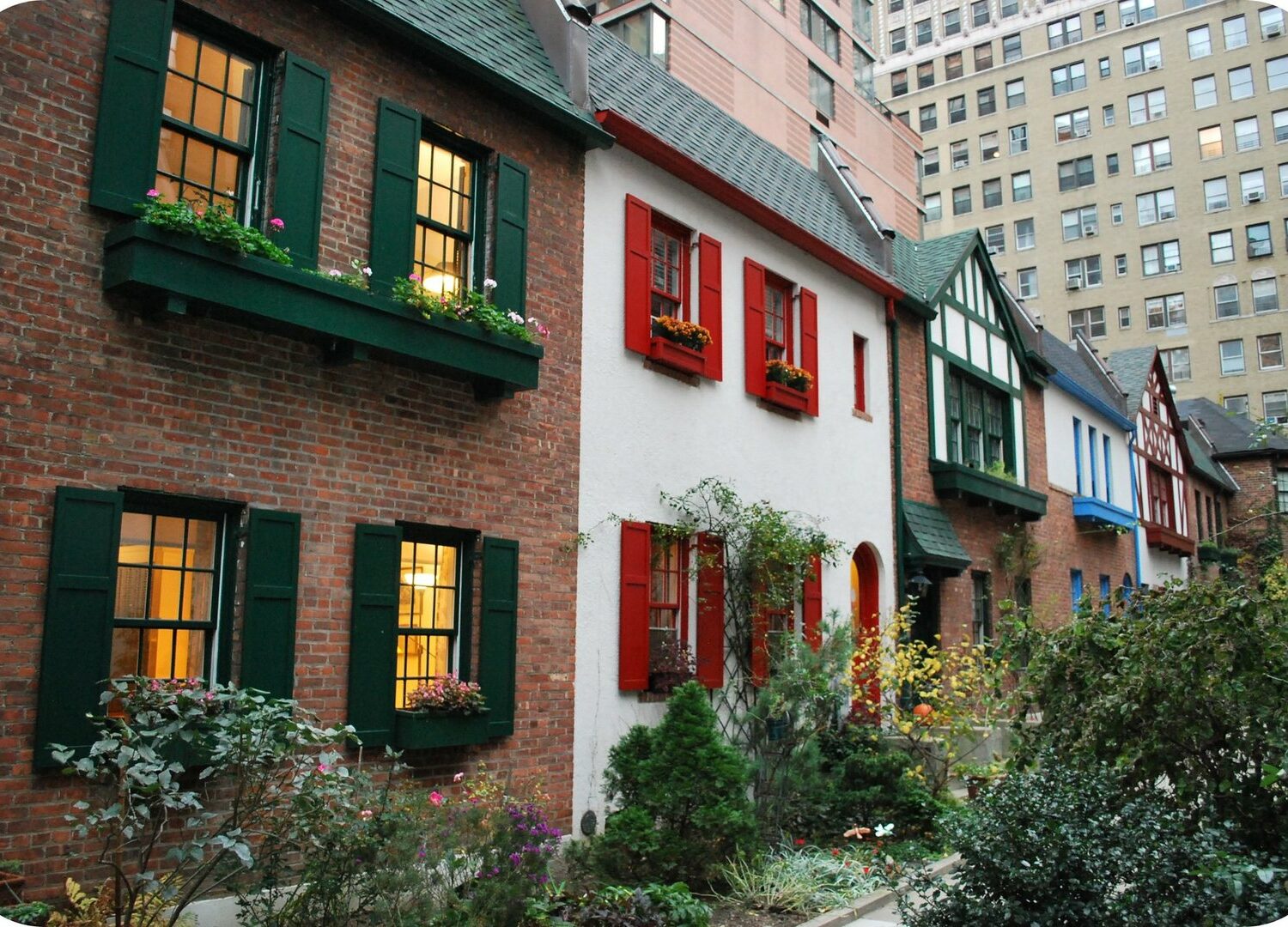
From West 95th Street you can see above all the gate. Behind, however, there are some steps and a narrow pedestrian street, flanked by low houses with colored doors, hedges, hedges and wooden beams applied to the facades. Around Broadway and West End Avenue, the large Upper West Side condominiums rise. The complex is called Pomander Walk, which comprises 27 buildings and is accessible only to residents and their guests. A so-called gated community, as there are so many in America. From the road you can see a part through the inferriate.
According to the report of the Landmarks Preservation Commission, sixteen two-storey houses overlook the internal passage. The other eleven buildings look towards 94th and 95th Street and form a kind of wall around the courtyard. Pomander Walk is also raised from the level of the sidewalks: to enter you must cross one of the two gates and climb a short staircase.
The comparison with London mews is useful for appearance, but a little less for history. The mews were generally born as service alleys, with stables and remittances for carriages then transformed into houses. Pomander Walk was designed directly as a residential complex. It was a small private road deliberately inserted into the regular Manhattan grid, at a time when on the Upper West Side, larger and more profitable buildings were built.
The model came from the theatre. Pomander Walk, a comedy of Louis N. Parker, debuted on Broadway at Wallack’s Theatre on December 20, 1910, and remained on stage for 143 performances. The story was set in an imaginary group of small houses near Chiswick, along the Thames. When in 1921 entrepreneur Thomas J. Healy commissioned the King & Campbell studio to build the complex, asked the architects to reproduce that same atmosphere. The spectacle houses were described as small Queen Anne-style dwellings; New Yorkers were made with a more free Tudor aesthetic, then rather widespread in the United States.
Healy, an Irish immigrant who had made fortune with restaurants, premises and real estate investments, had bigger projects for the land. According to the reconstruction of the architectural historian Christopher Gray, he wanted to build a hotel of sixteen floors. He did not manage to find the funding immediately, he made the houses as a temporary solution: the rents would produce revenue waiting to demolish everything and start the hotel. Healy died in 1927 and the project was not carried forward. The temporary arrangement remained in place.
King & Campbell obtained the desired effect using the proportions. The internal houses are small and irregular, with tilted roofs, fronts, plaster, bricks and false wooden frames. Doors, shutters and finishes were painted green, red and blue. In front of the entrances, sufficient spaces were left for flower beds and hedges, while the strongest buildings facing the streets visually protected the passage. The result was spectacular already in 1921, when Broadway ran a few meters away; it became even more with the construction of buildings that today overlook the houses.
In the 1970s, Pomander Walk was very deteriorated and it returned to be appealing for those who wanted to build on the lot. The inhabitants organized against demolition and demanded that the complex be protected. At the hearings of the Landmarks Preservation Commission in 1982, 71 people spoke in favour of designation and four opposed. On September 14 of that year, Pomander Walk became a landmark in New York; in September 1983 it was also included in the National Register of Historic Places with number 83001739.
Protection has not transformed Pomander Walk into a museum. It has remained a cooperative residential complex, today consisting of about 61 apartments: some units occupy only one floor, others were united to obtain duplex, triplex or entire houses. In 2009, a four-year restoration of façades was completed, with the recovery of architectural details disappeared or modified over time. Persians, florists and gardens depend largely on the daily maintenance of residents, who also defend the confidentiality of the place with some attention.
Pomander Walk survived first because the man who wanted to demolish it died and then because, half a century later, those who lived there managed to protect it. Today its strangeness comes mainly from the scale: two rows of houses designed to look like the backdrop of a comedy remained firm while the Upper West Side grew all around. To see them, you need an invitation. To understand how out of place you just have to look over the 95th street gate.
L’articolo The small English village hidden on the Upper West Side comes from IlNewyorkese.