



For more than 20 years Joe Macken has driven day trucks and built New York at night. He is not an architect, he did not study urbanism and before beginning he had no experience as a modeler. In the basement of his house near Albany, however, he reproduced, one at a time, the buildings of the five boroughs: skyscrapers, single-family houses, bridges, factories, stadiums, parks and entire neighborhoods.
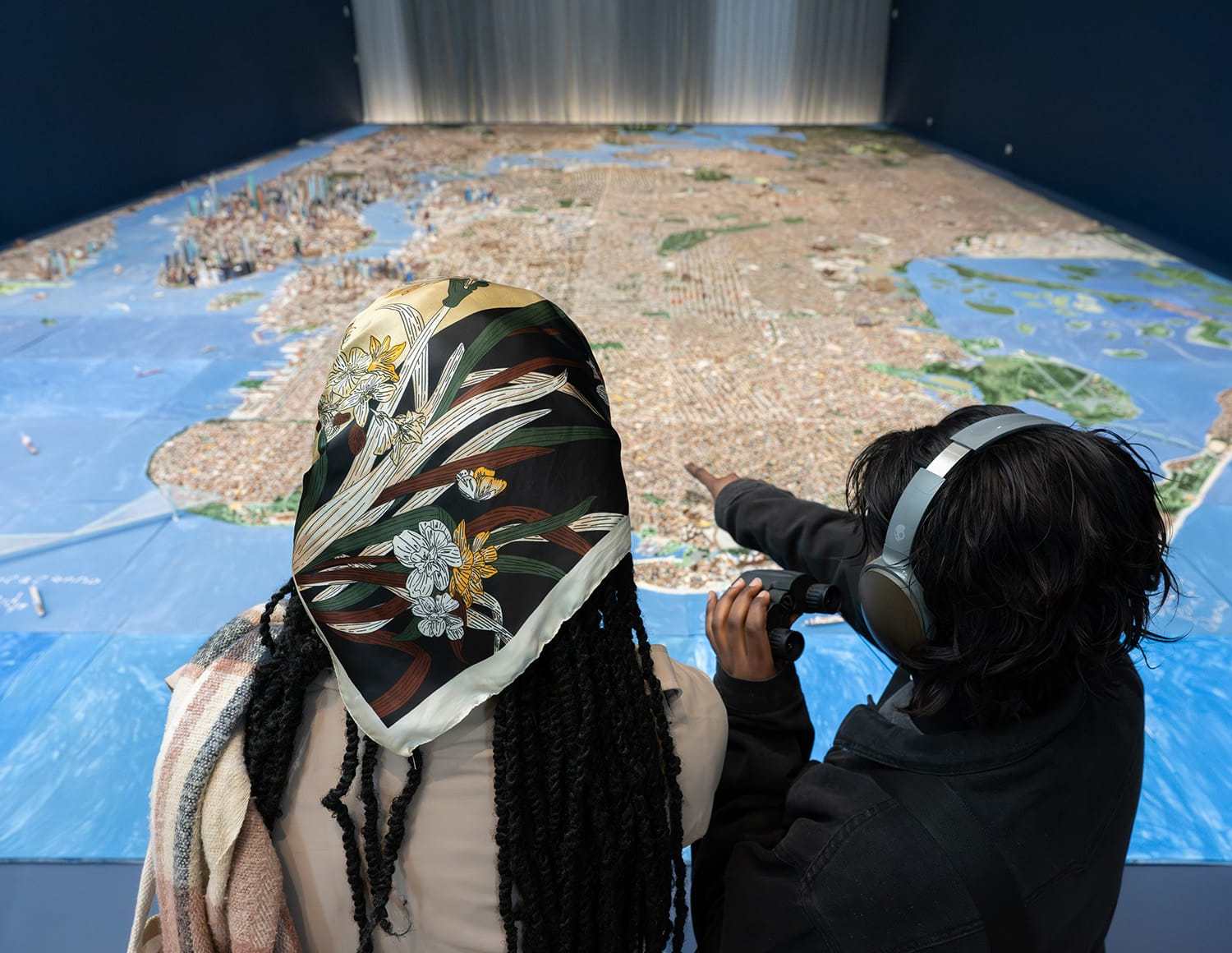
They eventually became more than 800,000. All together today form a 15-metre-long model that occupies a hall at the Museum of the City of New York on Fifth Avenue. The exhibition is called He Built This City: Joe Macken’s Model and is open until 12 October.
Macken is 63 years old and grew up in Middle Village, Queens. The idea of building a miniature New York dates back to when he was a child. As he told himself, during a school trip he visited the Panorama of the City of New York, the giant plastic created for the World’s Fair in 1964 and still today preserved at the Queens Museum. Looking at him he told a classmate that one day he would build one too.
It looked like a child’s dream, instead it became reality, although it took a few decades to actually start the work.
In 2003 Macken began to build a bridge with wooden sticks inspired by those of Brooklyn, Manhattan and Williamsburg. The model was then destroyed during a move. Soon after he decided to try again, this time starting from a real building: the 30 Rockefeller Plaza. The next day he built another one.
Macken began to expand the model around Rockefeller Center, mainly using balsa wood, cardboard, expanded material panels and glue, products that could buy in normal modeling shops. From Midtown he continued towards the rest of Manhattan. Only that part took him about ten years. The Empire State Building was one of the most difficult buildings to build, especially for the Art Deco spire, which Macken wanted quite precise to remain credible to the gaze of those who would look closely at it.
When Manhattan finished, he didn’t stop. He went to Brooklyn, Queens, Bronx and Staten Island, using maps, satellite images and photographs to rebuild streets and blocks. The chosen scale was about one inch every 160 royal feet, just under 49 meters. The model was built in hundreds of separate sections, which can be assembled as a huge puzzle.
The most surprising aspect of the story is that the work has been realized almost all in leisure time, after real work. Macken went home, spent the evening with his wife and children and then went down to the basement. In some periods he continued for hours, despite getting up at 4:00 in the morning to go to work. His obsession came to the point that he was carrying pieces and materials even during family holidays on the coast of New Jersey and took advantage of breaks when, on weekends, he worked as a bus driver.
“It was simply something I couldn’t stop doing,” he told the Associated Press. The curiosity is that his New York is not an exact reproduction of the city as we know it today. In some points of the model Macken deliberately decided to ignore the present.
In Queens he rebuilt the diner he used as a boy, although in his place today there is a new building. Between Brooklyn and Queens left the old Kosciuszko Bridge, demolished in 2017 and replaced by the current bridge. In Lower Manhattan it made an even more obvious choice: next to the One World Trade Center and the buildings built after the September 11 attacks there are still the Twin Towers.
Macken had seen them build from the house he grew up in Queens. Between the end of the 1960s and the beginning of the 1970s, he used to climb the roof of his parents’ house to watch Manhattan skyline in the distance. The Twin Towers were among his favorite buildings and when he built his own city he decided they would stay there.
The model is also a map of the memories of those who built it. The contemporary New York and Macken’s childhood coexist in the same space, without him trying to hide the inconsistencies.
For a long time, almost nobody outside the family knew what was in his basement. When the work was close to the conclusion, his daughter suggested he publish some videos on TikTok. Macken didn’t use social networks and he didn’t expect much. In a week the movies exceeded 10 million views.
Among the people who saw them were also responsible for the Museum of the City of New York. From there they decided to contact him and the idea of the exhibition was born.
Bringing the model to Manhattan was an almost comparable problem to build it. The work consists of hundreds of numbered panels, which once assembled occupy about 1,350 square feet, more than 125 square meters. They were assembled in the Museum to allow visitors to wander around the city and search for individual buildings and neighborhoods. Binoculars are also available to observe the most distant areas.
Credits: Museum of the City of New York website
The thing that many visitors do is not look for the Empire State Building or the Statue of Liberty. They look for their own home or glimpses of the city that have a particular meaning for them.
It is one of the most common and direct effects of Macken’s work. View from afar is a huge reproduction of New York; approaching the details becomes a sum of hundreds of thousands of places, very small glimpses, each of which has a particular meaning.
Macken doesn’t really consider the job done. The model already includes some parts of New Jersey and Long Island, now the new purpose of the author is to add at least fifty new buildings and continue to expand it beyond the borders of the city.
It is consistent with the way everything began, more than 20 years ago. Macken had built 30 Rockefeller Plaza and could have stopped there. The next day, however, had already begun to build the building next door.
L’articolo A truck driver has spent more than 20 years building New York miniature proviene da IlNewyorkese.