


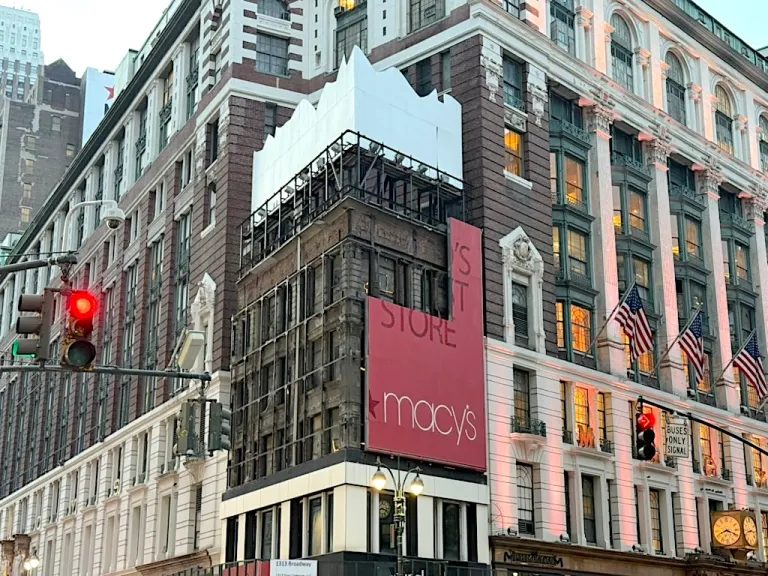
At the corner of West 34th Street and Broadway, where Herald Square opens to Sixth Avenue, it is reappearing a building that many New Yorkers did not even know existed. It has five floors, a brick and limestone façade, large windows and terracotta decorations. For decades he was almost entirely hidden behind a gigantic teaching of Macy’s in the form of a shopping bag.
In recent weeks, the red and white structure, installed about sixty years ago, has been gradually dismantled. On the ground floor are the scaffolding around the Sunglass Hut store, while the upper floors are covered by yard nets. A part of the sign is still visible on the side facing Sixth Avenue, but the profile of the building has been visible for the first time since the beginning of the twentieth century. The photos published on July 27 by Ephemeral New York also show walled windows, piping and various elements of the façade that have long been covered.
The building has the address 1313 Broadway and seems to be framed within Macy’s headquarters, which occupies almost the entire block between Broadway, Seventh Avenue, West 34th and West 35th Street. It is actually a distinct property and belongs to the Kaufman Organization. It is one of Manhattan’s best known real estate holdouts, i.e. those small batches that a owner refuses to sell and around which a larger project is forced to develop.
The story began in 1901, when Macy’s decided to leave its headquarters on 14th Street and move further north, near the railway stations and the new Herald Square transport lines. The area hosted restaurants, shops and the Koster and Bial’s Music Hall, the theatre where on April 23, 1896 the first public exhibition of Vitascope, one of the first systems to project moving images on a screen. The theatre was demolished together with other buildings purchased by Macy’s; its importance in film history is documented by the Library of Congress.
Macy’s managed to buy almost all the necessary land at the new headquarters. It remained excluded a lot of just 30 for 50 feet, about nine meters per fifteen, belonging to the Reverend Duane Pell. According to a story of the department store published in 1922 by Edward Hungerford, Pell demanded $250,000, a very high figure for such a small surface. Macy’s finally agreed to pay, but the sale was not finished.
The land was purchased for $375,000 by Robert H. Smith, who according to several reconstructions acted on behalf of Henry Siegel, owner of Macy’s main competitor at the time, Siegel-Cooper. His large warehouse on Sixth Avenue, between 18th and 19th Street, opened in 1896 as the largest in the world. Siegel proposed to cede the lot in exchange for one of the buildings Macy’s was leaving on 14th Street. Macy’s refused and in 1902 he also inaugurated Herald Square, building it around the property of the rival. The same company still indicates 1902 as the year of transfer in its official history.
In 1903 the previous building on the small lot was demolished and replaced by the current five-storey building, designed by architect William Hume. In 1911 the property was sold for a million dollars, a figure that at the time set a record for a lot of that size. Since then it was nicknamed “Million Dollar Corner”. Macy’s continued to expand his store: in 1924 he reached Seventh Avenue and exceeded the million square feet of commercial surface, according to the company’s reconstruction.
Since the 1920s, Macy’s began renting the façade of the small building for its own advertising. The signs became progressively larger, to cover almost all the upper floors. The result was a useful solution to both sides: Macy’s could make the lot look like part of his store, while the owners cashed the rent of one of the most in sight advertising spaces in Midtown.
That balance broke out in 2021, when he expired the sign contract. Macy’s sued the Kaufman Organization claiming that the owner wanted to rent the space to a large online retailer, identified by the company as Amazon. Kaufman denied contact with Amazon. In the case Macy’s quoted an agreement of 1963 that would forever prohibit the use of the facade by a competitor: an eventual advertising of Amazon would also be visible during the Thanksgiving parade, which ends in front of the headquarters of Herald Square. The parties seem to have reached an agreement, because Macy’s bag remained in place for another five years. The dispute was told at the time by the New York Post.
The removal was initially planned for the first weekend of June, but was postponed while Macy’s and Kaufman were still discussing the future of space. The Department of Buildings has authorized both the disassembly and the installation of two new signs, for work from the total cost of 1.7 million dollars. Macy’s has defined the old bag “superata” and has announced a new visual identity for the seat, without saying if it will continue to rent the facade. Kaufman hasn’t communicated what will take the place of the advertisement removed. Again, the permits and negotiations were rebuilt by the New York Post. The view of the building could therefore last only for the time necessary to mount the new signs.
L’articolo The small building Macy’s never managed to buy, now visible comes from IlNewyorkese.