



At Marlboro Houses, a large public building complex in southern Brooklyn, the paths of a new recreation space were made with the material obtained from about 450 thousand caps of wine and champagne. The area, called “Village Vibes”, was inaugurated on July 15 in the neighborhood of Gravesend and is the first application in New York of the Cork Collective recycling project.
The redevelopment covers more than 670 square meters distributed between two meadows, on opposite sides of West 11th Street: one close to building 16, the other next to the garden of residents and building 2. The intervention cost more than 500 thousand dollars, to which materials and labor donated were added. It includes accessible routes, games, seats, new plants and a system to manage rainwater. The recycled cork has been used for the continuous path that connects the different parts of the space, and not for all its structures. According to NYCHA, the project occupies a total of 7,200 square feet.
The caps come mainly from restaurants, bars, hotels and wine bars of the five districts. Cork Collective started the collection in the summer of 2024, installing containers in more than fifty Manhattan and Brooklyn premises and organizing the retreat with small electric vehicles. The organization was founded by the architecture firm Rockwell Group, the Portuguese producer of cork Amorim, the company BlueWell and the beverage distributor Southern Glazer’s Wine & Spirits. According to Rockwell Group data, around 2.9 billion caps are dropped every year and less than one percent is recycled.
Those collected in New York were shipped to Wisconsin, where they were cleaned and grounded. The granulate obtained was then transformed into a flooring placed directly on the spot. The system, called Corkeen, is composed for about 90 percent of cork and is applied in two layers: the lower one absorbs shocks, the upper one resists wear and makes the surface quite uniform for strollers and wheelchairs.
The choice of the material also concerns the heat. Cork is an insulator and absorbs less heat than some synthetic pavements normally used in playgrounds. Corkeen’s manufacturer claims that the surface temperature can be less than 20 percent than some rubber or plastic solutions. It is an estimate of the company, not the result of measurements conducted at Marlboro Houses, and can change according to exposure to the sun and the conditions of the soil. The surface is also permeable: water passes through the material instead of accumulating above, reducing puddles and slippery after rain.
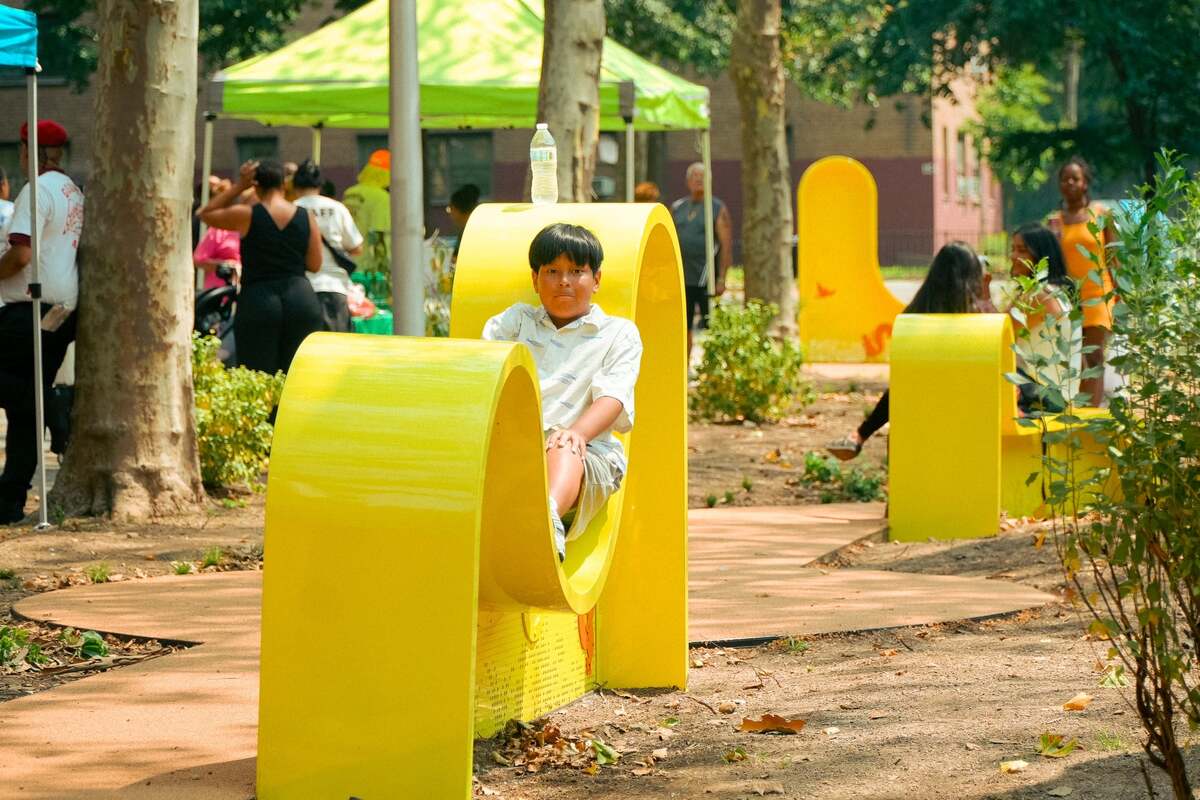
Next to the route there are yellow structures designed by The Urban Conga together with the Center for Justice Innovation. Some can be used as benches, others to climb, exercise or invent games. Their shape was chosen to allow different uses to children, adolescents and adults, avoiding rigidly separating space according to age.
The project was born from a series of meetings with the inhabitants of Marlboro Houses. During the workshops, residents had reported two main problems: the meadows were used little and some areas flooded often. The final design therefore provided small rain gardens, autochthonous plants and species suitable for pollinators. The landscaper Field Form has taken as reference the previous swampy nature of the area, choosing vegetation able to retain part of the water during storms.
“Village Vibes” is part of Green Space Connections, a $3.2 million program funded by Leona M. and Harry B. Helmsley Charitable Trust. The initiative was launched in 2022 to redevelop the open spaces of four New York City Housing Authority complexes, which total around 14 thousand people. The areas were selected on the basis of health indicators and their vulnerabilities to the effects of climate change. The other interventions were made at Roosevelt Houses in Brooklyn and Castle Hill and Patterson Houses in the Bronx.
Marlboro Houses concludes this phase of the program. The next should involve Richmond Terrace Houses in Staten Island, Wagner and Vladeck Houses in Manhattan and Ravenswood Houses in Queens. The route of Gravesend will also serve as a concrete proof to understand how a pavement still unused in the United States resists the heat, rains and daily use in a large residential complex.
L’articolo In Brooklyn a playground paved with 450 thousand cork plugs proviene da IlNewyorkese.