

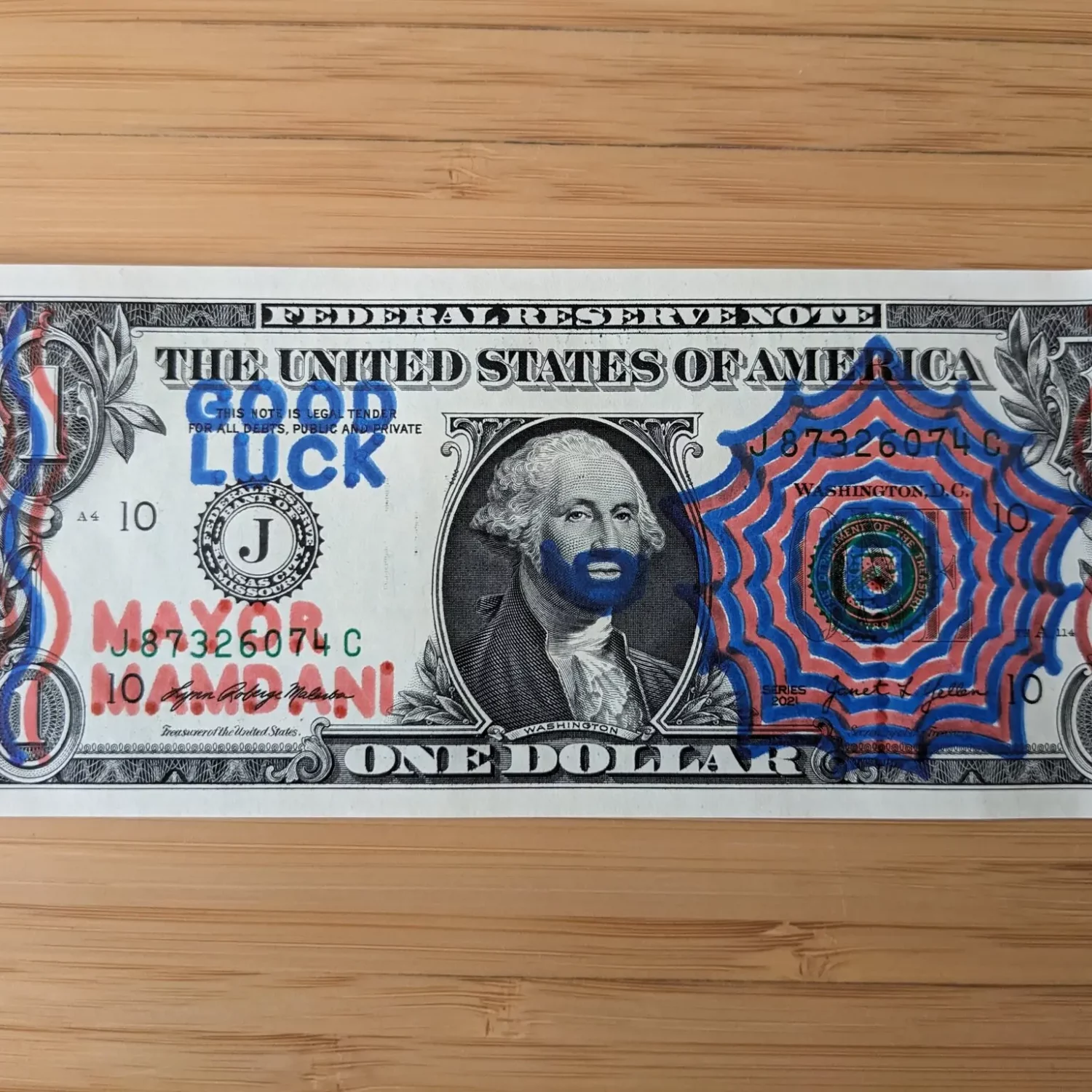
Earlier this year, Steve Pikelny, an artist living in Crown Heights, Brooklyn, sent a dollar to the new mayor of New York Zohran Mamdani. It had to be a lucky charm, similar to the first banknotes earned that many shops expose behind the counter. Pikelny imagined Mamdani could hang him over the desk.
He worked on the bill as he did with some of his works. He added to George Washington a beard similar to that of Mamdani, wrote in capital «Good luck Mayor Mamdani» and used a computer-controlled drawing machine to trace a circular pattern, vaguely similar to a web.
A few months later, the dollar returned to his house. In a letter of three sentences, the mayor’s office thanked him for generosity and explained that the municipal law on conflicts of interest prevented Mamdani from accepting the gift. Pikelny then published the bill on Reddit and the answer received.
The problem was not the gift value. Chapter 68 of the municipal statute stipulates that a public employee cannot receive compensation for the performance of his duties by persons other than the city, nor for persons whose interests may be affected by his decisions. The rule also applies to the mayor and does not provide a minimum threshold in such cases.
The threshold of 50 dollars, quoted often when talking about gifts to municipal employees, instead concerns gifts from companies and people doing business with the city. For tips or thanks related to public work, the Conflicts of Interest Board explicitly says that the value can be any: even a few dollars gift must be rejected.
Carolyn Miller, executive director of the Board, explained that the bill had been sent to Mamdani as mayor. That was enough to get back into the ban. The office that manages the City Hall correspondence usually follows the same procedure: in the first seven months of the Mamdani administration received five sendings containing cash, five checks and a gift card for a donut shop. A person had literally announced a donation, but had forgotten to attach it.
Pikelny said he had found the “refreshing” return, especially after the administration of Eric Adams. The reference was to the investigations that accompanied the last part of the mandate of the previous mayor. Adams had been accused of receiving illegal travel, electoral contributions and other benefits from Turkish officials and entrepreneurs in exchange for favors. He was declared innocent and the proceedings had been filed permanently in April 2025, after a request from the Department of Justice of the Trump administration. Judge Dale Ho predicted that archiving did not establish whether Adams was innocent and judged very problematic the hypothesis of an exchange between renunciation of accusations and the collaboration of the mayor of federal immigration policies. According to Ho, the story looked like a political deal.
Mamdani had not been Pikelny’s first choice at the 2025 Democratic primary, but Pikelny had voted for it in the November elections. So far, he said, he especially appreciates the less visible part of his work: the ordinary administration of the city.
The dollar also had a second purpose. In the plan told by Pikelny, Mamdani would appreciate the work, he would expose it and then invite his author to lunch. During the meeting Pikelny would try to convince him to introduce a land-value tax to New York, a tax calculated on the value of the land without considering the buildings built above.
Pikelny had graduated in economics at Bard College in 2011 and, before devoting himself to art, he worked as a financial analyst and computer engineer. According to him a tax on the value of the land would encourage the owners to build: two equivalent lots would have a similar imposition even if one was empty and on the other there was a large building. In the current system, however, constructions and improvements can increase the imponable value of the property.
In New York the application would be more complicated than that. The properties are divided into four classes, with evaluation methods, rates, limits to different increases and benefits. The same department of finances defines the procedure by which the tax is calculated. A study by the Lincoln Institute of Land Policy considers a tax on land value as a potentially useful tool to drive the development of sub-used lots, but it notes that it would be necessary to establish which changes could approve the city alone and which require the intervention of the state of New York.
The following imagined by Pikelny unintentionally explains the rigidity of the rule applied by City Hall. The dollar was almost irrelevant, but its sender hoped that it would provide access to the mayor and the opportunity to promote a reform. The rule prevents officials from deciding which small gifts are harmless enough to deserve an exception.
Drawing on the bill, instead, does not seem to have been a problem. The federal law punishes those who alter money with the intention of making it unusable or committing fraud. The Bureau of Engraving and Printing clarifies that the presence of writings or images does not automatically render a note illegal: it counts the purpose of the intervention. The Pikelny dollar clearly retained its value and could not be exchanged for a higher cutting note.
Pikelny continues to work with materials other than money. He is one of the four artists involved in Site Interruptions, a project of the Museum of the Moving Image of Astoria. Its installation, which can be visited from 2 July to 4 October, transforms the museum site into a sort of unreliable web page, full of alerts, windows and false updates. The museum describes it as an artist and engineer who builds “sites that should not be trusted”.
That committee has not received any banknotes. The museum paid him with a transfer.
L’articolo The lucky dollar the mayor of New York had to return comes from IlNewyorkese.