


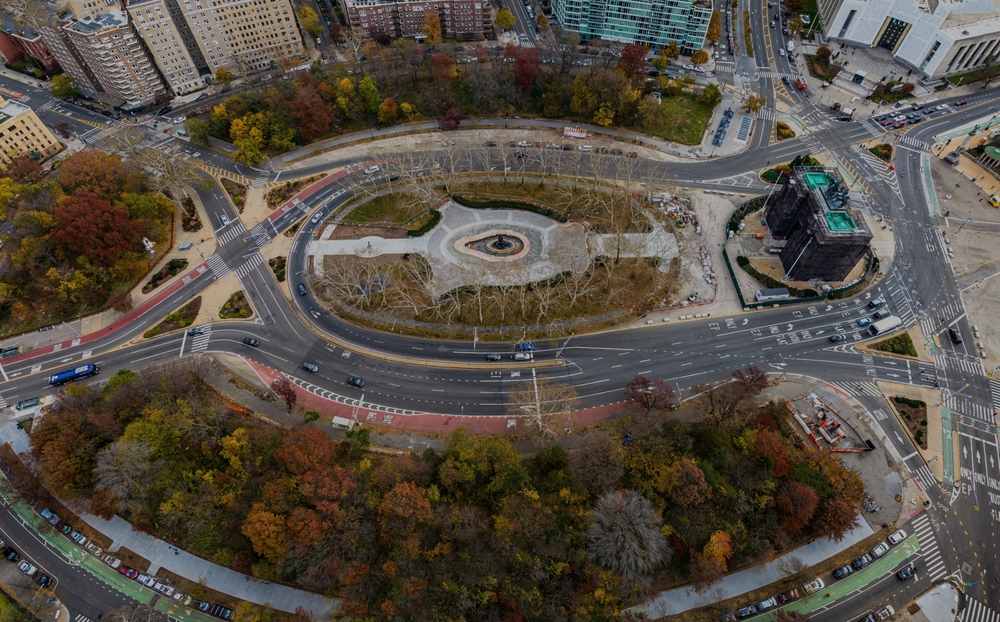
Grand Army Plaza is one of the most important and busy points in Brooklyn – a landmark, as New Yorkers would say – but also one of the fewest to walk through. It is located at the northern entrance of Prospect Park, around Soldiers’ and Sailors’ Memorial Arch, the monumental arch built at the end of the nineteenth century to commemorate the Union’s soldiers in the American Civil War. Today, however, the arch and the park are separated by traffic lanes, crossings, narrow pedestrian islands and car flows coming from several directions. The mayor of New York Zohran Mamdani announced in April a project to definitively close the southern part of the square, between Union Street and Eastern Parkway.
The main change concerns four lanes that pass today between the arch and Prospect Park. Eliminating them, the city would create a direct link between the monument and the park, without obliging pedestrians and cyclists to move between traffic lights and traffic. The square, which is already used for the Grand Army Plaza Greenmarket and for other events, would earn about three quarters of an open space acre, that is just over 3 thousand square meters. According to the Department of Transportation, this space could be used to increase the number of market vendors, host small outdoor shows and organize seasonal activities.
The change would serve above all to make more practicable a crossroads that today works almost like a large roundabout, with cars, buses, bicycles and pedestrians forced to cross several times. With the new design the traffic would no longer turn into a complete ring around the square, but would follow a form more similar to a horseshoe. The pedestrian and cyclist crossings would pass from 39 to 24, and ten pedestrian stripes would be raised, so at the same level of the sidewalk: this would force the cars to slow down and make the people crossing more visible.
The project also includes new cycle paths protected inside and around the square. Today some bicycle lanes are already there, but are partly painted on asphalt and not always physically separated from traffic. The new accommodation should use parked cars and flower beds as protection, although some details still need to be defined. For those arriving at the Brooklyn Public Library, overlooking the square, it would also mean not having to wait on small pedestrian islands surrounded by cars.
Grand Army Plaza adesso
La nuova proposta con le modifiche
The closure of a part of the ring would also change the route of some buses. The B41, one of the most used lines of the city, and the B69 would be slightly deviated: the first would remain on the east side of the square, while the second would avoid the nearest round of the arch. In parallel, the city is also working on Flatbush Avenue, where preferential bus lanes and new pedestrian islands are planned. For motorists there will be a little longer routes in some cases: those arriving from Union Street, for example, will no longer be able to cut directly towards Eastern Parkway, but will have to follow the new internal double way round.
The objections concern above all the risk that a part of the traffic ends in nearby residential streets, or that the emergency means take more time to pass. The Department of Transportation argues that the new design could make traffic more fluid, because it would reduce car accumulations at the most complicated points of the square. Residents have been asking for interventions for years and, according to data submitted by DOT, between 2020 and 2025 in the central area and on the outer ring of Grand Army Plaza there were 219 injured in road accidents. However, two decisive information remains that the city has not yet clarified: how much the project will cost and when the works begin.
L’articolo Grand Army Plaza might become a little less complicated proviene da IlNewyorkese.