



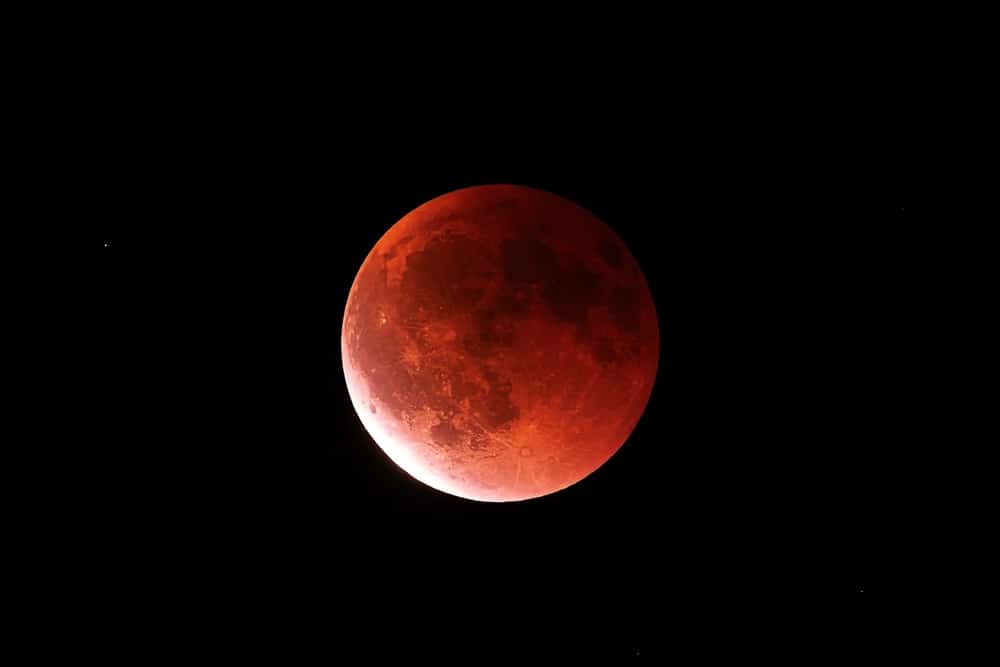
On the night between Thursday 27 and Friday 28 August from New York will be visible a particularly deep lunar eclipse, so close to the totality to be lit directly by the Sun only a small part of the lunar disc. At the maximum moment 96.2 percent of the visible surface of the Moon will be in the darkest shadow projected by the Earth. Technically, a partial eclipse will remain, even if the naked eye can look a lot like a total. NASA defines it as a “deep partial eclipse” and calculates a cover of 96.3 percent, a small difference due to calculation methods.
For those in New York the whole phenomenon will be visible, provided of course the sky is quite free from the clouds. The first phase will begin at 21:23 on Thursday, when the Moon enters the Earth’s pen shadow: at first the change will be very light and could be difficult to distinguish. At 22:33 the actual partial eclipse will begin, and the lunar disc will gradually appear the dark edge of the shadow of the Earth. The maximum will be reached at 00:12 on Friday 28 August, with the Moon about 38 degrees above the horizon, towards south-southeast. The partial phase will end at 1:52, while the last part of the pen-shade eclipse will end at 3:01. In all, the phenomenon will last a little less than five hours and forty minutes.
The very high percentage of coverage will make this eclipse different from the most common partials. At the central moment, only a thin portion of the Moon will remain out of the shadow, much clearer than the rest of the disk. The obscured part can instead assume red, orange or ramate shades. It is the same phenomenon that is observed during the so-called “blood light”, although this time there will be no real phase of totality.
The color depends on the Earth’s atmosphere. When the Earth is between the Sun and the Moon, it blocks almost all direct sunlight, but a small amount still manages to cross the atmosphere and reach the lunar surface. The shorter wavelengths, especially blue and violet, are dispersed more easily; the red and orange ones cross the atmosphere better and are deviated towards the Moon. It is basically the same process that makes red or orange many sunsets. The intensity of the color is not always the same and depends also on the amount of dust, aerosols and clouds present in the Earth’s atmosphere at that time.
To observe the eclipse you will not need protective glasses, unlike what happens with solar ones. You can look directly at the Moon for the duration of the event. A binocular or a small telescope will make more evident the contrast between the part immersed in the shadow and the subtle zone that will remain illuminated by the Sun, but are not indispensable. The Moon will also be high enough in the sky during the central phase, so from the city it will be necessary above all to find a point with a clear view to the south and, of course, hope in weather conditions.
The eclipse of 28 August arrives just over two weeks after the solar one of 12 August. That eclipse was total in some areas of Greenland, Iceland, Spain and the North Atlantic, while from New York it was only visible as a partial eclipse, with the maximum around 13:54. The lunar eclipse this week will therefore be the most evident astronomical phenomenon of the two for those in the city. In the coming years from New York will be visible other lunar eclipses, including two pens in 2027 and a partial in January 2028; to see from the city a new total lunar eclipse will have to wait the night between 25 and 26 June 2029, when the totality will last about an hour and forty-two minutes.
L’articolo In New York you will see an almost total lunar eclipse proviene da IlNewyorkese.