


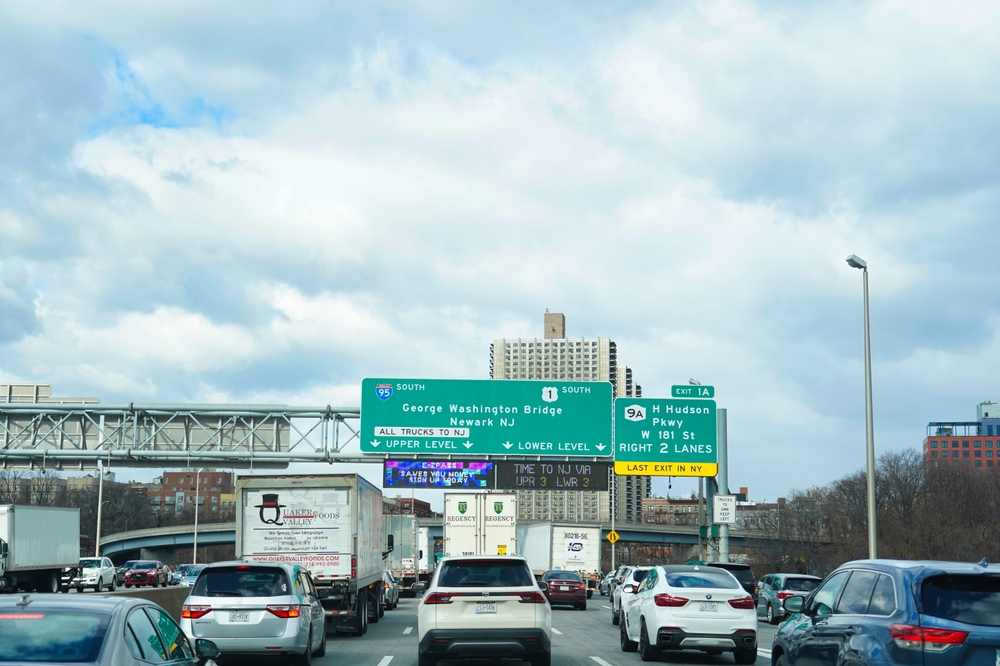
When New York introduced congestion pricing, that is toll to enter the busiest part of Manhattan, one of the main concerns came from the South Bronx. It is an area already crossed by great road arteries, bridges, warehouses, logistics centers and trucks, and for years has asthma rates among the highest in the United States. The fear was that, in order to avoid tolling, some motorists could change their path and move from neighborhoods that already departed from a very fragile environmental situation.
A new study at Columbia University says something like this could actually happen, although it doesn’t prove it permanently. The researchers analyzed the data collected by 19 sensors installed in the South Bronx, comparing the twelve months prior to the start of the congestion pricing with the next twelve months. According to Alexander De Jesus, PhD and among the authors of the study, between 2024 and 2025 the fine particulate in the area increased by 2 percent. The fine particulate matter is composed of very small particles, also produced by combustion of fossil fuels, which can enter the lungs and have health effects.
The increase was found in most of the district, especially near the main expressway. In two points of survey, one of which close to a Community garden, the levels have declined. The abstract of the study, which is not yet fully available, says that the increase is statistically significant, but also that estimates change a lot from one sensor to another. It is an important detail, because air quality is not measured as traffic at a toll booth: it changes with wind, temperature, seasons, heating buildings, fires and many other factors.
The authors of the study claim to have controlled some of these variables, including fire smoke, seasonality, weather, heating buildings and traffic patterns. After these checks, according to them, would remain an increase of 2 percent attributable to congestion pricing. Markus Hilpert, a professor associated with Columbia’s Mailman School of Public Health and co-author of the report, said that toll improved air quality in Manhattan’s paid area, but could have worsened it in nearby areas such as the South Bronx, probably due to traffic deviations.
The Metropolitan Transportation Authority, the agency that manages the program, has disputed with decision the study. A spokesman recalled that the work has not yet been peer reviewed and argued that it would not take adequate account of the smoke of fires that in 2025 affected the city for about six days. The authors say they have considered that factor as well. The MTA also mentions other data: a three-month study of the New York Health Department, which compared the spring of 2024 with that of 2025, did not find significant changes in the fine particulate area; a report of the same MTA says that in the same period the highway traffic had decreased in various areas, including the South Bronx.
The point, therefore, is not that congestion pricing has suddenly become a failure. The program reduced by 11 percent the number of cars entering the central district of Manhattan, amounting to about 73 thousand vehicles less, and in 2025 produced more than $578 million for MTA, also intended to improve metropolitan and bus. But the South Bronx asks that the success of the toll is not only measured by looking at Manhattan. In the area a child out of five suffers of asthma, the family median income is about 32 thousand dollars and every day almost 13 thousand trucks enter and exit from Hunts Point, one of the largest food distribution centers in the United States. For this reason the congestion pricing also finances approximately 70 million dollars of interventions in the Bronx, between programs against asthma and the replacement of diesel refrigerated trucks by hybrid means or less pollutants. For local associations, however, the program must be treated as a policy to monitor continuously, not as a measure already closed and archived as positive.
L’articolo The congestion pricing may only have moved the problem instead of solving it proviene da IlNewyorkese.