


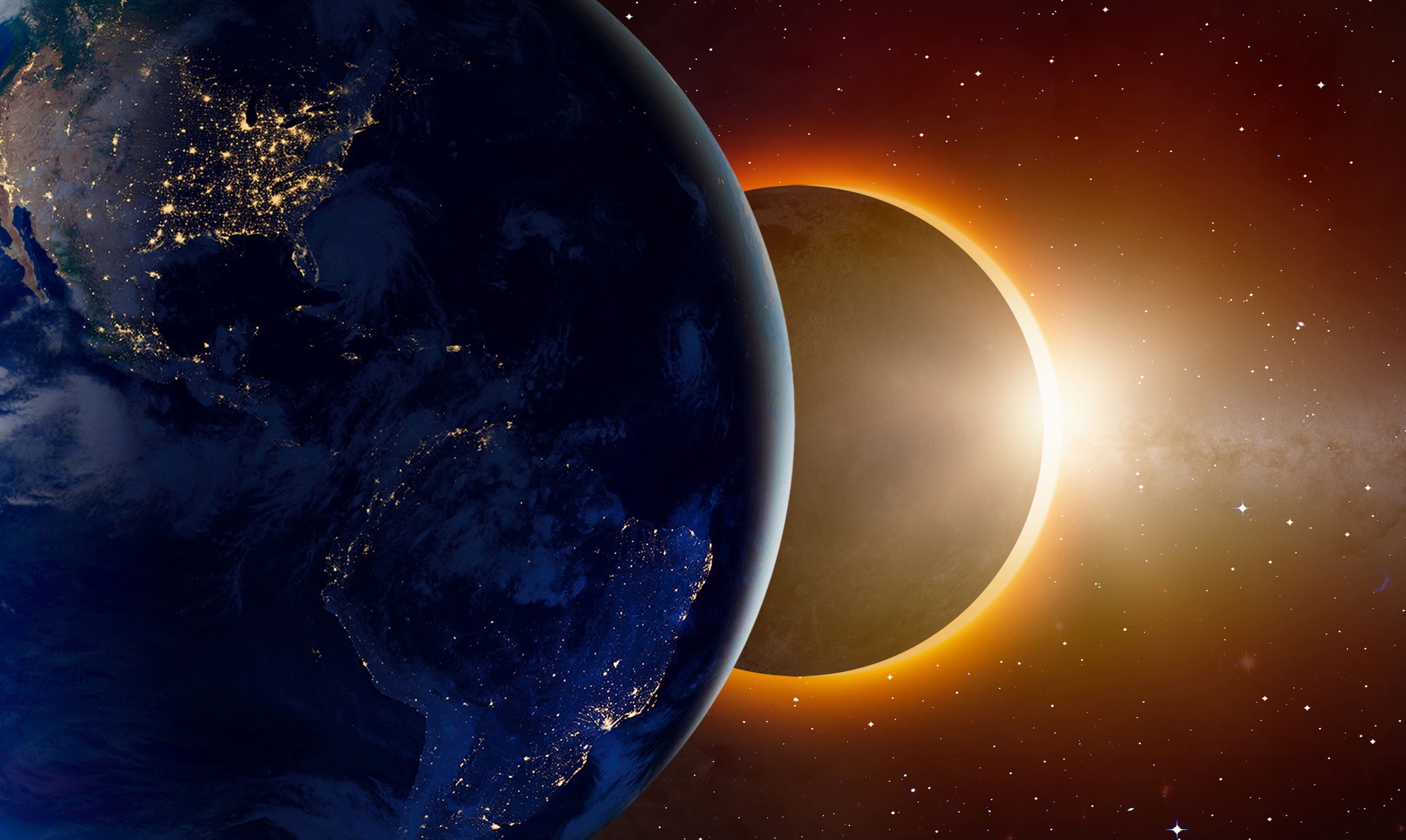
On Wednesday, August 12, part of the Sun will disappear for about an hour and a half from the sky of New York. The solar eclipse, which will be total in some areas of Europe and the Arctic, will be visible from the city only in partial form: at the time of maximum coverage, the Moon will hide about 9 percent of the solar disk.
According to the calculations published by NASA, the eclipse will begin at 13:07 in New York. The maximum coverage will be at 13:54 and the phenomenon will end at 14:38. It should not be expected that the city suddenly becomes dark: with over 90 percent of the Sun still visible, the effect on brightness will be limited and the eclipse will be recognizable above all by observing the solar disk with adequate protection.
The show will be very different from the other side of the Atlantic. The eclipse of 12 August will be total in a band that will cross Greenland, Iceland and northern Spain, as well as some areas of the Arctic. The totality phase will last just over two minutes.
Even from Italy the eclipse will be partial, but it will be much more evident than in New York and will increase in intensity from south to north. According to Time and Date calculations, in Milan the Moon will cover about 92.3 percent of the solar disk, with the maximum around 20:20. In Rome the cover will be of 69.1 percent, with the maximum at 20:11, while in Palermo will be around 34 percent, just before 20. In Italy the phenomenon will happen then at sunset and to observe it will be important to have the western horizon free from buildings or other obstacles.
To observe the eclipse, both in New York and in Italy, it is essential to protect the eyes. During all stages visible from New York the Sun will never be completely covered and will therefore not be sure to look directly at the naked eye at any time. NASA recommends using eclipse glasses or sun visors that comply with the international standard ISO 12312-2: the normal sunglasses, even very dark, are not enough.
The same caution applies to cameras, binoculars and telescopes. It is not enough to wear eclipse glasses to look at the Sun through these instruments: the lenses concentrate solar rays and require specific filters installed in front of the lens. Alternatively, the eclipse can be observed indirectly by projecting the image of the Sun on a surface.
For New York it will be a much less evident show than the eclipse of 8 April 2024. On that occasion, around 90 percent of the Sun was covered by the city, while a band from the United States between Texas and Maine witnessed totality.
The day of August 12 will also offer a second astronomical appointment. In the night the peak of the Perseids is expected, one of the most known meteoric sharms of the year. In 2026 the conditions will be particularly favorable because the peak coincides with the new moon, reducing the lunar light that normally makes it more difficult to see the meteors.
L’articolo Tomorrow there will be a solar eclipse and you will also see from New York proviene da IlNewyorkese.
L’articolo Domani ci sarà un’eclissi solare e si vedrà anche da New York proviene da IlNewyorkese.