



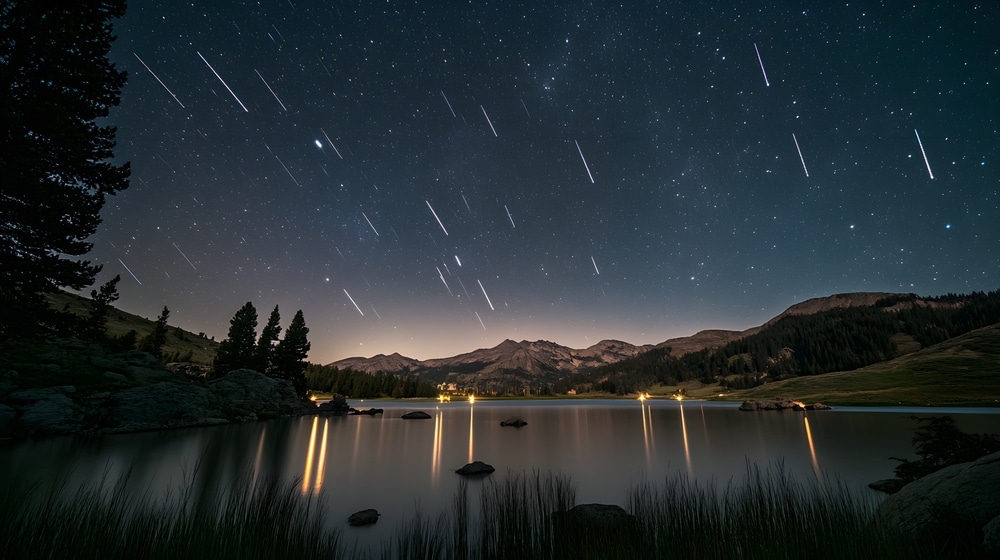
A few days ago we told the sky over New York for the smoke of Canadian fires and strong storms expected on the weekend. In mid-August you will return to look at it for a more pleasant reason. On the night between Wednesday 12 and Thursday 13 August the maximum of the Perseids is expected, the most followed meteoric swarm of the summer. The phenomenon began on 17 July and will continue until 24 August, but in those hours the Earth will cross one of the densest parts of the debris flow left by comet 109P/Swift-Tuttle.
The conditions will be particularly favourable for a coincidence with the lunar calendar. On August 12 there will be the new moon, so during the night there will be no light of the Moon to make less visible the weaker meteors. This is the aspect that distinguishes 2026, more than an exceptional activity of the swarm. The value of one hundred meteors per hour often mentioned in the forecasts is the ZHR, a theoretical rate calculated by imagining a perfectly dark sky and the point from which the meteors seem to come exactly over the observer. The American Meteor Society indicates a more realistic figure for rural areas between 30 and 50 meteors per hour. In the city will be much less. The International Meteor Organization calendar also warns that the general activity of 2026 could remain under the conventional value of one hundred.
The Perseids are meteors, and not meteorites: the tiny fragments of comet enter the atmosphere about 59 kilometers per second and consume before reaching the ground. The skies seem to start from the constellation of Perseus, from which the name of the shawl derives, but they can appear anywhere in the sky. Some are bright enough to be seen even in the presence of light pollution and can leave a visible trace for a few seconds.
For those in New York, the night to score is between 12 and 13 August. The International Meteor Organization ranks the main maximum between 2 and 4 o’clock in the morning UTC, then between 10 o’clock in the evening and midnight according to the time of New York. The larger range of activities is wider and reaches the hours before sunrise. After midnight Perseus climbs into the north-eastern sky and increases the portion of visible swarms: it is therefore advisable to start around 10:30 or 11 and continue at least for a few hours. You do not need to locate the constellation, because looking only towards the radiant point allows you to see shorter shales.
From the five boroughs you can intercept especially the brightest meteors. A roof with a wide view or area on the waterfront away from the streetlights can improve the conditions a bit, but do not eliminate the diffuse light of the city. Public parks also have times that make the observation complicated before dawn: according to the NYC Parks regulation, they are usually accessible until one at night, except the different times indicated at the entrances.
Long Island beaches are the closest alternative, but require a minimum of programming. Jones Beach, Montauk Point, Robert Moses, Sunken Meadow and Wildwood allow night parking to those who own the State Stargazing Permit. For 2026, however, sales closed on March 31 and will resume on September 8: those who do not already have the permit will not be able to buy it in time for the Perseids. Long Island Park Regulation also excludes Hither Hills in July and August. Turning out at night without having verified the conditions of access is likely to end in front of a closed parking lot.
To find a sky much darker you have to turn the observation into a journey. Cherry Springs State Park, in northern Pennsylvania, is about five hours from New York and is surrounded by Susquehannock State Forest. The park has a public area for observations of some hours and a separate field open all night to registered users: the overnight stay is not allowed in the normal Night Sky Public Viewing Area. The Adirondacks offer another possibility, but indicating them as a whole is not useful, considering the extension of the region. A more concrete reference is Tupper Lake, where the Adirondack Sky Center organizes public observations and where Moody Bridge and Rock Island Bay are indicated among the points with open view and little artificial lighting.
On 12 August there will also be a solar eclipse. The totality will cross Greenland, Iceland and part of Spain, while in New York the eclipse will be only partial and will cover a small portion of the Sun. In the city it will begin at 13:07, it will reach the maximum at 13:54 and will end at 14:38, according to the calculations of Time and Date. To observe it, you will need certified glasses or a projection system: during a partial eclipse it is never sure to look directly at the Sun.
For the Perseids, however, telescopes and binoculars are counterproductive because they restrict the field of view. They need a wide view, a reclining chair or a blanket and at least twenty minutes without looking at the phone, so that the eyes get used to the dark. The new moon is predictable with precision; clouds, haze and other fire smoke are much less. The final choice of the place will therefore make sense only two or three days before, when the forecasts will allow to understand which area around New York will have the most free sky.
L’articolo In August you can see the most beautiful meteor rain of the year proviene da IlNewyorkese.