


But how nice it is to get out of work, take the metro, go home and remember to have the empty fridge because we didn’t do the shopping? Not good, exactly. However it is convenient to know that we can take the phone is order anything through an app. Here, New York is a city built also on the logistics of takeaway food. In recent years, with the expansion of delivery platforms – Uber Eats, DoorDash and Grubhub – the number of riders has grown rapidly: according to industry estimates, there are about 80,000 carriers active in the five districts.
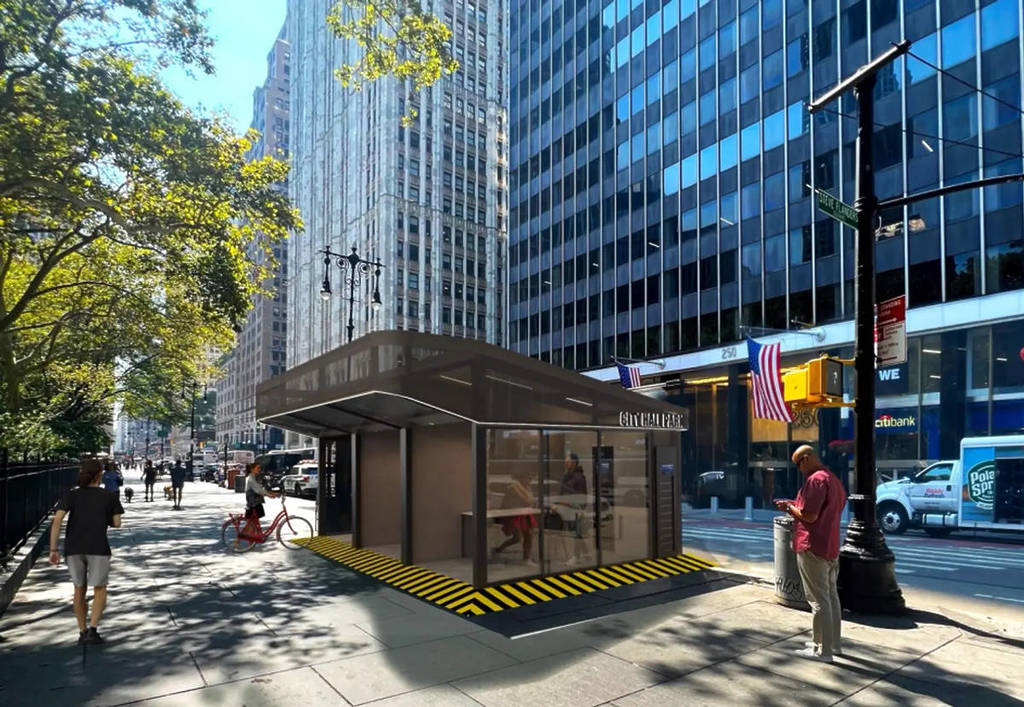
Many of these, too, work with precarious contracts or as autonomous, and everywhere in the world you are beginning to try to understand how to make the work – and life – of these people more to measure than the first world. No wonder then the opening of the first U.S. Deliverer Hub, inaugurated on 249 Broadway, a few meters from City Hall Park. A project promoted by the Workers Justice Project together with the Los Deliveristas Unidos collective, funded with approximately a million dollars of federal funds.
The hub was born from the conversion of an old abandoned newsstand and introduced a space designed for a category that, until today, worked almost exclusively in the street. The structure offers a covered area for breaks, destined to mitigate climatic conditions often extreme, and in the coming days will be completed with seats and a small workshop for rapid interventions on bicycles and scooters. This also adds a charging station for lithium-ion batteries: through a dedicated app, riders can access 24 hours a day to about 40 safe lockers.
In recent years, fires linked to e-bike batteries in New York have increased significantly, pushing authorities to introduce more restrictive guidelines on home charging. To offer certified and controlled points therefore becomes a necessary safety measure even before a service for workers. Within the hub, open five days a week in the day-end, there is also a structured support: legal assistance for cases of non-payment, road safety guidance and help in managing disabling accounts on platforms, one of the main criticalities of on-demand work.
In New York, already in 2023, a minimum hourly wage for riders was introduced, one of the first regulatory interventions of the genre in the United States, and this explains why New York is the first to build one of these hubs for riders alone. However, some criticism remains: the current office does not have toilets, a limit linked to the absence of water laces, and that the organizers indicate as a priority for the next hubs. The New York City Department of Parks and Recreation is evaluating new openings, including a possible space on the Upper West Side, with the aim of extending an existing infrastructure.
L’articolo The first hub for rider arrives in New York proviene da IlNewyorkese.