


In 2024 service 311 in New York, the number of non-emergency services for the city of New York introduced in 2003 to separate it from 911, recorded over 738,000 complaints related to noise, more than twice as much as about 345.000 reports ten years earlier. Among the calls arriving at 311, those related to noise are the most frequent category and this reflects the growing intolerance of New Yorkers towards acoustic pollution.
If you look at the data of the Department of Environmental Protection (DEP), that is, the agency that intervenes on a specific part of the violations of the Noise Code, the total is lower because the scope is different. In the annual DEP report for 2024, 57,739 complaints were received directly from the department. The heaviest voices are: 22.843 for construction work before or after hours allowed, 8.807 for construction equipment, 8.343 for barking dogs, 5.572 for alarms and 4.388 for air conditioning or ventilation systems.
In general, urban noise has become one of the most discussed problems in New York, a city historically associated with the idea of continuous activity – the city that never sleeps, in fact -, which is now forced to intervene with a series of measures aimed to contain acoustic pollution, especially in the spring and summer months, when the opening of windows and the use of outdoor spaces make the problem more perceptible.
A first strengthening of the regulatory framework took place in 2021, when Governor Kathy Hochul signed a law that increased the sanctions for illegally modified marmits and exhaust systems, introducing fines of up to $1,000 and stricter controls on workshops. This intervention has provided a legal basis for other actions and initiatives of the authorities, which in recent months have begun to intensify controls and operational instruments.
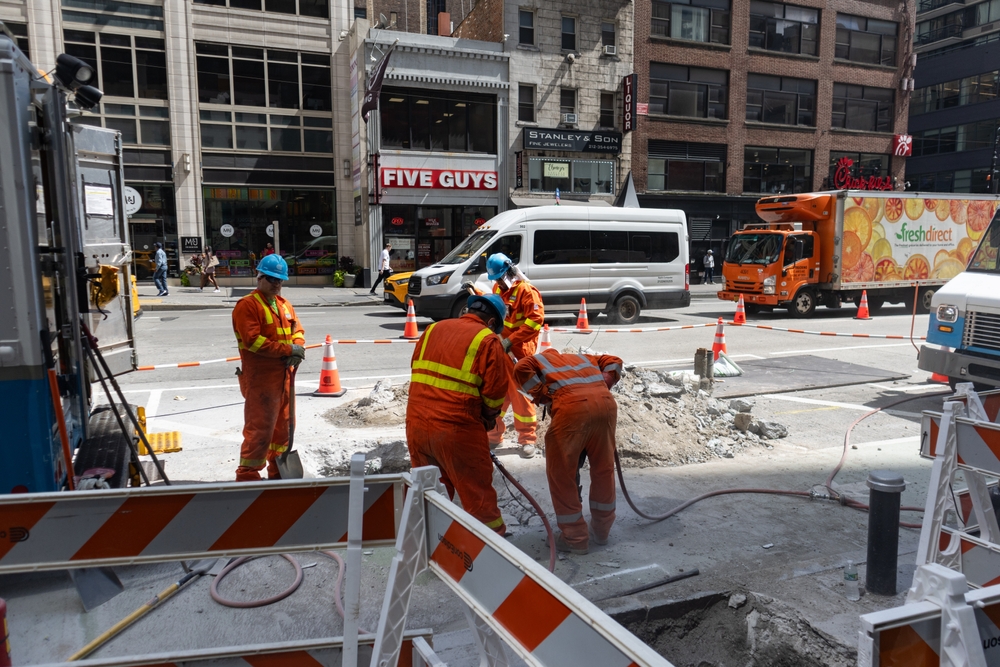
One of the main innovations is the construction sites. From 21 April 2026, large building projects – over 200,000 square feet, lasting more than 30 days and located less than 15 meters from residential buildings – will have to install active acoustic monitoring systems 24 hours a day. The data collected is transmitted to the Department for Environmental Protection, which can thus verify in real time any overcomings of the limits provided by the noise code, reducing dependence on sample controls.
At the same time, the city is expanding the use of so-called “noise cameras”, devices that combine arrays of microphones, a fisheye room panoramic (fisheye is a type of wide-angle lens that embraces a field angle of at least 180°) and a plate reader. When the system detects overcoming the threshold, the fisheye identifies the source of noise with a red point and the plate reader associates the event with the vehicle. The DEP also points out that the cameras are not only for engines and exhausts, but can also be used for clacson and for music from vehicles. .
The images are then verified by the inspectors of the DEP and, if confirmed, give rise to an administrative penalty. The fines start at about 800 dollars and can reach up to $2,500 for relapses, according to local legislation introduced in 2024. However, in 2024 the Local Law 7 that implemented noise cameras asked 5 in each district by September 2025. The DEP, in its reports updated at 2025, claims to have received only 12, therefore the implementation proceeds slow and the diffusion of the cameras is not understand how much it should be.
Despite this, in 2025 the program recorded 15,994 events and produced 1.691 fines, that is about 11 percent of the events detected turned into a dispute. The report adds that only 1.2 percent of the disputes were canceled or filed at the OATH (and this means that the cameras work in 98.8% of the cases), while the sanctions imposed reached 1 million and 472 thousand dollars and those actually paid 308 thousand dollars.
In addition to everyday discomfort, continuous noise is also associated with different negative health effects, such as sleeping disorders, increased stress levels and possible hearing damage over the long term. The authorities also connect some of the most noisy vehicles – especially those with modified discharges – to higher levels of pollutants.
L’articolo Noise in New York has become a serious problem proviene da IlNewyorkese.