


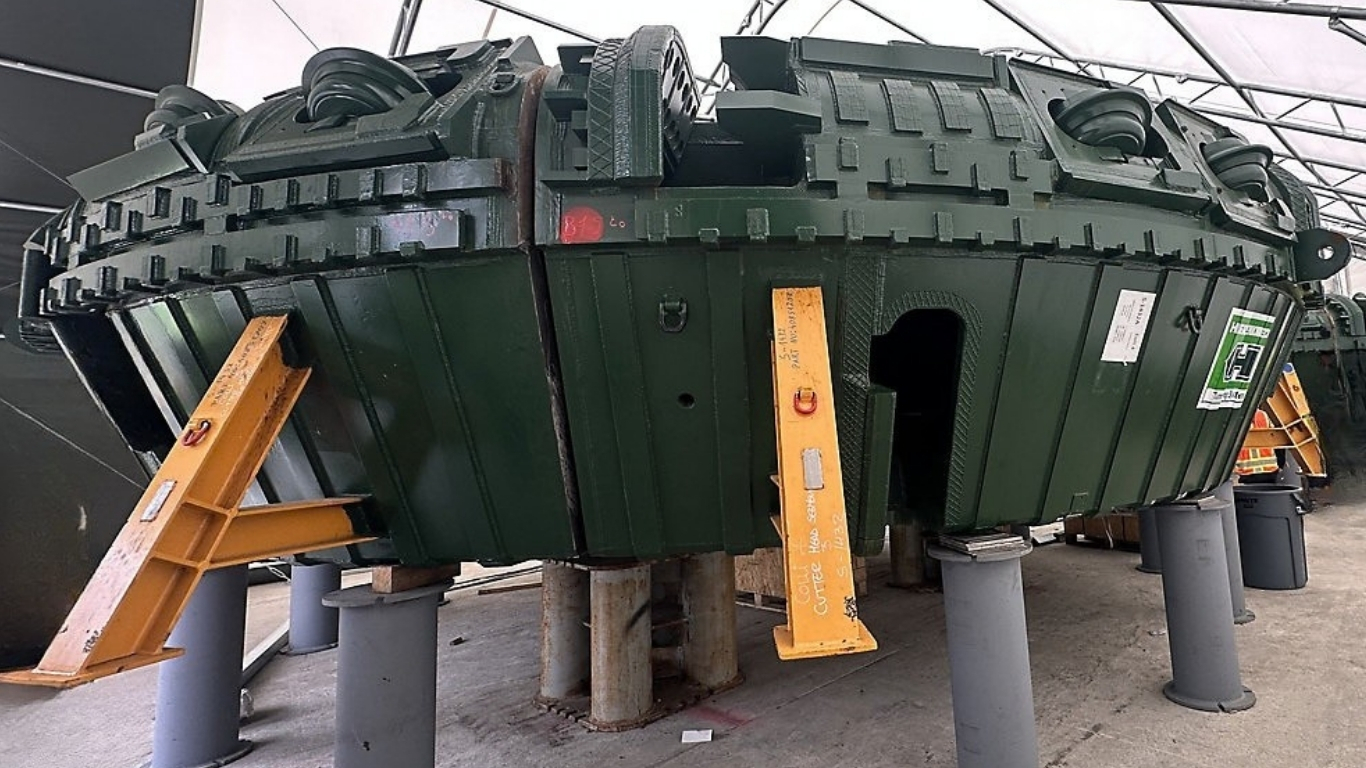
On Monday, September 28, at the Tonnelle Avenue yard in North Bergen, New Jersey, it was symbolically operated the first of the great friezes that will serve to build the new railway tunnel towards Manhattan. It has not yet begun to dig: according to the statement of the State of New York, the last tests will be completed in the coming days and then the actual excavation will start. A second machine will come into operation shortly after.
It is a concrete step for a project that has been mentioned for over a decade and has so far been composed mainly of finance, wells, preparatory work and surface works. The Hubson Tunnel Project of the Gateway Development Commission costs approximately $16 billion and provides for the construction of a new two-channel tunnel between New Jersey and New York, as well as the subsequent complete renovation of the current North River Tunnel. The official calendar provides for the opening of the new link in 2035 and the conclusion of the work on the old tunnels in 2038.
The two machines launched at this stage will not yet pass under the Hudson River. They will depart from North Bergen and dig 5,100 feet, just over a mile and about a kilometre and a half, in the Palisades rock to the Weehawken Hudson County Access Shaft. By advancing about 30 feet a day, i.e. nine meters, they should take more or less a year to complete the stretch, including the necessary stops for maintenance.
They are machines built specifically to work in hard rock. Each is about 150 meters long, has a excavation head of almost nine meters in diameter and weighs more than 1,600 tons. The front part crushes the rock with a series of discs; the excavated material is then collected and transported to the outside through a strip system. In the meantime, a mechanical arm mounts the prefabricated concrete segments behind the mill, forming the definitive coating of the tunnel. In practice, while the machine digs, it gradually builds the structure that leaves behind.
The cutters used now are single shield type and have been designed for the relatively dry and compact terrain of the Palisades. Arriving at Weehawken will be disassembled and taken out through the access shaft. In their place there will be two more, designed for different geological conditions, which will carry out the next part of the two reeds under the Hudson to Manhattan.
For this reason to say that Monday “the excavations under the Hudson began” would be premature: the phase of boring tunnels of the project began, but the river will be faced later.
The reason why the new tunnel is considered so important is above all in what is already under the Hudson. The current North River Tunnel was built by the Pennsylvania Railroad and opened in 1910. It is formed by two single-track barrels and is still today the only direct rail link between New Jersey and Manhattan: in a normal working day there are about 450 Amtrak and NJ Transit trains, for about 200 thousand trips. Amtrak explains that closing one of the two barrels for a long time in order to renovate it would have to pass the traffic in both directions in the only one left open, with a strong reduction of the service.
To make the renovation more urgent the damage caused by Hurricane Sandy in October 2012. Millions of litres of salt water entered the tunnels, leaving corrosive residues that continued over the years to deteriorate cement, electrical plants and other structures. The plan is then build first the new link, transfer you part of the traffic and only then close once at a time the old barrels to give it back completely. At the end of the program there will be four modernized tracks between New Jersey and New York, instead of the current two.
The project also had a complicated financial history. In 2024 the Gateway Development Commission had closed the funding plan from approximately $16 billion, with about 70 percent of the costs covered by federal funds and the rest supported by New York, New Jersey and Port Authority. The federal share includes a $6.88 billion loan from the Capital Investment Grants program.
On September 30, 2025, the Trump Department of Transport suspended payments while verifying the conformity of the project to the new federal rules on the Disadvantaged Business Enterprise program. The lack of liquidity led to a short suspension of the yards in February 2026. Payments resumed in the same month after a first federal court intervention; On June 29, Judge Jeannette Vargas of the Southern District of New York established that the suspension of funding through federal grants was contrary to the applicable rules and ordered that it be cancelled.
The Gateway Development Commission calendar continues to indicate 2035 for the entry into service of the new tunnel. It is a slow process, but it is the first time since the beginning of the project that the new rail link to Manhattan materially begins to form into the rock.
L’articolo The excavation of the new railway tunnel between New York and New Jersey has begun.