



Before calling New York, the most populous city in the United States was called New Amsterdam. The name was chosen by Dutch settlers who, in the 17th century, founded a commercial settlement on the southern tip of Manhattan. In 1664, when the British conquered the territory, they decided to redefine it in honor of James Stuart, Duke of York and brother of King Charles II. Twenty years later, that duke would become king of England under the name of James II.
The name story, however, does not end here. In 1673 the Dutch temporarily regained the city and called it New Orange, in homage to the Orange Dynasty. The following year the territory returned under English control and resumed the name New York, which also retained after American independence. The story is reconstructed by the New York State Senate and the National Archives of the Netherlands. Even before the arrival of Europeans, however, the island was known by native populations with a name from which the current one of Manhattan derives.
New York is not the only American state whose name refers directly to Europe. The nearby New Jersey takes its name from Jersey Island, in the English Channel, where George Carteret was born, one of the owners of the English colony. New Hampshire instead recalls the county of southern England. In both cases the colonizers transferred to the American continent names of places they already knew, adding the term New to distinguish new settlements from European ones.
Other states were called in honor of rulers and influential characters. Georgia owes its name to King George II of England, who authorized the founding of the colony in 1732. Louisiana recalls Louis XIV of France, the Sun King, while Maryland was dedicated to Enrichetta Maria, wife of King Charles I of England. Pennsylvania is named after British admiral William Penn, father of the man to whom the English Crown granted that territory. The name combines the name Penn with a Latin reference to the woods. Virginia, on the other hand, was named after Elizabeth I, known as the Virgin Queen. West Virginia retained part of the same name when he separated from Virginia during the American Civil War in 1863.
But a substantial part of the geography of the United States retains names that existed long before European colonization. According to a reconstruction published by the Bureau of Indian Affairs, the federal agency dealing with relations with native peoples, many states owe their name to indigenous languages. Alabama, Kansas, Massachusetts, Illinois and Iowa, for example, derive from the names of populations living in those territories. Oklahoma comes from two words of the choctaw language that mean person and red respectively. Dakota is generally associated with the concept of ally, while Connecticut comes from an indigenous expression related to the long river that crosses the region.
Several great American rivers have also sent their name to the States. Mississippi comes from a word of the ojibwe language which means great river. Michigan has a similar root and recalls a large lake, while Minnesota comes from a dakota expression related to water. Nebraska is connected to the Platte River and indigenous words describing its broad and shallow course. In many cases, however, the names were transcribed by European explorers according to their own pronunciation, and then changed over the centuries. For this reason it is not always possible to go back with certainty to the original word and its meaning.
One of the most unusual stories about California. The name does not come from a local population or a geographical feature, but in all probability from a Spanish cavalry novel published in the early sixteenth century. In Las Sergas de Esplandián, the writer Garci Rodríguez de Montalvo described a fantastic island called California, rich in gold and ruled by Queen Califia, head of a community of women warriors. Spanish explorers would later use that name to indicate a part of the west coast of North America. This is also the origin of the California Parks Department.
If California probably owes its name to literature, Idaho could have been born of an invention. Around 1860 the name was proposed for a mining territory that would later become Colorado. He argued that he came from an indigenous language and meant something similar to mountain gems. However, subsequent checks did not find reliable results for that translation. The territory was named Colorado, while Idaho remained in circulation and in 1863 was assigned to another territory to the northwest. The Idaho State Historical Society considers the name a word invented in the nineteenth century, not a translation from a native language.
Some names come directly from Spanish and describe local characteristics. Nevada means snowy and refers to the Sierra Nevada mountains. Colorado recalls the red color, while Montana comes from a word that indicates the mountain. Florida was the name chosen by explorer Juan Ponce de León in 1513, during the Easter period, in reference to Pascua Florida, an expression linked to the religious festival. Vermont is instead a name of French origin, formed by words that mean green and mountain.
Not all etymologies are just as simple. For Arizona there are at least two important interpretations: one connects it to a word of the O’odham language referred to a small source, the other to a Basque expression that means good oak. Maine also has a discussed origin. It could be derived from the French region or from the English word mainland, mainland, used by sailors to distinguish the coast from the numerous islands. In 2001, the Parliament of Maine officially recognized the connection with the French province, but the matter is not considered definitively resolved by historians.
Then there is the case of Arkansas, which preserves a particularity also in the pronunciation. The name comes from that used by other native populations to refer to the Quapaw, then adapted by the French explorers. The handwriting was similar to that of Kansas, but the pronunciation followed a different evolution. The confusion was such that in 1881 the state parliament passed a resolution to establish how to correctly pronounce Arkansas, with the final change. A linguistic decision became legislative matter.
Among the most recent denominations is Washington, the only American state named after a US president, George Washington. The name is shared with the federal capital, Washington D.C., which does not belong to the State of Washington: the two territories are located at the opposite ends of the country, one on the eastern coast and the other on that of the Pacific.
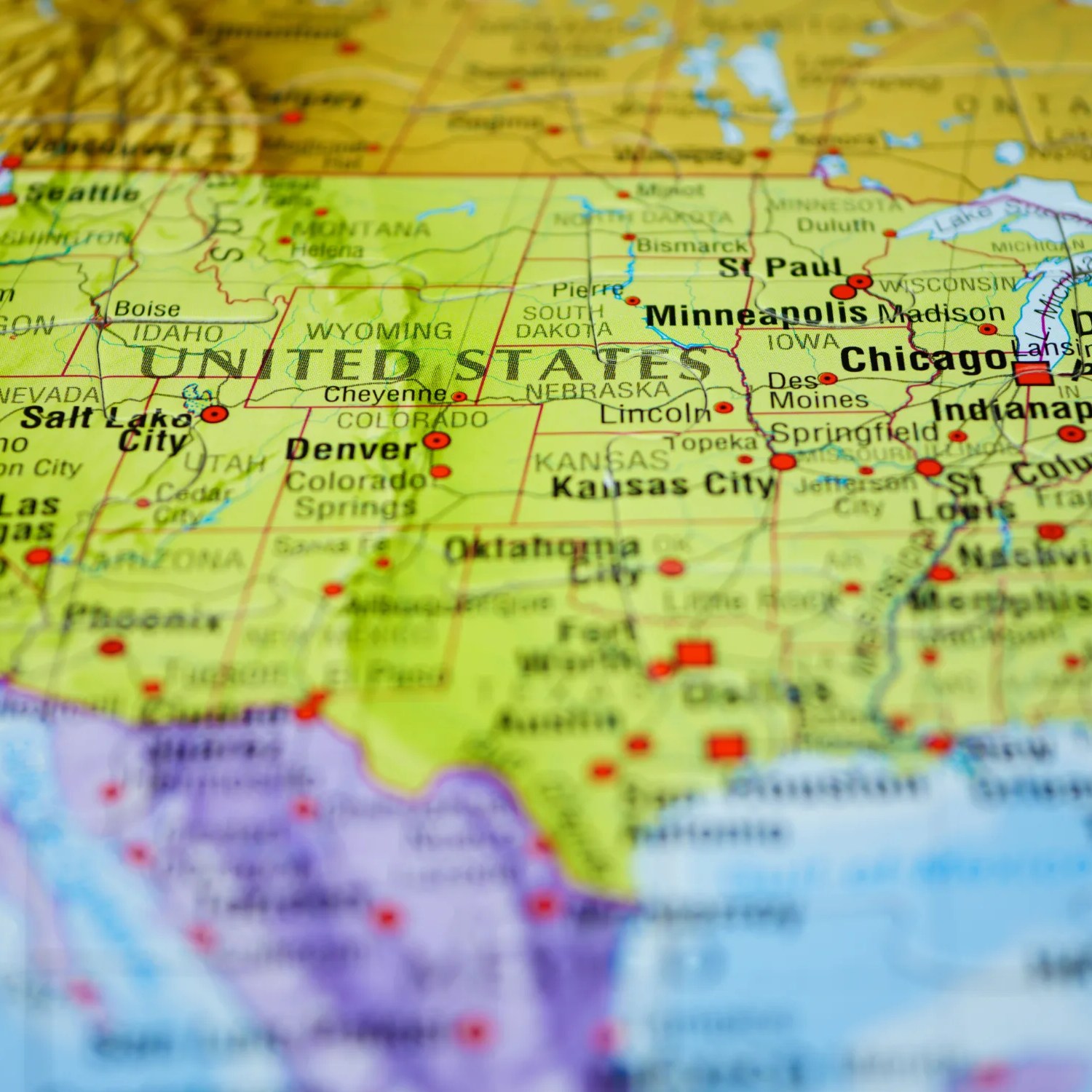
The names of the 50 states thus tell different periods of American history. Some keep words used by native peoples, others remember the French, Spanish and British presence, others were still born from political decisions or fortuitous circumstances. New York, in this sense, is a particularly significant example: a city that still bears the name of an English ruler, but whose history began long before the arrival of the British and the founding of the United States.
Why is New York called that? The history of the names of the American States comes from IlNewyorkese.