



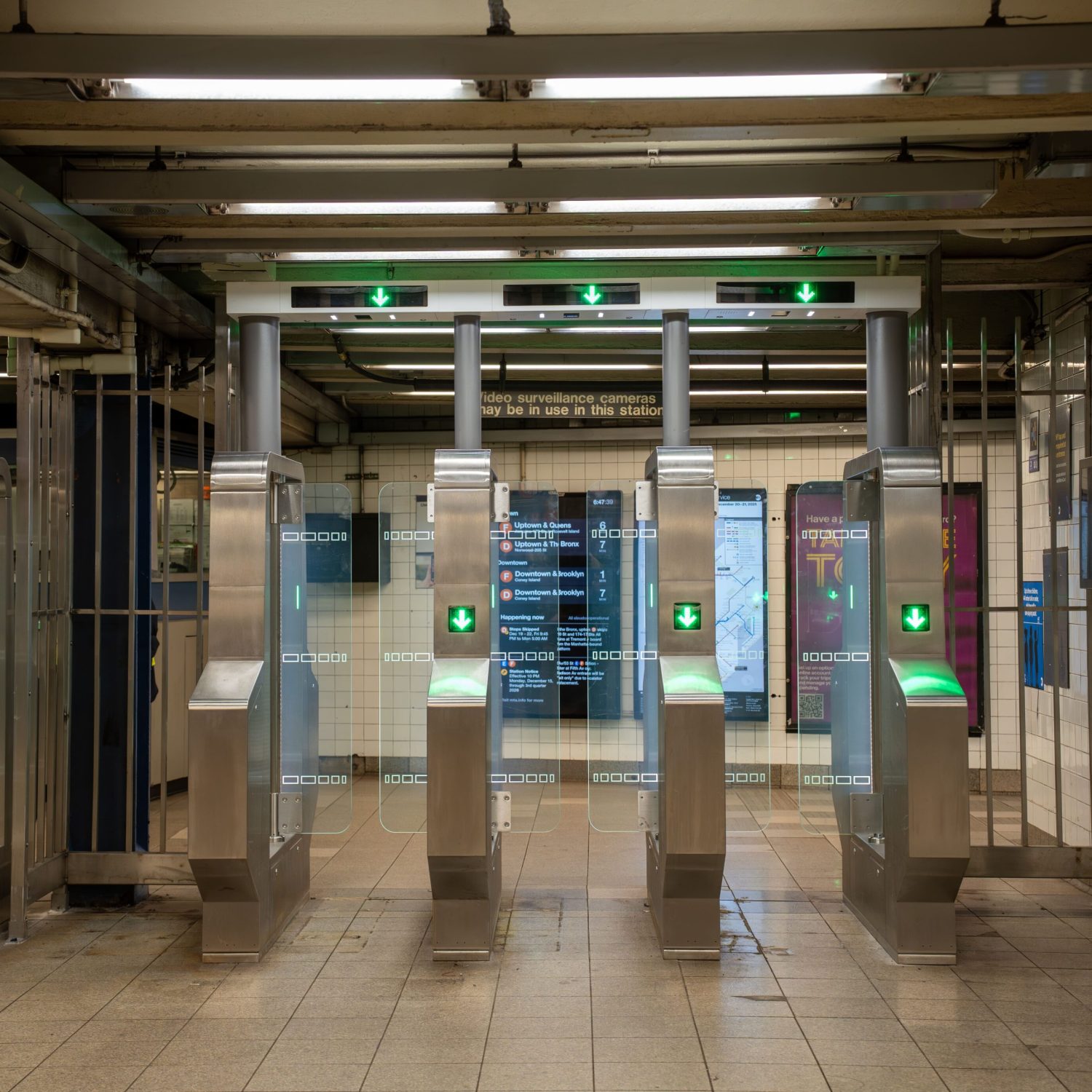
The traditional New York metro turnstiles, those with the three metal bars that for decades regulate the entrance to the stations, will be gradually replaced by new gates with automatic doors. Yesterday, Wednesday, October 7, the Metropolitan Transportation Authority (MTA) and the New York State Governor, Kathy Hochul, announced the extension of an experimental program that has already involved 20 stations. The goal is to install new devices at at least 150 stations, with a total investment of 1.1 billion dollars.
The decision came after the first results of the trial, started to check if new accesses could reduce the number of passengers using the subway without paying. According to data from MTA, in the 20 stations involved tariff evasion decreased on average by 35 percent. In two Brooklyn stops, Hoyt Street on lines 2 and 3 and Nostrand Avenue on lines A and C, the declared decline was 72 percent.
The new gates consist of mobile doors in glass and metal, equipped with sensors that detect the passage of passengers. Compared to traditional turnstiles, it makes it more difficult to skip the barriers or move below the structures without paying. They are also larger, to allow easy access to wheelchair users, parents with strollers and travellers with bulky luggage. The system could also eliminate the need for current emergency side doors, considered by the MTA one of the main entrance points used to avoid the payment of the race.
The first phase of expansion will affect 20 stations by the end of 2026, distributed between Manhattan, Brooklyn, Queens and Bronx. These include 14th Street–Union Square, 161st Street–Yankee Stadium, Coney Island–Stillwell Avenue, Flushing–Main Street and Forest Hills–71st Avenue. Unlike initial testing, which provided for the replacement of only one group of turnstiles per station, this time the new devices will be installed in all accesses of the selected stops. The program will continue in 2027 with 30 other stations, leading to 70 the expected total by the end of next year.
The substitution is part of the investment plan MTA 2025-2029, which provides assistance on the rail network, stations and access systems. The problem of tariff evasion has assumed in recent years an increasing weight in the company’s accounts: according to the estimates reported by MTA, unpaid races involve losses for hundreds of millions of dollars each year. Hochul argues that the spread of new entrants could allow to recover almost $100 million a year.
The project also represents a change in how MTA addresses the problem. In recent years the company had introduced several modifications to the existing turnstiles, adding barriers to prevent overcoming and intervening on the exit doors, often used to enter for free. The results were judged insufficient by the agency executives, who then decided to experiment with a completely different system. Three companies, Cubic, Conduent and South Korean STraffic participated in the test phase, now admitted to the competitive procedure for awarding contracts.
There are still some doubts about the effectiveness and safety of the devices. Videos of people who were able to circumvent the new barriers were circulated during the trial, while problems in the operation of the doors were also reported. In one case, a five-year-old girl was stuck between the panels and was taken to the hospital. Moreover, as the New York Post noted, some previous evaluations of the reduction of evasion were based on very short observation periods. It will therefore be necessary to check whether the results announced by MTA will be maintained over time and on a greater number of stations.
New York is the most important transformation of the metro system since the nineties, when modern turnstiles were introduced along with MetroCard. In recent years those same devices had been adapted to the OMNY contactless payment system, without substantially changing the structure. The new program will also change the physical barrier through which passengers enter the station. The complete replacement calendar in the 150 stops has not yet been defined.
L’articolo New York will change the metro turnstiles proviene da IlNewyorkese.