


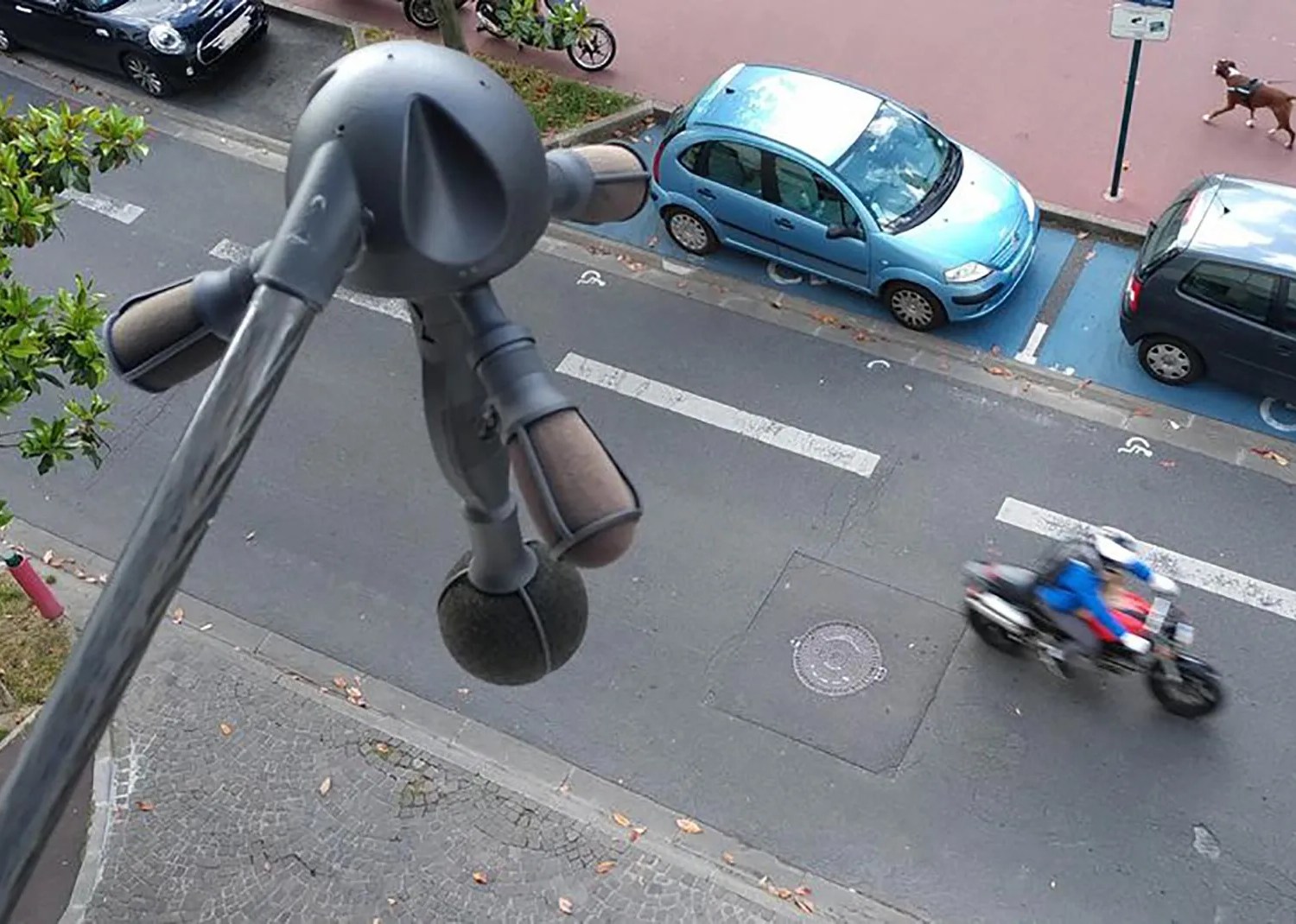
A New York City some road cameras do not only control what goes in front of the lens but also listen to what happens around. These are the so-called noise cameras, installed by the Department of Environmental Protection (DEP) to identify cars that produce noises above the allowed limits: especially engines and very noisy marbles, but also high volume music and clacson used without need.
The program is much smaller than the speed control cameras, but in recent years it has become a part of the system with which New York tries to enforce its noise rules. In 2025 twelve cameras were operational and almost 16,000 potentially irregular events were recorded. After the controls, the DEP issued 1.691 fines.
They work more or less like this: each device combines a high-definition camera with a series of acoustic sensors. When a noise above the thresholds provided by the system is recorded, the sound and images necessary to identify the vehicle are acquired. According to the DEP, the cameras are oriented in order to recover the plate but not the inside of the car or the people on board.
The software then analyzes the recording and tries to determine which type of noise caused it, for example a pot or a clacson, and to read the plate automatically. However, it is not the program to decide on its own whether to issue sanctions: the material is controlled by DEP staff, which must confirm both the infringement and the vehicle involved. In a report published in 2026 by the New York City Office of Technology and Innovation, the Municipality has specified that the system uses video recordings, decibel levels and automatic classification of the type of noise, and that the processed data may include identification information.
At first, the program was designed especially for modified or particularly noisy marbles. Experimentation began in 2021 and since 2023 the system is also used for high volume and clacson music. The City Council then transformed the project into a permanent program, providing at least five devices in each of the five boroughs by September 2025, but subordinating the expansion to the availability of funds.
That expansion has not yet happened. According to the DEP, the necessary money has not been allocated. The cost of each device is in the order of tens of thousands of dollars: when the City Council approved the program, the estimated cost was about $35,000 per unit. The fines, on the other hand, can be quite high. For an overly noisy pot start at $800 and can reach 2.625. For the unnecessary use of the clacson range from 350 to $3,000; for the music too high from 140 to 1.050.
In 2025 the sanctions issued through the program totaled 1,47 million dollars. At 31 December, approximately 308 thousand were actually paid, just over a fifth. Of the 1.691 proceedings opened during the year only 20 were concluded with the cancellation of the fine, although many others had not yet reached a definitive decision.
The most important issue is the protection of privacy associations, however, does not concern both fines and microphones. Will Owen, spokesman for Surveillance Technology Oversight Project (STOP), a New York organization dealing with surveillance and civil rights, summed up the objection saying that “a microphone is a microphone”. The point is that a device capable of recording sounds quite precisely to distinguish its origin could at least in theory acquire even noises that have nothing to do with a car, including human voices.
There are no indications that the DEP uses noise cameras to intercept or analyze conversations. In public documents of the municipality the purpose remains limited to the detection of violations of the Noise Code, and the recordings are analyzed to identify the type of noise and the vehicle that produced it. The question raised by the privacy organizations therefore concerns above all what such technology could allow to do, and what guarantees exist because it continues to be used only for what was installed. The City Council also authorized the DEP to use different detection technologies in the program, including beamforming techniques – which allow to locate the origin of a sound – and artificial intelligence systems.
There is then another dispute that comes from the owners of the cars hit by the fines. Anthony Aquilino, owner of an insurance agency, was sanctioned in 2024 while driving a Lamborghini Huracán Performante in Manhattan. He argued that the noise of his car depended on the characteristics with which it was produced and not on a modification made to make it intentionally louder. After losing before the administrative judge and the New York Supreme Court, he brought the case in appeal.
In short, noise cameras affect how much noise produces a vehicle, not necessarily because it produces it. From the point of view of Aquilino, this means being fined for a feature of the car that cannot easily change. From the point of view of the municipality, on the other hand, the problem remains the same for those who live or work along that road, regardless of whether the noise comes from a modified pot or from a very expensive sports car exit so from the factory.
And that’s also why noise cameras were introduced. The noise of the vehicles often lasts a few seconds, and for an inspector it is difficult to find exactly in the right place when passing a very noisy car. A camera can stay there all day.
L’articolo Noise cameras may not only hear noise from IlNewyorkese.