


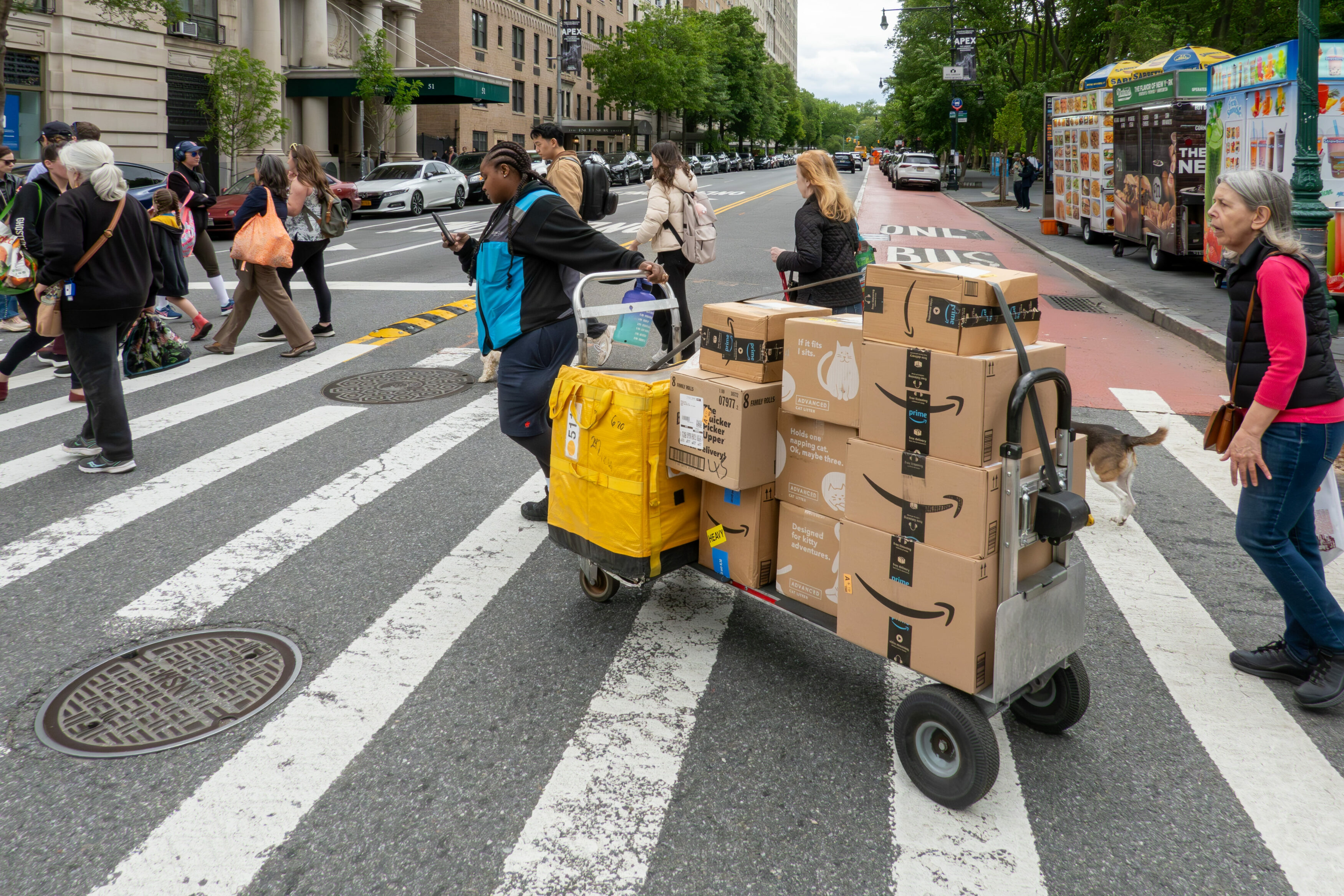
Those who receive an Amazon package in New York often see a van with the company’s logo, led by a courier wearing an Amazon uniform. That worker, however, in most cases is not an Amazon employee. He works for one of the external companies dealing with the last part of the delivery, the one carrying the parcel from a distribution center to the customer’s door.
It is this system that mayor Zohran Mamdani wants to change. On Monday, August 10, the New York Major announced its support for the Delivery Protection Act, a proposal presented by the city councilwoman Tiffany Cabán who would introduce new rules for the distribution centers of the last mile and for the companies that manage them. The measure concerns the delivery sector as a whole, but the political comparison focused mainly on Amazon and its system of contracting companies.
The last mile has become one of the most visible sectors of the economy in New York. In 2017, around 1.1 million packages per day were delivered in the five boroughs. In 2019 they were already 1.8 million and in 2021, after the growth of e-commerce during the pandemic, they had become 2.3 million. In 2024, according to the report Fast Shipping. Slow Justice, published in November 2025 by the New York Comptroller’s office, estimated about 2.5 million packages each day.
To deliver them quickly the companies opened warehouses closer to customers’ homes. These are the so-called last-mile facilities: structures in which the parcels arrived from the great logistic centers are ordered, loaded on the means and started to the final destination. From 2017 to New York, 18 new major centres of this type were opened, 11 of which from 2020, according to the data collected by the Comptroller.
Amazon manages a substantial part of its network through the Delivery Service Partner program, or DSP. Instead of directly hiring all drivers carrying their packages to customers, the company entrusts deliveries to independent companies. Amazon describes the DSPs as small autonomous companies, which hire and manage drivers, while the Company provides infrastructure, technology and other services necessary for deliveries.
It is precisely the division of responsibilities between large companies and these companies to be at the center of the Delivery Protection Act. The proposal would introduce a mandatory licence for those who run a centre of the last mile in New York, administered by the Department of Consumer and Worker Protection. It would also provide minimum standards for safety and training and prevent the managers of the structures from entrusting to external companies some of the so-called core services, i.e. the essential activities of the warehouse and the delivery. The workers who carry out them should therefore be taken directly by the operator of the structure.
Mamdani and the supporters of the proposal argue that the current system allows large companies to control many aspects of work without taking directly the responsibilities that would result from being the employer. Amazon disputes this reconstruction and argues instead that Delivery Service Partners are real independent companies, responsible for recruitment, fleet management, staff organization and route assignment.
The debate is not just about employment contracts. The report published in 2025 by the New York Comptroller analyzed 50 structures of the last mile identified by the Department of City Planning and also examined what happened in the surrounding streets. In areas around 14 of the 18 structures opened since 2017 road accidents with injuries increased after opening: it means that the phenomenon was observed in 78 percent of the cases analyzed. The report does not show that the opening of the warehouses was alone the cause of the increase of accidents, but indicates in the increase of the traffic generated by the deliveries one of the elements to consider.
The same report analysed the accident data communicated to the Occupational Safety and Health Administration. Between 2022 and 2024, 38 of the 50 structures considered reported altogether more than 2,000 accidents at work, an average of 678 per year. The average rate was 8.3 accidents each one hundred full-time equivalent workers, compared with 2.4 registered in 2023 for all private employers in the United States. Approximately 85 percent of accidents reported in the centres of the last mile have resulted in days of absence from work or job limitations.
The data collected by the Comptroller show an even higher rate among companies participating in the Amazon DSP system. In 2023 and 2024 they recorded an average of 9.2 accidents each one hundred workers equivalent full time. The data does not mean that Amazon is directly responsible for accidents recorded by contracting companies, but it is one of the arguments used by the advocates of the new law to ask for a different distribution of responsibilities.
Amazon is strongly opposed to the proposal. In a testimony presented at the City Council, the company argued that the measure, in its current formulation, would question the relationship with more than 40 Delivery Service Partners present in New York, which according to Amazon employs more than 5,000 people. The company said that, if the proposal was approved without modification, it could evaluate to transfer a part of its activities and structures used for deliveries out of the city.
Amazon also claims to have invested more than $2.5 billion since 2019 to improve the security of its activities globally and states that, in the same period, its record rate decreased by 43 percent. According to the company, eliminating the current model would not necessarily increase the safety of workers and would instead risk to cancel small local businesses that have built their business around Amazon deliveries.
The same objection was raised by some owners of the companies carrying out deliveries. While Mamdani, Cabán and the unions publicly supported the measure, some industry operators protested against the proposal. Opponents argue that jobs potentially involved in the entire sector can be up to 10 thousand, a larger than the 5,000 employees of DSP partners indicated directly by Amazon.
The Delivery Protection Act is not yet a law. It is at the examination of the City Council and its text can still be modified before a possible vote. Mamdani’s support, however, increases political pressure to approve it and makes the fight with Amazon more explicit.
If the measure enters into force in its current formulation, it would change an important piece of the machine that makes rapid deliveries possible in New York: not so much the path of packages, as the relationship between the large companies whose name appears on the vans and the workers who drive those vans every day.
L’articolo New York wants to change the way Amazon delivers packages proviene da IlNewyorkese.