



The New York Building Department ordered the suspension of part of the works at 750 Third Avenue, a skyscraper for Midtown Manhattan offices that the real estate company SL Green is turning into about 640 apartments. It is the third major conversion project affected by a stop, total or partial, after the serious incident occurred on July 7 in the former headquarters of the Pfizer, a few blocks away.
During a Tuesday inspection, municipal technicians found some sections of the welded steel columns among themselves in a way that may not have been indicated in approved projects. When asked for welding documentation, the site manager was unable to show it, according to Andrew Rudansky’s department spokesman at the New York Times.
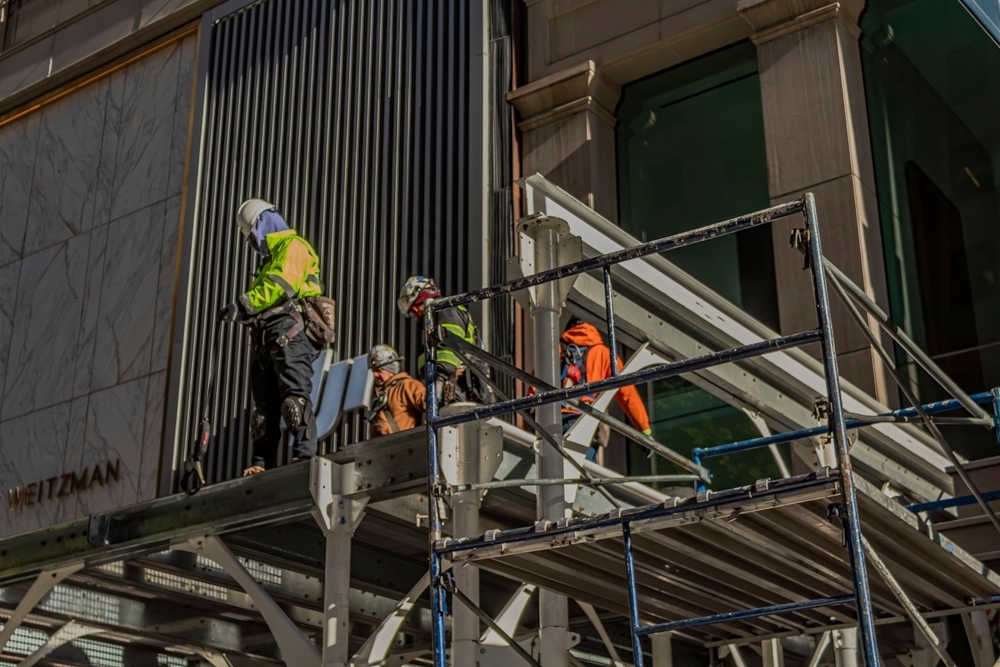
The measure covers structural steel work from the ninth floor up. To obtain the revocation, the company will have to submit a report signed by an engineer who describes the conditions of the building and confirms its stability. The other interventions can continue: on Wednesday some workers in fire insulation still worked on the upper floors, while welders, carpenters and plasterboard cutters had left the area concerned.
The Commune has specified that there have not been found yields, deformations or other signs of structural suffering. No evacuation has been ordered and the building would not represent a danger for people passing through the nearby streets. The partial stop serves to clarify whether the reinforcements on the columns correspond to the calculations and the designs deposited: the suspension orders are an ordinary tool of the Department of Buildings, which emits thousands every year also for limited irregularities.
SL Green gave a similar reconstruction, claiming to have identified difformity during preparatory work. According to the company, welds concern elements already present in the structure and became visible only after the removal of some coatings. The builder is updating the projects together with the responsible engineer and has already asked the Municipality to revoke the order. In a statement reported by the Commercial Observer, it excluded structural problems and consequences on the conclusion of the work, scheduled for 2029.
750 Third Avenue occupies an entire block between 46th and 47th Street. It was built at the end of the 1950s and has 35 floors, according to the sheet of the building published by SL Green. The conversion project includes 639 accommodation, as well as a gym, common spaces, terraces and commercial activities. A later version of the plans indicated about 680.
The estimated cost is $805 million. The figure helps to understand how much such interventions can be more complex than a reorganization of indoor spaces. According to an analysis of the New York comptroller office, at 750 Third Avenue will be removed a part of the facade and will be added new surface on the back. The transformation will also reduce about a quarter of the space that can be used compared to the total surface of the building. 59 percent of the apartments will consist of studios or small units with one room.
The intervention was already one of the best known cases of the New York office conversion program. After the pandemic, the work remotely left many Manhattan buildings partially empty, especially those built in the second half of the twentieth century and remained less competitive than the most recent towers. In the same period the scarcity of houses has increased rents and made politically convenient to encourage the reuse of commercial properties.
In 2024 the state of New York introduced the tax program 467-m, which grants real estate exemptions to conversions intended entirely for rent. To access the benefit, at least 25 percent of the apartments must be reserved for families with income established by the program; these units remain subject to the stabilization. The rules published by the municipal agency for the house also require that the facilitated accommodation share entrances and common spaces with those rented at market price.
At the beginning of 2025 the comptroller had identified 44 conversions concluded, started or considered possible, for a total potential of over 17 thousand apartments. Projects could absorb more than a third of the spaces left free in mid-low Manhattan offices since 2019. For this reason, the administration of Mayor Zohran Mamdani continues to consider conversions an important part of its housing policy.
However, the incident at the former Pfizer headquarters has changed the level of attention on the yards. On July 7, two supporting columns deformed to the 21st floor of the 235 East 42nd Street skyscraper, where Metro Loft and David Werner Real Estate Investments are getting more than 1,600 apartments. Some floors have lowered and the building, along with several nearby properties, has been evacuated. The technicians had to install temporary supports before starting the checks, as Engineering News-Record rebuilt. The final causes of the failure have not yet been ascertained.
After that episode the Department of Buildings intensified inspections in the main conversion yards. At 222 Broadway, in the financial zone, the works were stopped completely on July 24 after the inspectors discovered two polished concrete beams and already repaired on the highest floor. According to the municipality, the company had not communicated the incident in time and had not deposited all the changes to the repair plan. The building has been judged stable, but the works remain suspended while the municipal technicians examine the reports presented by the designer, according to the documentation reconstructed by ENR.
A previous partial stop had covered 77 Water Street, where machines were found without the required certifications and a scaffold without authorization. In that case the measure was revoked after a few days.
The three yards therefore have very different situations. At the former headquarters of the Pfizer there was a structural emergency; at 222 Broadway the control concerns repaired beams without a complete communication; at 750 Third Avenue some differences between existing columns and available projects must be clarified. So far the elements collected do not indicate a common problem to all conversions. They show however how much the safety of these interventions depends on the correspondence between what is designed, what is found in old buildings of decades and what is actually built.
L’articolo New York cautious with the yards that are converting offices into apartments proviene da IlNewyorkese.