



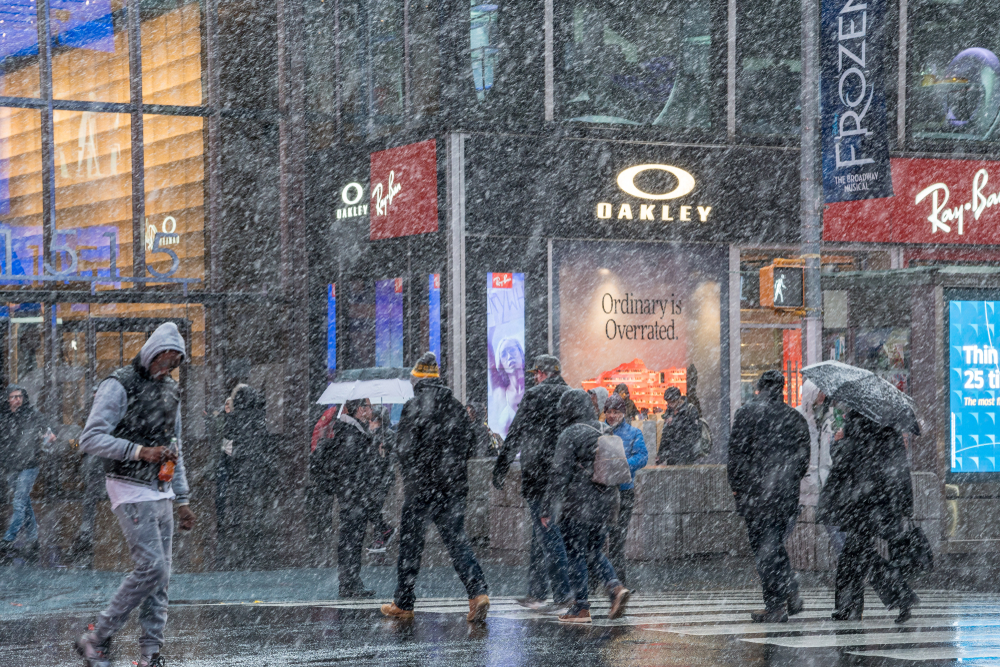
The New York Times, in a recent article, told how at the Empire Luggage Center in SoHo, when a thunderstorm is planned, the employees raise from the ground the bags kept in the basement: in the nearby Flipper’s, a restaurant known especially for soufflé pancakes, they keep ready some bags of the garbage to give to customers so that they can cover their shoes before leaving. At the French bistro Felix, instead, opened for 35 years, the owner Alain Denneulin expects me to spend the rain and then begins to clean. “Here you can do nothing but pray,” he told the reporter of NYT.
These are the different ways in which SoHo traders adapted to flooding, which in some streets are now quite frequent to be considered an ordinary problem. On Saturday, July 18, the water submerged the intersection between West Broadway and Grand Street, entering the premises and forcing pedestrians to cross the road with legs immersed in the dirty water. In some areas of New York and nearby New Jersey fell more than 60mm rain. In Woodside, Queens, more than 75 have been measured.
Three days later it rained again. On Tuesday, July 21, Manhattan, Brooklyn, Queens and Bronx were subjected to a sudden flood alert, while on the whole city there was also an alert for possible tornadoes. The precipitations were less destructive than expected, but they flooded some roads and dropped trees and large branches, especially in Queens. The alerts were canceled in the evening, when the water began to retreat.
Most of the New York sewers were designed to handle about 44mm rain in an hour. During the most intense storms of July, the forecasts indicated possible accumulations between 38 and 50 mm in the same time interval. When the rain exceeds the capacity of the pipes, the water remains on the surface or dates from gravel, drains and toilets.
The criterion used to measure a large part of the network also derives from data collected between 1903 and 1951, when storms of this intensity were less frequent. The city plan for the management of rainwater recognizes that those parameters may not be more suitable for infrastructure intended to work for decades. Approximately 60 percent of the network is combined: the same conduct collects rainwater and waste water from buildings. When filling, the system can reject contaminated water in the streets, in the basements or in the waterways surrounding the city.
To complicate things is the form of New York. The water follows slopes that are often not immediately visible, built on old swamps, underground streams and natural depressions. Kissena Park, near Flushing, is lower than the surrounding areas and during storms it fills like a conca. Knickerbocker Avenue, in Bushwick, crosses a kind of urban valley in which flows the water of nearby roads. A free caditoia can then obstruct a few minutes later, dragged by the trash from a higher block.
New York has more than 150 thousand road sheds, connected to a sewerage network about 12 thousand kilometers long. Before the most dangerous weather events, the Environmental Protection Department controls about a thousand priority points. Clean them is important, because leaves, bags and other waste can prevent water from entering the pipelines. However, it is not enough when the pipelines are already full or when the rain falls faster than the system can dispose of it.
For this reason the request of the municipality to the residents to free the grates close to their homes has caused a certain irritation. It is a useful operation during normal rains, but it may seem a transfer of responsibility in the neighborhoods that flood even when the caditories are clean. At SoHo several traders said they called the 311 without receiving an intervention. After the Saturday storm, Felix’s employees washed the sidewalk and the road with bleach and jets of high pressure water to eliminate the smell left by sewer waters.
Many residents have organized in the same way. In the houses with a basement are installed pumps to expel the water and valves that prevent the slurry from laughtering from discharges. Before the storms, sand bags are arranged in front of the doors and furniture, appliances and documents are moved to the upper floors. They are expensive interventions that reduce damage, but do not prevent the road from flooding. Moreover, not everyone can afford them, especially those who live for rent or in the informally obtained semi-trailers, which are among the most dangerous environments during a sudden flood.
The municipality has started several programs, but the difference between the ads and the times of the works is one of the reasons for frustration. In March, mayor Zohran Mamdani made $108 million to replace $6,708 old caditories in the next ten years. The floor also includes 40 new trucks to clean the underground rooms where waste and sediment accumulate. The replacements began in Queens in July, but will cover less than five percent of the caditories in the city.
Operations on pipelines take even more time. In Bushwick, a $390 million project is planned to replace nearly five kilometres of sewerage around Knickerbocker Avenue. In some places the capacity should increase by more than eight times, protecting about 2,300 acres of the neighborhood. However, the construction should not begin before 2029 and the entire system could only enter into operation in 2037. Until then, the activities facing the road will continue to depend on the pumps, the mobile barriers and the speed with which they can move the goods.
The city is also building spaces designed to fill temporarily during the clouds. Sports fields, parks, gardens and underground pools can hold water and release it slowly when the sewers return to have space. The first pilot project of this type was completed in 2025 in the South Jamaica Houses, where a basketball court can turn into a collection basin. Other interventions are planned in Kissena Park, Corona, East New York and the Bronx. They are faster than replacing entire pipelines, but they only work in areas where they were designed.
According to the projections used by the financial controller of the city, within the middle of the century New York could have once and a half the current number of days with extreme rainfall. This does not mean that every storm will produce the same damage: count the affected neighborhood, the duration of the rain, the maintenance of the caditories and how much land is available to absorb the water. But it means that the episodes so far treated as exceptions will become more common.
A SoHo this transformation is already visible in the habits of shops. The bags are lifted before it rains, the bags of the garbage have become shoe covers and after every storm you check how high the water has arrived. The great works promise to reduce flooding in several years. For the next cloud, instead, the preparation is still to secure what you can and wait for it to stop raining.
L’articolo In New York storms have become a serious sewer problem proviene da IlNewyorkese.