


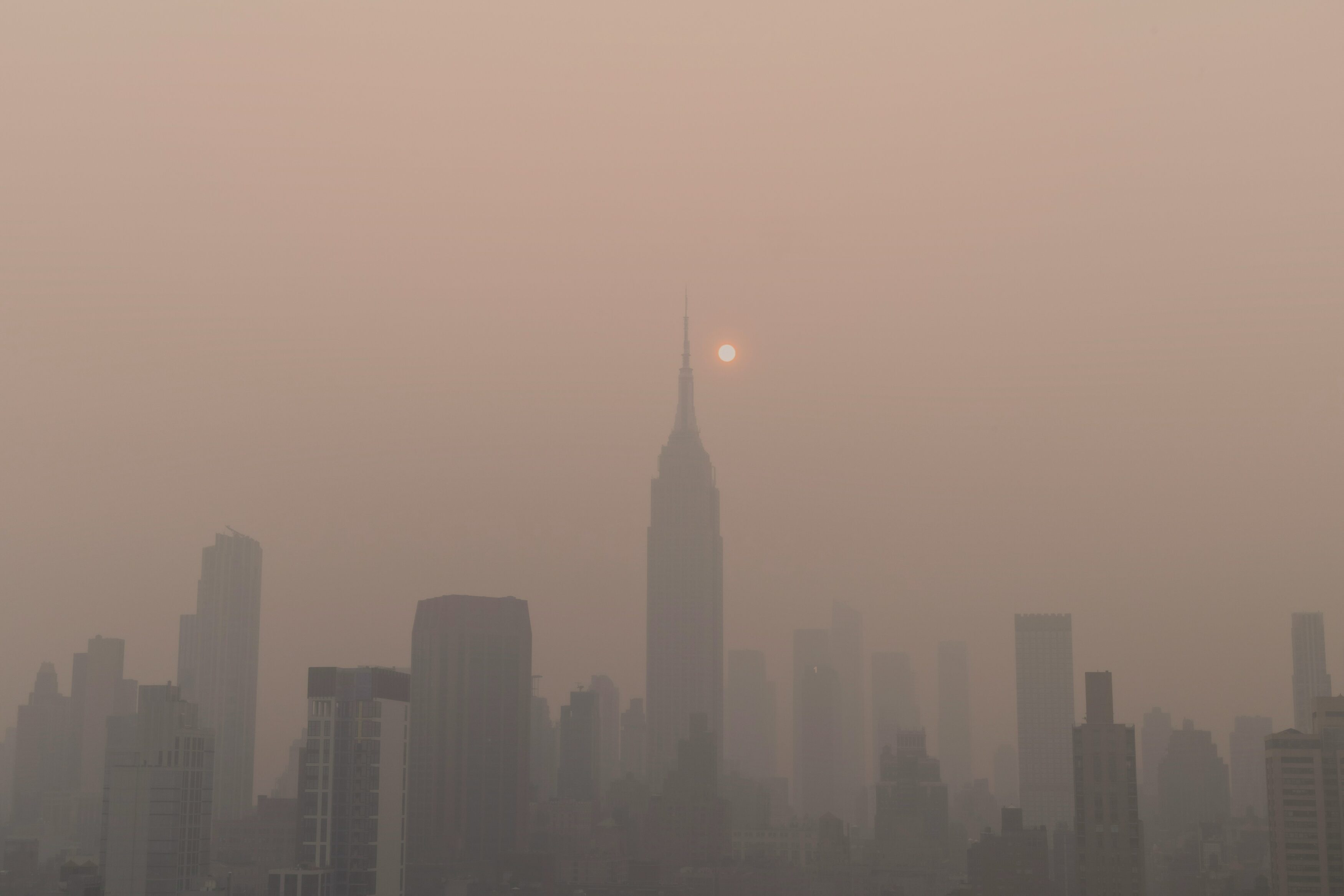
In recent years, New York summers are influenced by a progressively more frequent meteorological and environmental phenomenon: the concomitance between summer heat waves and the arrival of large masses of smoke from forest fires, which often develop at thousands of kilometers away, mainly in Canada or in the western states of the United States.
This overlap results in a “double alert”, which combines the risks associated with temperatures close to or above 100°F (about 38°C) to those resulting from a drastic worsening of air quality.
During the great fire seasons, high-altitude air currents transport smoke particles to the east coast of the United States. When these air masses meet high pressure systems responsible for heat waves on the New York region, a stagnation effect occurs. The warm and still air acts as a sort of atmospheric lid, trapping thin powders (especially PM2.5 particulate) in the lowest levels of the atmosphere, that is, those close to the ground. The visible result is the characteristic milky or opaque sky that shields the sun, accompanied by a perceptible smell of burned throughout the city.
The combination of these two factors amplifies health problems when they occur individually. On the one hand there is a strong thermal stress, the extreme heat forces the body to a greater cardiovascular effort to regulate body temperature; and on the other there is an important air pollution so the breathing of particulate air irritates the respiratory tract and reduces oxygenation.
When the two phenomena occur together, the air quality index (AQI) of the city regularly drops below safety levels. This condition is dangerous for the entire population, but especially for vulnerable categories: children, elderly people, pregnant women and people with chronic respiratory diseases such as asthma. In these periods, the civil protection protocols and the New York health department recommend limiting outdoor activities, using air conditioning to filter the air in the closed environments and wear protective masks (such as N95 or KN95) in case of prolonged stay outside.
Until recently, episodes of intense smoking in New York were considered exceptional and isolated events. The elongation of the fire season and the increase in global average temperatures have made them a constant in urban planning.
For the city administration, this resulted in the need to update the monitoring and breeding systems of the population. Summer emergencies are no longer managed only by monitoring the electric consumption peaks linked to air conditioners, but require constant control of continental air flows to predict the arrival of thin powders in advance days.
L’articolo Fire smoke and extreme hot double emergency in New York proviene da IlNewyorkese.