


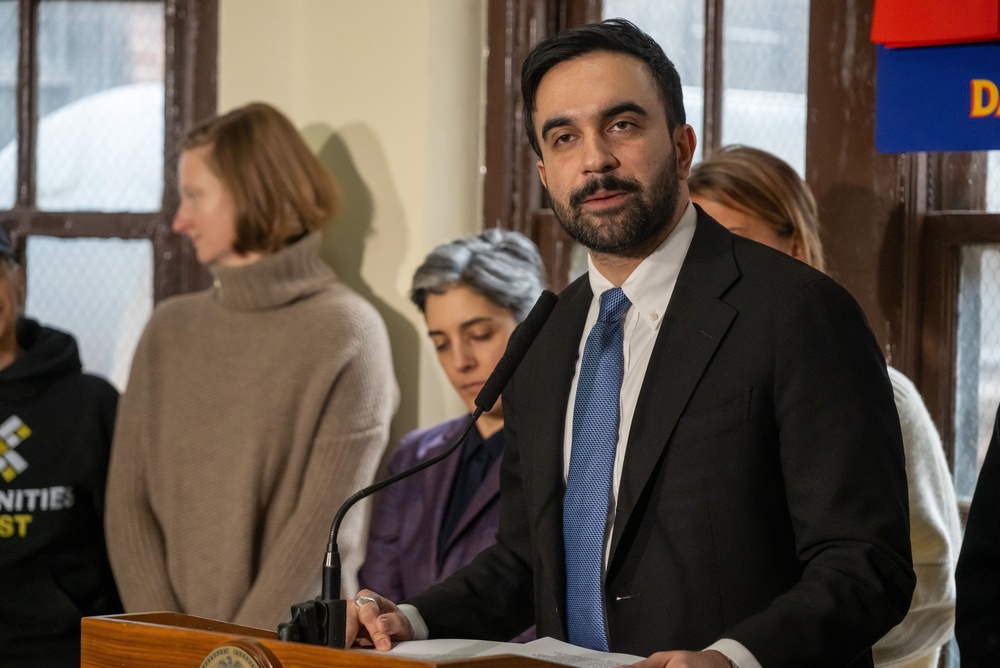
New York Mayor Zohran Mamdani announced that Little Italy will be placed on the map of the city’s immigrant communities, after protests caused by its exclusion. The graphics, titled New York City Immigrant Enclaves, indicate thirty neighborhoods in the five districts and suggests the nearest metro stations. It was widespread as part of a tour guide linked to the World Cup, to encourage visitors and residents to know areas such as Koreatown, Little Pakistan and Little Yemen.
The most evident absence, however, was that of Little Italy – but it was not the only one: Woodlawn and Breezy Point did not appear on the map, neighborhoods associated with the Irish community, nor areas with a strong Orthodox Jewish presence of Borough Park and Williamsburg. The president of Staten Island, Vito Fossella, also reported the exclusion of the Sri Lankan community present in the borough. Italian politicians also recalled Belmont, in the Bronx, and Bensonhurst, in Brooklyn: less touristy neighborhoods of Mulberry Street, but still linked to the Italian history of the city.
Presenting the graphics simply as a map created by Mamdani, however, is unpredictable: the project from which it was started in 2023, during the administration of Eric Adams, by the Mayor’s Office of Immigrant Affairs. Originally it was a series of illustrations dedicated to individual communities, created for the Immigrant Heritage Celebration. Mamdani said that his administration inherited that material and added some locations; among those indicated as new ones there are Little Senegal, Little Egypt and Little Palestine. Adams’ office has however wanted to reject the attempt to attribute to the previous administration the responsibility of the current version and assumed the total responsibility of the shortcomings, explaining the motivation to the base.
The discussion mainly depends on what is meant by “immigrant enclave”. The Municipality argued that the selection concerned neighborhoods with substantial populations born abroad, and not all ethnic or religious communities present in New York. According to the city’s most recent demographic report, New York has 3.1 million residents born outside the United States, more than one third of the population, and the main contemporary settlements are mainly located in Queens and Brooklyn. Historian Tyler Anbinder noted that, in order to represent the communities now largely composed by the descendants of immigrants, it would have been more correct to speak of “ethnic enclave”, and not “immigrant”.
Little Italy is the case that makes the difference clear. Between the end of the 19th and early 20th century, Mulberry Street and nearby streets hosted one of the largest concentrations of Italian immigrants in the United States. Since the 1950s, many residents moved to Brooklyn, Queens, the Bronx and the suburbs, while Chinatown expanded north. Today the nucleus of Little Italy is reduced mainly to some blocks of Mulberry Street, occupied by restaurants, pastries and activities for tourists. However, the district remains part of the Chinatown and Little Italy Historic District, written in the national register of historic places.
This is why exclusion was perceived as a symbolic removal. The map was not attached to a statistical study, but to a guide destined to visitors: in that context Little Italy continues to be one of the most famous places of New York immigration. Ernest Lepore, whose family opened Ferrara Bakery in 1892, said he was surprised by the absence. The problem of graphics was the contrast between the stated criterion – show where immigrants live today – and how it was presented, as an itinerary through cultures that formed the city.
Mamdani said Little Italy will be added and will follow other changes, without specifying which neighborhoods will enter the new version. He also recalled that in New York there are more than two hundred ethnic communities and that a single map could not include them all. But the point is not necessarily to include them all: such a guide must clarify whether he wants to describe the current concentrations of residents born abroad or tell the historical geography of immigration. The first choice requires verifiable data and criteria; the second makes it difficult to leave Little Italy out.
L’articolo Zohran Mamdani and Little Italy quarrel a little proviene da IlNewyorkese.