



In Governors Island, apart from work to rebuild the ecosystem of the port of New York begins with the leftovers of restaurants. They are oyster shells consumed a few weeks or months before in Manhattan, Brooklyn and other boroughs, collected instead of being thrown and transported to the island, where they are cleaned and left outdoor. They will serve as a basis on which to grow new oysters to be brought back to the waters of the city.
It is the system developed by the Billion Oyster Project, a non-profit organization born in 2014 with a rather easy goal to remember: bring a billion oysters back to the port of New York by 2030. According to the most up-to-date data published by the organization, so far more than 200 million have been reintroduced, about 19 acres of seabed, little less than eight hectares. At the end of 2025 it was still 180 million, according to the annual monitoring report published in August: the project then reached about one fifth of its goal.
To understand why the oysters have to return to a New York much earlier than the skyscrapers. Before the industrial transformation of the city, its port housed about 220 thousand acres of oyster barriers. They were a central part of the estuary ecosystem and also of the New York diet: in the nineteenth century oysters were an economic and widespread food, sold in the markets and on the street. Intensive fishing, the dredging of the seabeds and above all the pollution of the waters gradually disappeared those barriers. In 1927 he closed the last oyster shop in the city.
The situation slowly began to change in the second half of the twentieth century, especially after the Clean Water Act of 1972 and with the improvement of wastewater treatment systems. The port remains very different from the one before industrialization, but it has returned quite healthy to allow oysters to survive and reproduce. It is from this possibility that the Billion Oyster Project was born, initially developed around the New York Harbor School, the public school of Governors Island specializing in marine professions.
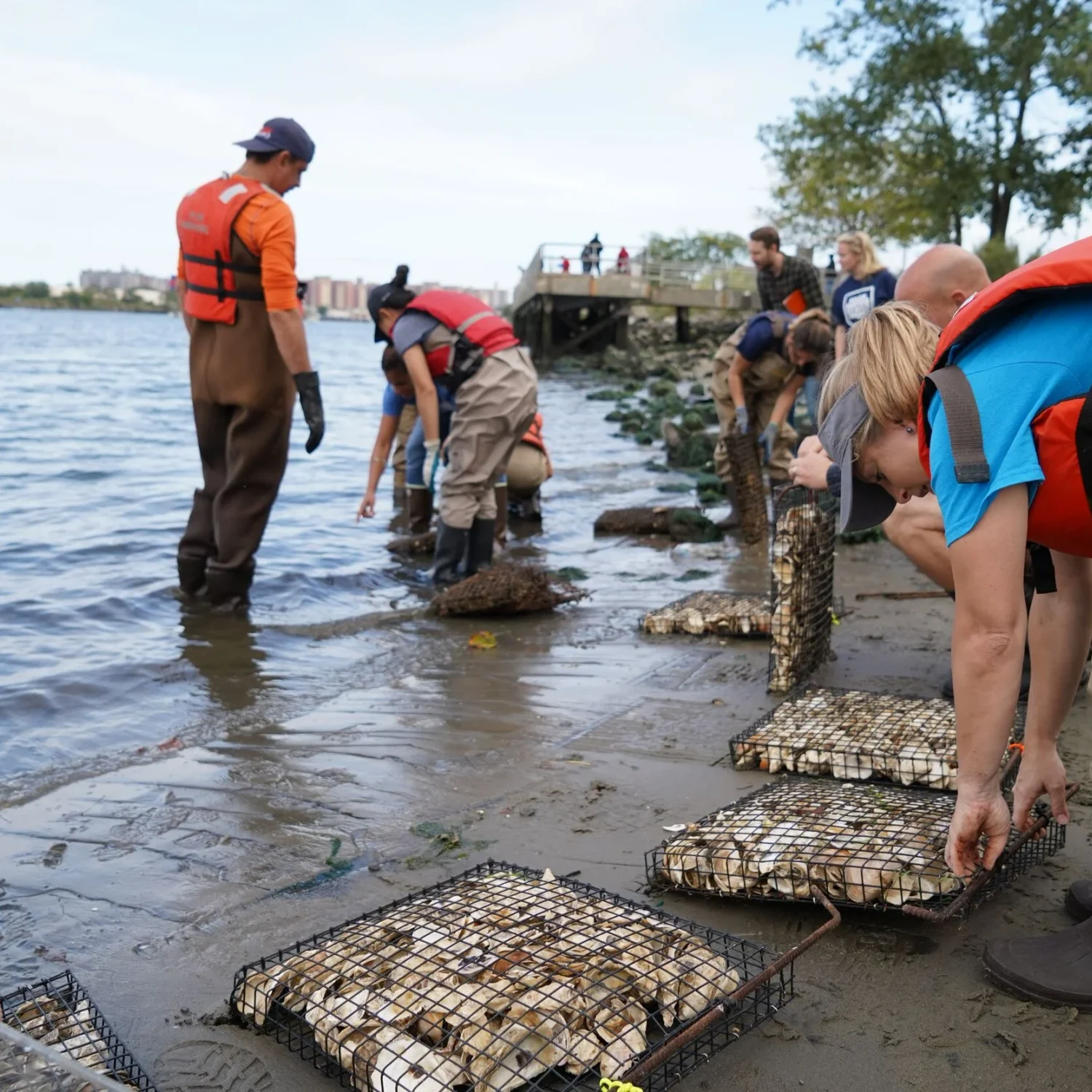
The problem is that to bring back oysters it is not enough to release millions in the water. The larvae need a hard surface to attach to and the shells of adult oysters are particularly suitable. When the old barriers disappeared, this substrate was also lost. The project is therefore trying to reconstruct it artificially starting, among other things, from the shells that New York produces every evening in its restaurants.
Today, more than 80 restaurants participate in the collection program. The shells are separated from the other waste, collected and brought first to the Fulton Fish Market transfer station and then, about once a month, to Governors Island. Here they stay outdoors for months, so that organic bacteria and residues disappear. Volunteers and students select and clean them before they are used together with concrete structures designed to reproduce irregular surfaces of a natural barrier. More than 16,000 volunteers have participated so far in these operations. Overall 3.2 million pounds of shells were recovered, about 1.450 tons.
On the shells are then deposited the larvae raised in the structures of the project. When attacking they become spat, i.e. young oysters, and can be transferred to the restoration sites scattered in the port. The point is not simply increasing their number. The observations conducted in recent years show that oysters are able to grow and, on some sites, to reproduce themselves; however, they also show that small and isolated barriers can hardly keep without new interventions. This is why the Billion Oyster Project is trying to build a network of habitats that are quite extensive and connected to sustain over time a population capable of reproducing without being continually supplied by man.
Oysters are useful especially because they change the environment in which they live. Their barriers create cavities and surfaces used by fish, crabs, shrimps, molluscs and other organisms. In the monitoring carried out in 2025 in twelve harbour sites, the researchers of the project recorded 44 different taxonomic groups and counted more than four thousand fishes and invertebrates around the studied areas.
Then there is water filtration, probably the most known characteristic of oysters. An adult specimen can filter, in favorable conditions, up to about fifty gallons of water per day, about 190 liters, removing algae and part of the suspended nutrients. But it is easy to attribute more importance to this than it really does. A billion oysters would not solve alone the problem of pollution of the port of New York. A part of the city still uses combined sewer systems that, during the most intense rains, can download untreated waste water in rivers and bay. That is why the oysters of the project are not considered safe to eat and are not raised for consumption.
The barriers can also have another effect, particularly important for a city that has invested a lot in the protection of the coasts in recent years: their irregular structure absorbs part of the energy of the waves and can reduce the erosion of the shores. NOAA considers oyster barriers one of the possible forms of natural infrastructure for coastal resilience, along with wetlands, mangroves and marine prairies. Efficacy depends on the size and location of the barrier: I am not a substitute for the works against the great floods or a sufficient defense, alone, against events such as Hurricane Sandy.
The other half of the Billion Oyster Project takes place outside the water. The organization wants to involve a million students by 2030, taking part in oyster monitoring, water quality analysis and field activities. At the end of 2025 he had involved more than 40 thousand; the most recent data published on his site now speak of more than 66 thousand. The idea is that a restoration project for decades also needs people who know how the port works and continue to take care of it when the first experimental barriers will become old.
What do you need a billion oysters in the port of New York? It’s from IlNewyorkese.