



In the first seven months of 2026 New Yorkers reported about 9,900 rat sightings at 311, the city service for requests and reports. It is 22 percent less than the same period of 2025 and the lowest data from 2020, according to data collected by the New York Post.
The number is not a census of rats present in the city: it indicates only how many sightings were communicated by residents. But it is the indicator used by New York to understand where the problem is most obvious and how it changes over time. The decline this year coincides with the extension of closed containers for waste collection.
The clearest case is that of Manhattan Community District 9, in the western part of Harlem. The neighborhood is completely containerized from June 2025 and was the first in New York to collect all the garbage through closed containers. In the first seven months of 2026 rat reports decreased by about 35 percent compared to the same period of the previous year.
The experiment that led to this result began in September 2023, when the Department of Sanitation had installed the first ten-block containers of Hamilton Heights, always within the Community District 9, where fourteen schools were also located. In the pilot area, 311 signals had decreased by 60 percent compared to the same period prior to installation, according to data published by the Department of Sanitation on the pilot project.
The reason is especially practical. The bags left on the sidewalks remain for hours within the reach of animals and can be opened, washed or dragged. There are often food remains inside. The containers with the lid reduce access to waste and make it more difficult for rats to find a regular supply source. The Department of Sanitation explains the operation of the containerization of waste in these terms: less exposed bags means less food available on the road.
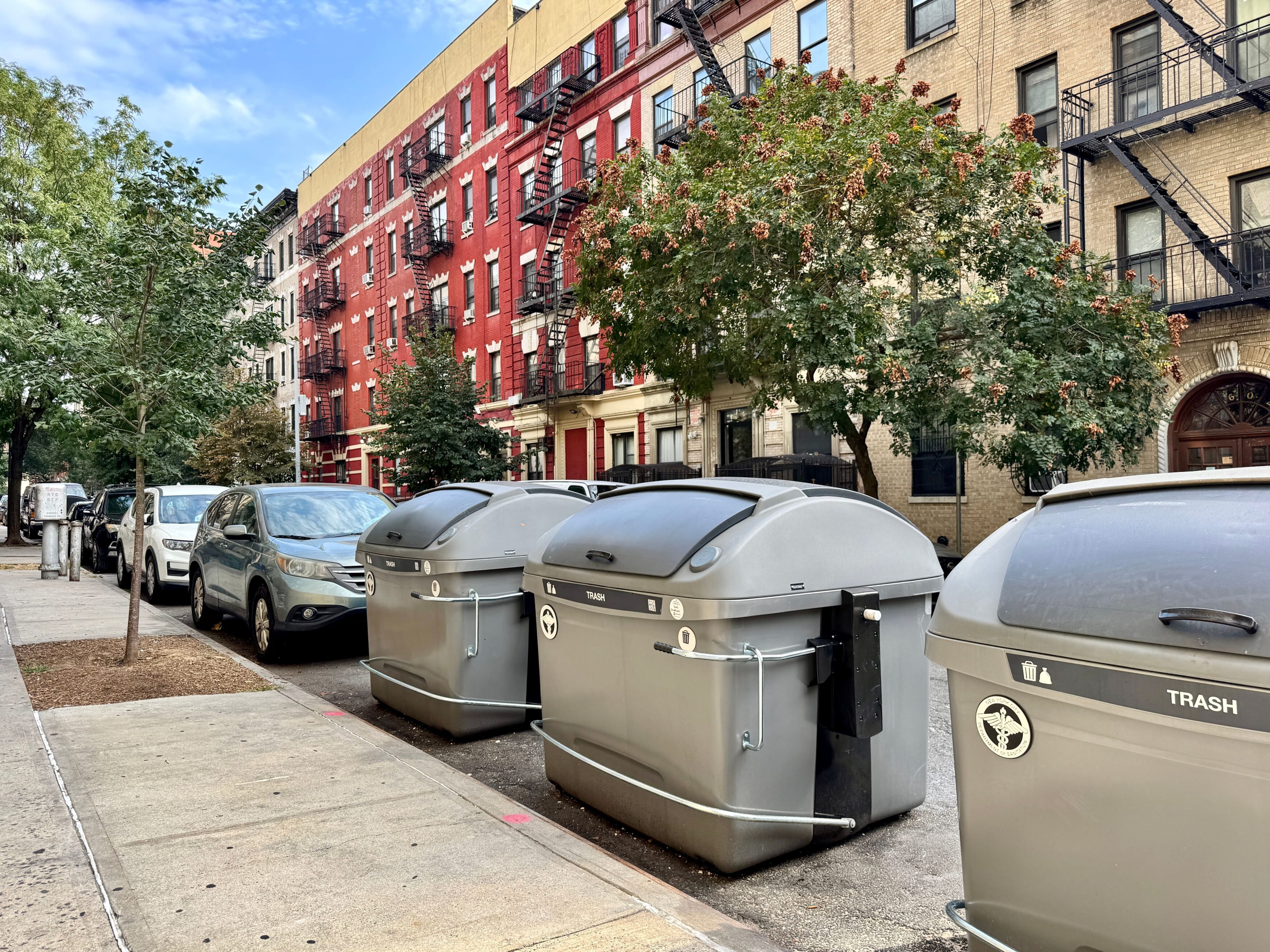
Empire Bins are large fixed containers placed along the edge of the carriageway and assigned to a single building. They cannot be used by anyone: they can only be opened by authorized personnel through an electronic card. They are emptied by the new DSNY automated trucks and each container can collect about four cubic yards of waste, the equivalent of 25 large bags.
The rules change according to the size of the buildings. The property with at least 31 apartments must use Empire Bins in the areas reached by the program. Those between 10 and 30 units can choose between Empire Bins and smaller containers. Buildings with one, two or up to nine units must instead use the Official NYC Bins, containers with safe cover introduced throughout the city.
The obligation for smaller properties came into force on 1 June 2026. Until September 7, DSNY will warn those who do not comply with the rules; from September 8 the fines will begin, which can be 50 dollars for the first violation, 100 for the second and 200 for the next. The indications are summarized in the official FAQ on NYC Bins.
The containerization was started during the administration of Eric Adams, who in 2022 had inserted the management of waste between the measures to reduce the presence of rats. The administration of Zohran Mamdani decided to extend the project. By the end of 2027 six other Community Districts, at least one per borough, should be completely containerized. For this phase, more than 6,500 Empire Bins will be used for more than 3,500 buildings, according to the mayor’s office plan.
The program should arrive throughout New York by the end of 2031. The DSNY estimates that approximately 60,000 containers and hundreds of trucks will be required to empty them.
There is also some of Italy in the development and marketing of the trucks used to empty Empire Bins: their most specific component, the automated lateral loading system, was designed by Farid Industrie, a company based in Vinovo. The Mack chassis was supplied in the United States, while the final assembly and assistance were entrusted to the New York Vasso Waste Systems. The site of the group reconstructs the technical chain of the project.
Every medal has its reverse. Each container occupies a space on the edge of the road: according to the commissioner to Health, in the neighborhoods already concerned were sacrificed about 2 or 3 percent of the parking spaces.
However, large-scale use of closed waste containers seems to be the right way to limit rat proliferation in the Big Apple. The test of the nine comes from the neighborhoods where the plan has not yet entered into force. In Manhattan Community Board 3, which includes East Village, Lower East Side and parts of Chinatown, reports increased by 37.6 percent: from 218 to 300 between January and July. In those areas many larger buildings have not yet been reached by the program and bags continue to be left on the sidewalks.
The available data still does not allow to say that the total population of rats in New York has decreased. However, they show a relationship between how the city retains waste and the number of registered sightings. Where the bags have been replaced by the containers, the signals are dropped. The result must be verified in the coming years, when the system will be extended to the neighborhoods that are still excluded today.
L’articolo The bins are decreasing rats in New York proviene da IlNewyorkese.