



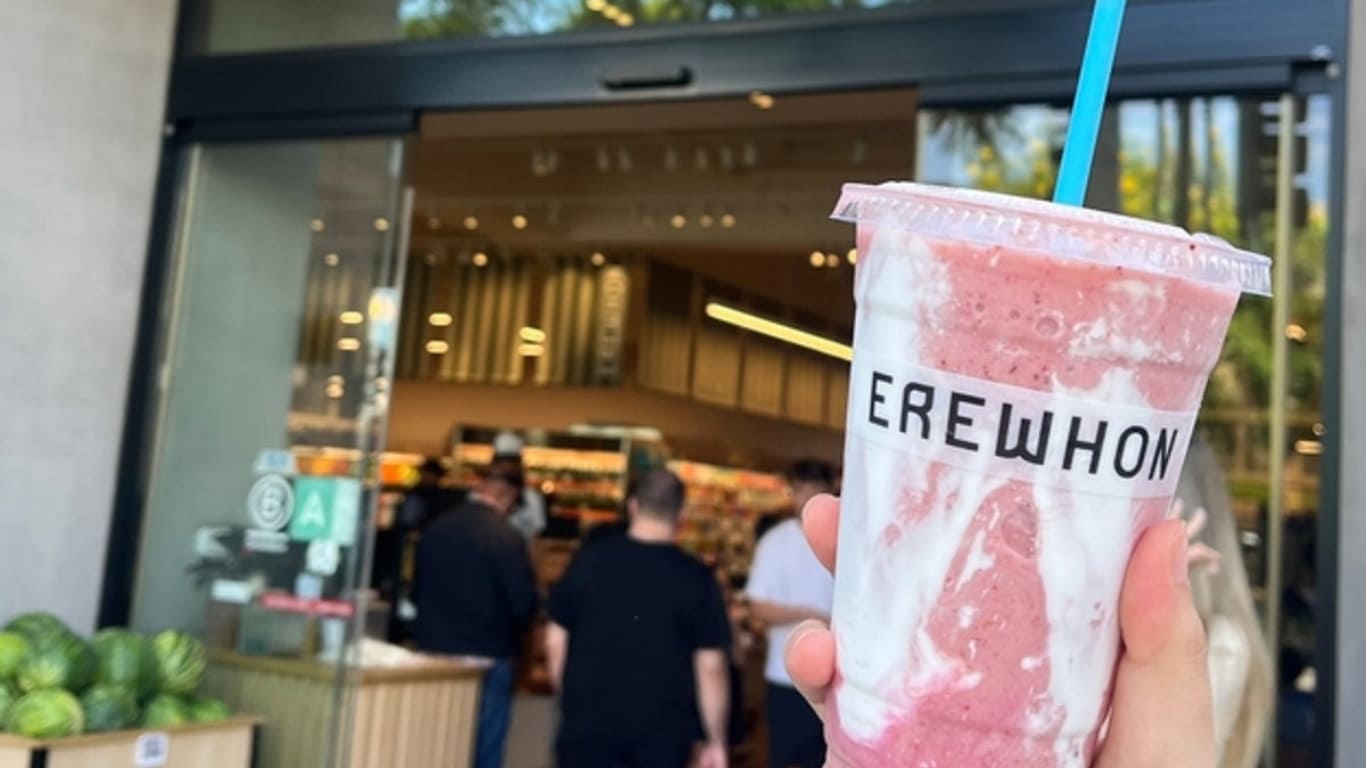
In New York, where a coffee can cost five dollars and a fast lunch easily more than fifteen, there is who is willing to spend 21 dollars for a smoothie. And wait an hour to buy it. It happened on Friday, November 20, when Erewhon, the California supermarket chain became famous for its luxury organic products, opened a Tonic Bar inside the Kith Women store, at 644 Broadway, between SoHo and NoHo.
According to the New York Post, some customers lined up before dawn to be among the first to try drinks. The restaurant offers smoothies, juices, coffee and other products that made Erewhon one of the most recognizable food brands on social Americans. Prices start at about USD 13 for some coffee drinks and arrive at $20–21 for the most elaborate smoothies. With the addition of extra ingredients, the account can exceed 30 dollars.
Erewhon was born in Boston in 1966 as a shop specialized in natural foods. The name is inspired by Samuel Butler’s novel Erewhon, an almost perfect analogue of the word English nowhere. In the following years the activity moved to California, where it became a chain of supermarkets also frequented by actors, influencers and characters of the show. Today it is known mainly for its expensive products and for a very recognizable aesthetic, made of cured packaging, ingredients presented as healthy and drink designed to be photographed.
The product that has contributed more to its popularity is the Strawberry Glaze Skin Smoothie, created in collaboration with Hailey Bieber. It contains, among other ingredients, strawberries, almond milk, avocado, dates and collagen. The drink, characterized by pink and white streaks visible through the glass, has become a recurring object in the videos published on TikTok and Instagram. Other smoothies were created in collaboration with celebrities, transforming a rather common product category into an affordable luxury market.
New York opening marks an important passage to Erewhon. Until today the brand had focused its commercial presence in the area of Los Angeles, where its supermarkets have become frequented places also for the possibility to meet famous characters. A complete supermarket was not opened in Manhattan, but a Tonic Bar, a space dedicated to beverages and a limited selection of products.
The choice to collaborate with Kith is not casual. The brand of clothing and lifestyle founded in New York by Ronnie Fieg has built part of its identity through collaborations with other brands, limited edition collections and shops designed to offer experiences that go beyond the purchase of clothes. The new Tonic Bar follows the same logic: the customer enters a fashion shop, but can buy a food product already very well known online.
An exclusive drink for New York was also presented for the inauguration. It is a way to make recognizable the new opening and attract even customers who have already tried the Erewhon smoothies in California. The availability of products related to a city or a specific collaboration is one of the strategies with which food brands try to transform repeatable purchases on particular occasions.
The price, of course, is the part that attracts more attention. A $21 smoothie costs much more than an equivalent drink purchased in several bars or juice bars in Manhattan. The difference depends not only on the ingredients, some of which can be expensive, but also on the positioning of the brand, the collaborations with celebrities and the experience associated with the purchase. For a part of customers, buying an Erewhon smoothie also means participating in a phenomenon they already know through social media.
It is a dynamic that is increasingly seen in the New York food industry. In September, for example, he discussed Rye by Martin Auer, an Austrian bakery open to SoHo that sells a strand of natural yeast rye bread from a pound and a half to 60 dollars, about 52 euros. The price attracted the attention of many influencers, who posted videos on TikTok and Instagram to show and taste the product, helping to make it viral. The bread is prepared with organic flour imported from Austria and a particularly long processing, but its cost has fueled a debate that goes beyond the ingredients. The phenomenon is the same that accompanies the arrival of Erewhon: a relatively simple product becomes an experience to tell about social, and its success is measured not only in sales, but also in photographs, videos and discussions that generate online.
The phenomenon also has an interesting economic aspect. The customer is not necessarily buying a product that considers it convenient compared to alternatives. He can be willing to pay more because he wants to try something he has heard about, share the experience or simply take out a curiosity. It is the same mechanism that has contributed to the success of other gastronomic openings in New York, from biscuits shops to locals specialized in just one dessert.
Erewhon also linked the opening to a charity initiative with Bowery Mission, the New York organization that assists people without abode and in economic difficulty. The link was presented as part of the collaboration with Kith, adding a local element to the brand’s arrival.
The Tonic Bar is accessible to the public without the need for registration or purchase in the clothing store. For the moment it represents a commercial experiment more than the announced start of an Erewhon supermarket network on the eastern coast. No definitive plans have been communicated for the opening of complete stores in New York.
It remains to be understood if the files of the first days will continue even after the curiosity for the inauguration has passed. Meanwhile, the arrival of Erewhon offers another photograph of New York consumption: in a city where the cost of life is already among the highest in the United States, a $21 smoothie can become simultaneously a purchase, a social content and a small tourist attraction.
L’articolo A New York queue to buy a $21 smoothie proviene da IlNewyorkese.