



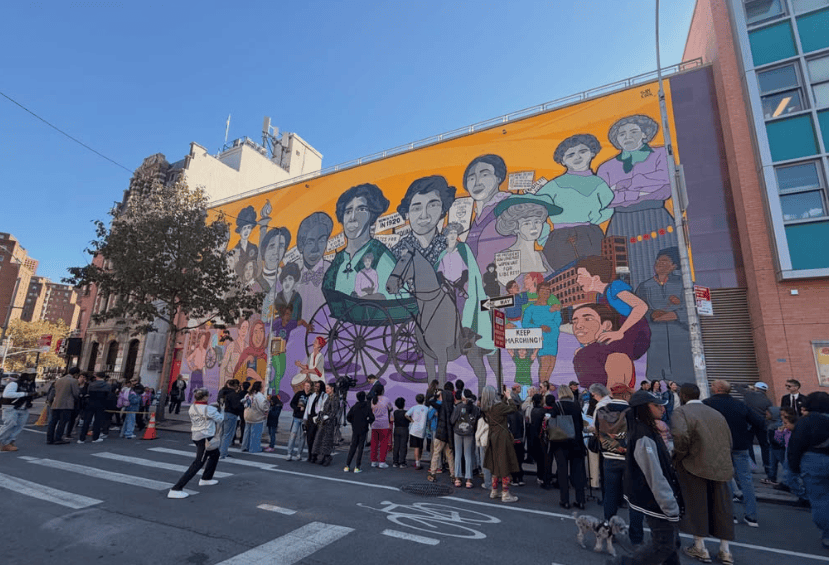
An eleven-metre-high brick wall, outside a lower east side school in Manhattan, has become a great story of the history of female suffrage in the United States. The new mural, entitled Still Our Fight, depicts sixteen women who contributed to the conquest of voting rights and, more generally, to the affirmation of female rights. The work, more than 25 meters wide, was inaugurated on Friday, October 23, on the eve of the opening of seats for the early vote in New York in view of the elections of 3 November.
The mural is located at 293 East Broadway, on the facade of the P.S. 134 Henrietta Szold School, a public elementary school. It was created by American artist Sam Kirk along with a team of six other artists, within the National Suffrage Mural Series, a project promoted by the cultural organization Monumenta. The initiative aims to bring back in public spaces the stories of women who contributed to the political and social changes of the United States, often without receiving the same recognition reserved for male protagonists.
The sixteen figures represented do not all belong to the same movement and did not all have the same role in the conquest of the vote. Some were directly engaged in suffragist campaigns, others contributed to women’s emancipation through political work, community organization and civil rights defense. Among these is Laura Cornelius Kellogg, belonging to the indigenous nation Oneida, who fought for the rights and autonomy of native peoples. In the lower corner of the work a legend has been inserted that allows to identify the protagonists, accompanied by a QR code through which passers can deepen their biographies.
New York’s choice is not random. The city played a key role in the American women’s suffrage campaign. In May 1910, about ten thousand people participated in a demonstration in Union Square to seek the right to vote for women. In the following years, court and public initiatives brought tens of thousands of protesters to the streets of Manhattan. In 1915 a proposal to extend the vote to women in the State of New York was rejected by voters, who were then only men. Two years later, in 1917, a new referendum finally approved female suffrage in the state, helping to prepare the ground for national change.
The 19th Amendment of the American Constitution, approved by Congress in 1919 and ratified in 1920, stated that voting rights could not be denied to a citizen because of sex. The conquest did not eliminate all discrimination. Many African American women, especially in the South, continued to encounter obstacles in access to urns, including electoral fees, literacy tests and intimidation. Other battles were needed to arrive at the Voting Rights Act of 1965, which introduced federal instruments against racial discrimination in the vote.
The Lower East Side project also wants to remember this part of the story, giving space to figures from different communities. Michelle Duster, co-director of the National Suffrage Mural Series and pronipote of the African American journalist and activist Ida B. Wells, explained during the inauguration that the neighborhood was a particularly suitable place to host the work. The Lower East Side has for generations been a point of arrival for immigrants from different countries and cultures, and many of its roads still retain traces of political, trade union and social organizations that contributed to the transformation of the city.
Over one hundred people attended the ceremony, including students, teachers, representatives of cultural organizations and local administrators. Robert Perales, head of the P.S. 134, stressed above all the educational value of the initiative. The wall, until recently devoid of decorations, is now visible every day to children entering school. The project was also born thanks to the collaboration with the Henry Street Settlement, the historic social organization of the Lower East Side, which put in contact Monument with the school institution.
During the construction, which lasted several weeks, the artists worked directly on the facade of the building, attracting the attention of residents and passersby. Danielle Mastrion, one of the muralists involved, told amNewYork that many people stopped to ask for information about the characters depicted and the meaning of the project. The presence of a team composed entirely of women was itself an element of interest for those who watched the work. For Sam Kirk, the work also represents a way to show how the achievements of the past continue to influence contemporary life.
The mural also addresses a more general problem of female representation in public art. According to the data cited by Monumenta, less than five percent of public monumental works represent women or historical events that see them protagonists. In New York, the issue also emerged during the debate that preceded the installation, in 2020, of the Women’s Rights Pioneers Monument in Central Park: the sculptural group dedicated to Susan B. Anthony, Elizabeth Cady Stanton and Sojourner Truth was the first monument of the park to represent women who really existed as historical protagonists, rather than imaginary or allegorical figures.
Still Our Fight is part of a program intended to continue in other American cities. After the first interventions in Chicago, Monumenta provides new murals in Portland, Los Angeles, Salt Lake City, Kansas City and Austin. Each work will be dedicated to the local protagonists of the movements for the rights of women, with the aim of making recognizable figures often absent from traditional monuments.
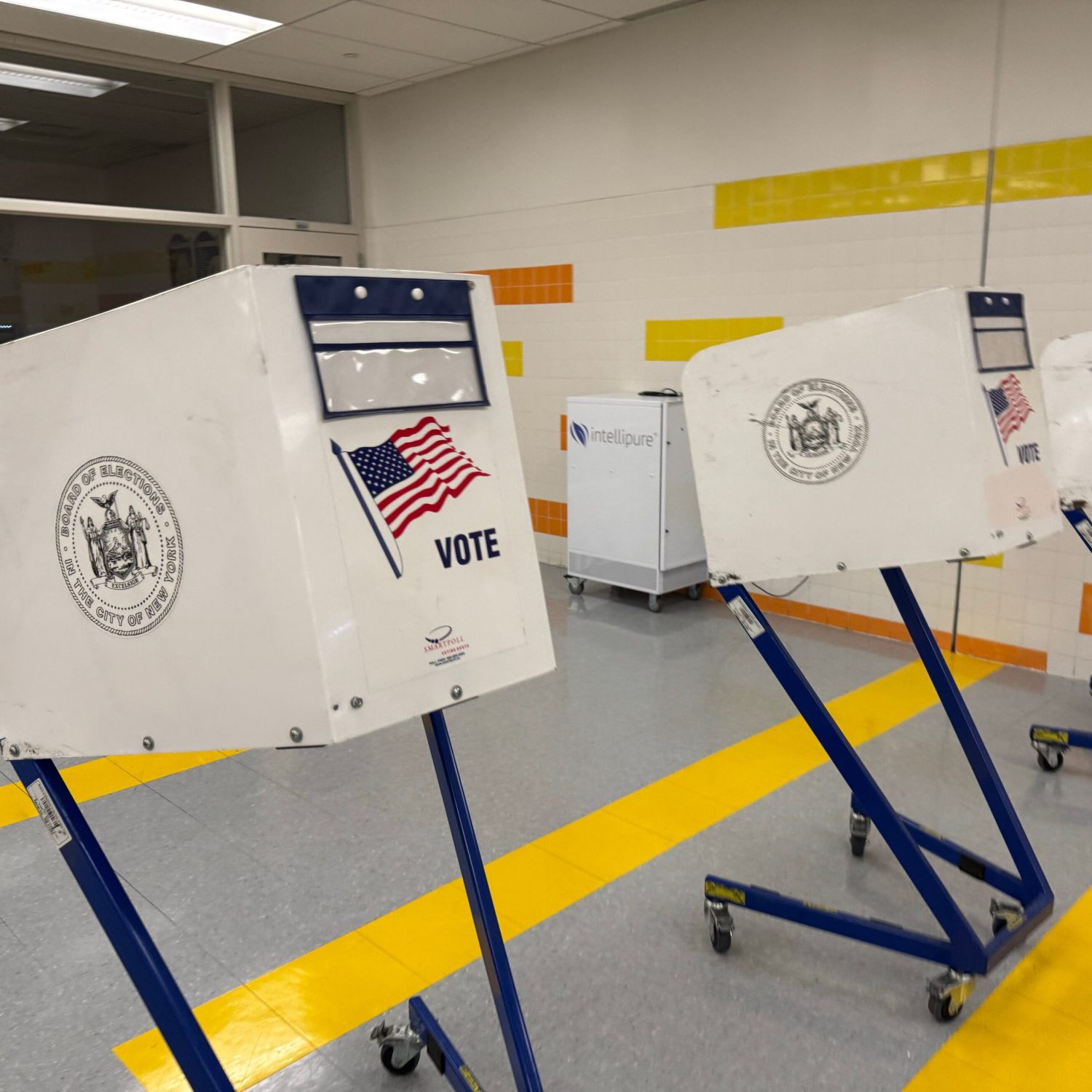
In New York City, on the day after the ceremony, on October 24, seats were opened for the early vote of the elections on November 3. A little more than a century after the ratification of the 19th amendment, the sixteen women painted on the wall of the East Broadway school remind us how long the path that has led millions of Americans to obtain a law today considered fundamental.
L’articolo A gigantic mural tells the story of voting for women on the Lower East Side proviene da IlNewyorkese.