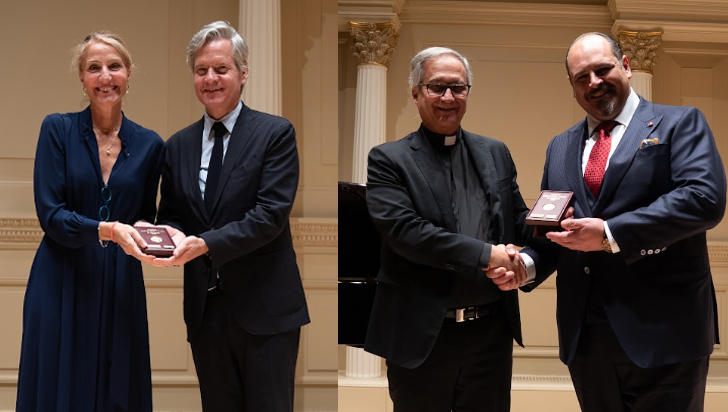




The history of the millions of Italians who left their country for the United States between the late 19th and early 20th centuries will receive greater attention in Italian schools. This is the aim of a memorandum of understanding signed in Rome on Monday, October 12, by Italy’s Minister of Education and Merit, Giuseppe Valditara, and Robert Allegrini, president of the National Italian American Foundation (NIAF). The three-year agreement provides for educational activities focused on Italian immigration to the Americas, as well as cultural and academic initiatives connecting Italy and the United States.
The agreement outlines different approaches depending on students’ ages. In high schools, the ministry has committed to including the history of Italian immigration to the Americas beginning in 1880 in school curricula. Elementary and middle schools will organize specific activities on the subject, including extracurricular programs. The agreement does not establish a new school subject. Instead, it aims to incorporate these topics into existing courses and supplement them with meetings, seminars, and other educational initiatives.
The historical period covered by the agreement is significant. Between 1880 and 1920, the United States was one of the main destinations for Italian emigrants, particularly those coming from southern Italy. According to the Library of Congress, approximately 300,000 Italians arrived in the United States during the 1880s, followed by 600,000 in the next decade and more than two million between 1900 and 1910. By 1920, the total number of arrivals had exceeded four million.
Many were farmers and unskilled workers who left in search of higher wages and better living conditions. Not all intended to settle permanently in the United States. According to the same Library of Congress historical account, between 30 and 50 percent of Italian immigrants from that generation returned to Italy within five years of arriving.
For those who stayed, becoming part of American society was often difficult. Italians found work in construction, factories, mines, and infrastructure projects, but also faced low wages, overcrowded housing, and discrimination. In New York, many settled in working-class neighborhoods across Manhattan and the other boroughs, establishing communities that would eventually play an important role in the city’s history. The living conditions of early Italian immigrants are also documented by the Library of Congress, which describes overcrowded tenements and poor sanitation in the neighborhoods where they lived.
Italian immigration was also marked by episodes of racist violence. One of the most notorious occurred in New Orleans in 1891, when eleven Italians were lynched by a mob after being accused of involvement in the murder of the city’s police chief. Some had been acquitted, while others had not yet stood trial. The incident illustrates how Italian immigrants’ acceptance into American society was a long and often difficult process.
Today, the history of Italian immigration is frequently told through the achievements of later generations, whose members have risen to prominent positions in American politics, business, culture, and society. The agreement between the ministry and NIAF seeks to make this history better known among Italian students, who generally encounter immigration to the United States as part of the broader history of migration during the 19th and 20th centuries.
The agreement was signed on Columbus Day, the American holiday commemorating Christopher Columbus’s arrival in the Americas in 1492. Valditara linked the initiative to the contribution of Italian immigrants to the development of the United States and to relations between the two countries.
“We want to share the extraordinary history of Italian emigrants who crossed the Atlantic and contributed, through their courage, talent, and hard work, to the development of the United States,” the minister said, also emphasizing the role of schools in preserving historical memory. According to Valditara, strengthening educational cooperation with the Italian American community will help reinforce ties between Italy and the United States.
For NIAF president Robert Allegrini, the agreement is above all a recognition of the experiences of the more than four million Italians who arrived in the United States during the great wave of immigration. Allegrini described it as a history of “courage” and “sacrifice,” highlighting Italian Americans’ contributions to the country’s economic and social development. He also thanked the ministry for choosing the foundation as its partner in the initiative.
The National Italian American Foundation is a U.S.-based organization dedicated to promoting Italian cultural heritage and strengthening ties between Italy and the Italian American community. Under the new agreement, it will participate in educational initiatives, promote the Italian language, and support exchanges of teaching experiences between the two countries. La Scuola d’Italia in New York, one of the city’s main institutions for Italian-language education, is also expected to be involved.
The agreement also includes forums, webinars, seminars, and conferences dedicated to Italian culture, language, and Made in Italy industries. A committee composed of representatives from the ministry and NIAF will coordinate the work, promote initiatives, and monitor their implementation, as outlined in the agreement announced by the ministry.