


New York has planted 18,261 trees in the last fiscal year, the highest number registered by the city since 2016. But the most interesting part of the data announced by NYC Parks is not so much how many trees have been planted.
Most of it ended in neighborhoods that the city considers more vulnerable to extreme heat. In the Bronx the list includes Mott Haven, Morrisania, Soundview, Edenwald and Concourse Village; in Brooklyn Brownsville, East New York, Bushwick, East Flatbush and Sunset Park; in Manhattan East and West Harlem, Lower East Side, Hamilton Heights and Washington Heights. In Queens they were interested, among others, Long Island City, Sunnyside, Elmhurst, South Ozone Park and Cambria Heights.
It’s not a random distribution. For some years New York has considered the trees also as a tool to reduce the effects of extreme temperatures and since 2025 has changed the system with which it decides where to plant them.
With the Neighborhood Tree Planting Program, NYC Parks no longer accepts normal residents’ demands for a new tree in front of the house. Techniques instead spend entire blocks looking for the spaces in which it is possible to plant one and proceed neighborhood by neighborhood, giving precedence to the areas with the highest values in the Heat Vulnerability Index elaborated by the Department of Health. The goal is to gradually arrive throughout the city over a nine-year cycle.
The index gives the neighborhoods a score of 1 to 5 and does not simply measure how hot it is. It holds together the average temperature of the surface, the amount of green, the presence of air conditioning in the houses, the income and other factors that the health data associate with a greater risk of dying during the heat waves. The districts classified at levels 4 and 5 are those where the risk is higher.
The amount of trees present is one of the reasons why the heat is not perceived in the same way throughout New York. Asphalt, cement and roofs absorb heat during the day and release it slowly, while trees create shadows and help cool the air through evaporation. For this two relatively close neighborhoods can have very different conditions during the same heat wave.
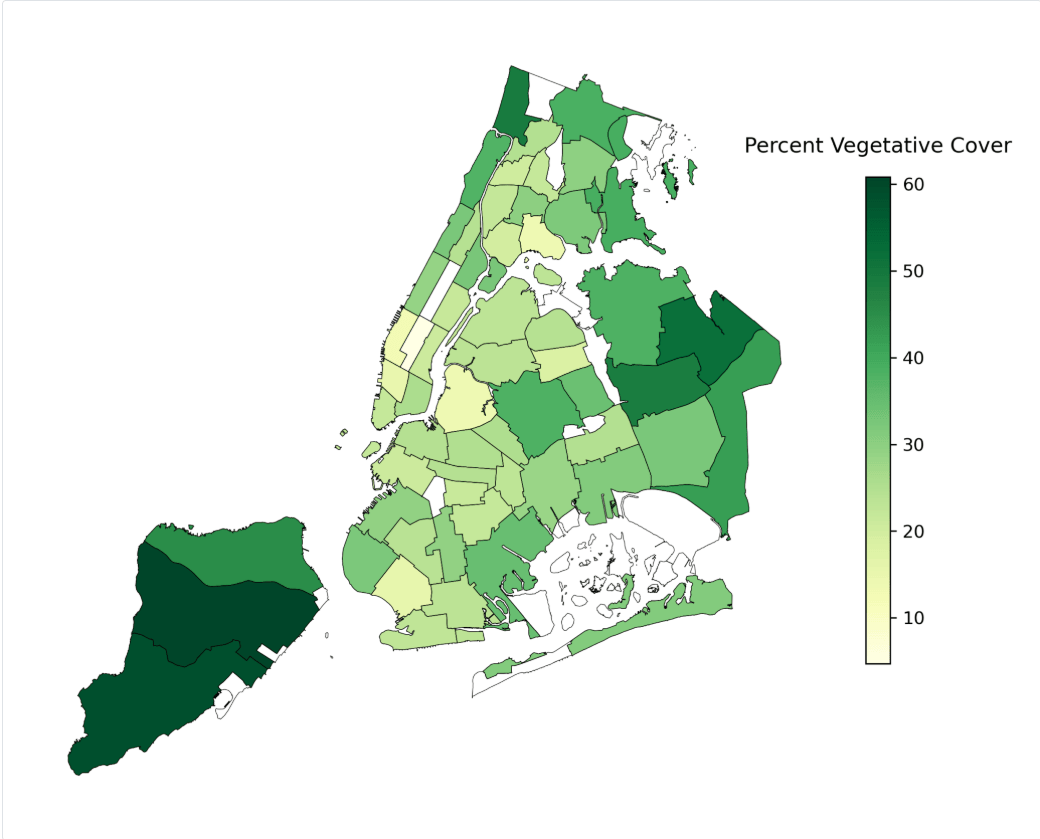
The differences in the arboreal cover are remarkable. A report published this year by the New York Comptroller estimates that in South Bronx trees cover only between 8 and 12 percent of the surface and in some parts of Central Brooklyn between 11 and 15 percent. They are also some of the areas that record more vulnerability to the heat.
This is why planting a tree in Brownsville or Mott Haven is today considered unlike planting one in a neighborhood that already has many parks and tree-lined streets.
The city gives over 7 million trees in the five boroughs functions that go beyond the shadows. Chiome intercepts part of the water during intense rains, absorbs some atmospheric pollutants and reduce the energy consumption needed to cool buildings. According to the estimates of the Comptroller, the entire urban forest produces approximately 120.6 million dollars a year of benefits, absorbs more than a billion gallons of rainwater and removes from the air about 1,100 tons of pollutants.
New York wants to further increase this surface. The Urban Forest Plan sets the goal of bringing the chiome cover to 30 percent of the city territory by 2040.
To succeed, however, it is not enough to increase the number of plantations.
A newly planted tree produces a much lower amount of shadow than an adult specimen and takes years before significantly contributing to the neighborhood coverage. The Comptroller report also emphasizes that irrigation, pruning and soil care in the early years are decisive to prevent new trees from dying before reaching maturity.
NYC Parks says he changed this part of the job. To arrive at the 18,261 last year’s plantations, he ordered the trees first to the nurseries, anticipated part of the operations compared to the spring growth of the buds and kept unrivalled and mulled the new specimens during the summer. The same system will be used for the next autumn season.
The number announced this week should also be read with an important distinction. In municipal relations, higher figures may appear because trees planted by Parks, other agencies, authorized subjects and interventions in natural areas are counted together. In the fiscal year 2025, for example, the Mayor’s Management Report recorded altogether 34,667 trees, of which 17,767 along the streets, 5.628 in the landscape areas of the parks and 11,272 in the natural areas. The 18,261 announced this week refer instead to the plantations attributed directly to the NYC Parks program, and is compared to this series that the city speaks of the highest result since 2016.
The most significant change, therefore, is not only that New York is planting more trees. It is that he stopped deciding where to put them mainly on the basis of the requests received and began to systematically use the data on the heat to determine which neighborhoods should come first.
In a city where the shadow is not distributed evenly, the position of a new tree has also become a decision of climate adaptation.
Tags SEO: trees New York, NYC Parks, hot New York, climate change New York, Urban Forest Plan, Heat Vulnerability Index
L’articolo New York is planting trees especially where it is warmer proviene da IlNewyorkese.