


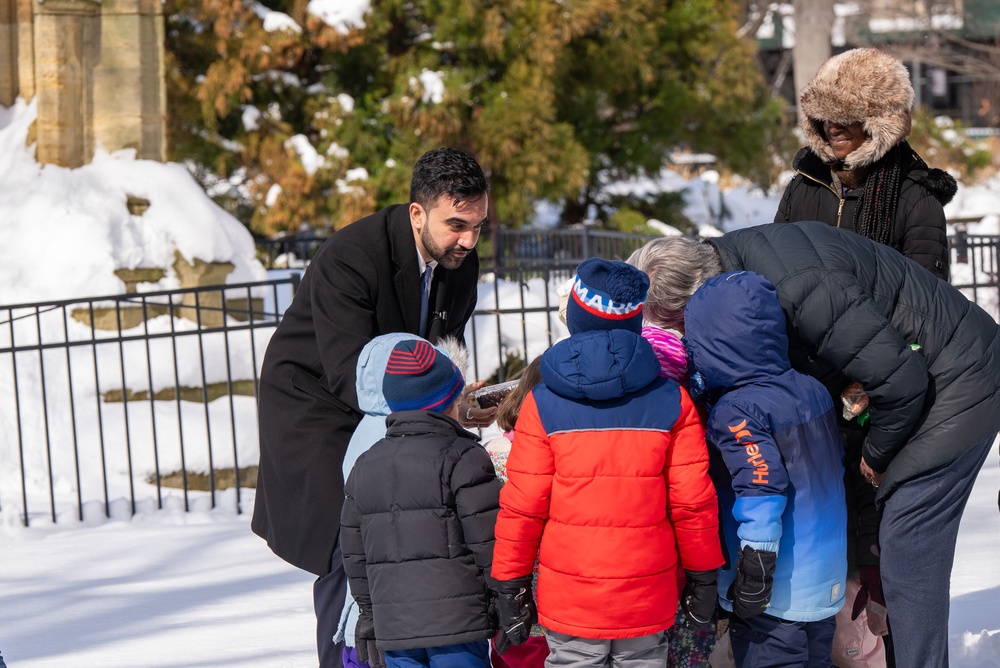
A few days from the beginning of the school year, many of the centers that manage public programs for New York’s childhood have not yet received the necessary money to pay teachers, buy material for classes and cover normal management expenses. Some have anticipated tens of thousands of dollars, others have asked for personal loans or money to family members. At least for now, Mayor Zohran Mamdani assures that on September 10 they will be able to open.
On Monday its administration has announced a series of measures to prevent some centers from being closed: to speed up the concession of loans bridge without interest, to temporarily move municipal employees to the job of registration of contracts and to deliver directly to the centers what is missing in the classrooms. The material includes toys, diapers and hygiene products, as well as colour pencils, cardboards and paper rolls. Loans should be processed within five working days if the documentation presented is complete.
The problem is that much of public education for young children is in fact carried out outside public schools buildings, through kindergartens and private organizations signing contracts with the Department of Education. According to Chalkbeat, about 150,000 children under five years receive subsidized services through this system. The centers hire teachers, pay rents and organize classes, and are then funded by the city.
For years, however, the passage between these two things – providing service and receiving money – works pretty badly. In order for a centre to be paid, its contract must complete a long administrative procedure and arrive at the Comptroller’s office for registration. When this happens after the start of the activities, the center actually begins to work anticipating the costs. In 2024, 90.7 percent of municipal service contracts were registered late; more generally, the Comptroller’s office found cases where the first issues arrived over six months after the formal start of contracts.
In childhood education, the problem is particularly old. It had already emerged in 2014, during the introduction of the Universal Pre-K wanted by Bill de Blasio, when about two-thirds of the new contracts were not ready at the beginning of the lessons. He returned with special gravity during the administration of Eric Adams, after a reorganization of the division that manages the early childhood education and the reduction of the staff responsible to follow the centers. In 2022 delays had become serious enough to force the Department of Education to create an intervention group dedicated to payments.
This time the situation has become more delicate because it coincides with the start of one of the most important projects of the Mamdani administration. From September New York will offer for the first time 2-K, a free program for children of two years. It starts with just over 2 thousand places in five school districts, between Washington Heights, Inwood, some areas of the Bronx, Brooklyn and Queens. The questions were over 5,700. The stated goal is to reach 12 thousand places in 2027 and make universal service within four years.
Some of the same centres chosen for the new 2-K are those who have had difficulty in obtaining answers on funding in recent weeks. Theresa Hyland, who runs the Little Tots Red Wagon in Queens and should open a class for twelve children two years, had asked for a $80,000 bridge loan. Initially the Department of Education offered him 29 thousand. After his protests, on Friday the agency told her that he would receive the full figure: “I can pay my employees,” he told the New York Times. In Brooklyn, Olena Olson from the Let’s Play and Learn center instead received the promise that a $76,316 loan will arrive this week. He said he wanted to wait before he believed it.
The response announced by Mamdani is a $43 million investment in the Division of Early Childhood Education. It will serve, among other things, to hire more than 200 people, to strengthen the offices following contracts and to create procedures with more defined deadlines. In recent days the city says it has already tripled the number of employees engaged on the contracts of the centers. The economic problem of the managers goes beyond the delays of these weeks: in 2024 the Comptroller had found wage differences even greater than 30 thousand dollars between some teachers of the partner centers and colleagues with similar qualifications assumed directly from the Department of Education.
L’articolo In New York the affiliated kindergartens are waiting for the city’s money proviene da IlNewyorkese.