


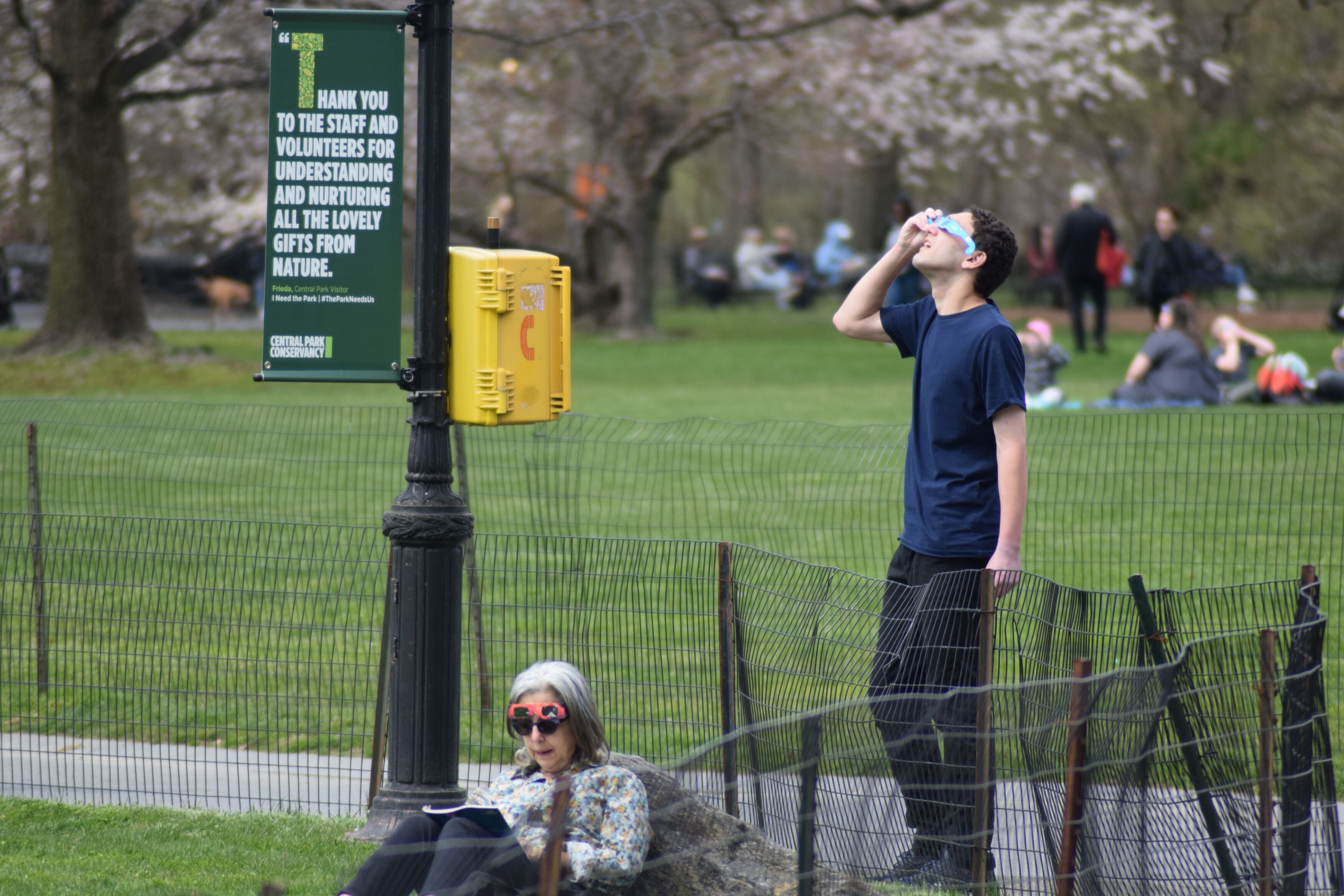
Yesterday in New York you had to know that there was an eclipse to notice it. The Moon crossed the solar disk even above the city, but at the maximum coverage it hid only about 9 percent. Very different the show seen on the other side of the Atlantic, where the eclipse became total in a band that crossed Greenland, Iceland and Spain.
A New York the phenomenon began at 13:07, reached the maximum at 13:54 and ended at 14:38, basically as expected. These are the same times and the same intensity we had anticipated on New York on the eve of the event: with over 90 percent of the Sun still discovered, there was no clear decrease in brightness and the eclipse was recognizable above all by observing the solar disk with adequate protection.
The conditions of the sky were not ideal, with clouds and haze that could make the observation less clear. But the weather was not the main manager of the rather modest show: even with a perfectly calm sky, from New York only a small partial eclipse would be visible.
In Europe it went differently. The totality range crossed Greenland, Iceland and part of Spain, where for a few minutes the Sun was completely hidden from the Moon. In other European areas the eclipse remained partial and the possibility of observing it is also dependent on weather conditions and, towards the south, the arrival of sunset. The trajectory of the eclipse followed that provided by astronomers, with the totality band that reached northern Spain just before sunset, as indicated by NASA’s astronomical calculations.
In Italy the difference from New York was remarkable, especially in the North. The day before we reported the forecast for three Italian cities: 92.3 percent coverage in Milan, 69.1 percent in Rome and about 34 percent in Palermo.
These percentages indicate the portion of the solar disk covered by the Moon and depend on the geometry of the eclipse: clouds do not change them, but they can prevent them from seeing the phenomenon. Yesterday’s observations confirmed the strong difference between North and South. In Milan the eclipse was very evident just before sunset; in Rome it was less and in Palermo even less. For all three cities it was also necessary to have free the western horizon, because the phenomenon occurred when the Sun was now very low.
The question of security remains. Looking directly at the Sun during a partial eclipse can cause a solar retinopathy, i.e. a damage to the retina. The risk also exists when a part of the Sun is covered and normal sunglasses do not offer sufficient protection. On the eve of the eclipse, NASA recommended the use of viewers that comply with ISO 12312-2. It was the same indication from New York before the event.
In the first 24 hours there was no public signalling of an abnormal increase in access to New York hospitals for eye injuries resulting from the eclipse. It is a data to be read with caution: it means that at the moment there is no emergency, not that one can exclude the existence of individual cases. Symptoms of solar retinopathy may appear in the hours after exposure and include blurred vision, sprains and dark spots at the center of the field.
The low intensity of the eclipse seen from New York probably limited the prolonged exposure to the Sun by large groups of people. It was a very different situation from 8 April 2024, when around 90 percent of the solar disk was covered by the city and thousands of New Yorkers gathered in parks and public spaces to follow it.
Yesterday was especially a European eclipse. In New York only the margin of the phenomenon arrived: enough to see it with the right tools, too little because most of the city noticed that for an hour and a half a small part of the Sun was missing.
L’articolo In New York the eclipse has passed almost unnoticed proviene da IlNewyorkese.