



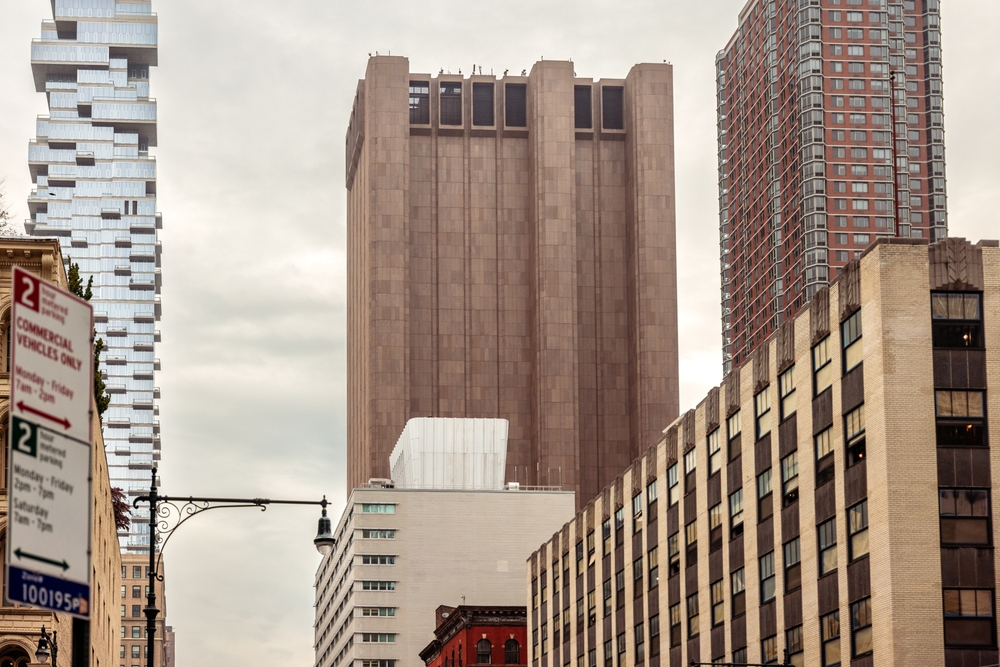
In Lower Manhattan, just north of the municipality and inside the area that is now called Tribeca, there is a skyscraper that seems to come out of a dystopian film. It is located at 33 of Thomas Street, is about 168 meters tall, has 29 floors and has no windows. The façade is made of concrete panels covered with brown granite, interrupted only by large openings for ventilation. By day it resembles a huge technical infrastructure placed in the middle of residential buildings and offices; at night it becomes even more evident, because, unlike the buildings and glass skyscrapers that it has around, it does not return any light to the street.
Its original name was Long Lines Building, and was completed in 1974 for AT&T, when the company controlled a huge part of American telecommunications. It had to host the world’s largest centre for long distance phone calls, at a time when passing a call from one city to another required bulky machines, cables, power stations, power systems and cooling equipment. The architect John Carl Warnecke designed it as a machine building before the people. The floors are much higher than normal and the floors were designed to hold heavy loads, because inside there were no desks, open space or apartments, but very heavy equipment that had to remain in operation for long periods.
The shape of the building is better understood when it was designed. In the late 1960s, telephone infrastructure was considered an essential part of American national security. During the Cold War it was not enough to make it work: it was necessary to imagine that they could continue to work even after an attack, a blackout, a sabotage or a military crisis. For this reason, 33 Thomas Street was built as a sort of vertical bunker, without vulnerable openings, with reserve generators, fuel supplies, water and enough food to keep many people inside for two weeks. Its strangeness, in short, is not born from an aesthetic whim of brutalist mold but it is mainly involved with the need to protect the telephone network separating it as much as possible from the outside world.
In an article published by Places Journal, journalist Zach Mortice also reported that 33 Thomas Street was thought of in years when American institutions were not only afraid of the Soviet Union, but also internal tensions: protests against war in Vietnam, radical movements, urban revolts, fear of attacks and sabotage. This does not mean that the skyscraper was built mainly against the protesters or against the civilian population. That would be a shortcut. But it helps to understand why a private infrastructure, built in the center of Manhattan, has assumed the form of a fortress. He had to defend communications from everything that could stop them outside and inside the country.
This form has made the Long Lines Building a perfect object for cinema and television. A windowless building, almost impossible to visit, in the middle of one of the densest and guarded areas of New York, already seems to tell a story before someone writes it. Over the years he has appeared or has been summoned to films and series related to political paranoia, espionage and social control, from X-Files to Mr. Robot.
In 2016 this impression came out of the fiction field. An Inquiry of The Intercept, based on Edward Snowden’s documents, indicated 33 Thomas Street as the probable location of TITANPOINTE, a center used by the National Security Agency to intercept past communications through AT&T infrastructure. According to that reconstruction, the site was connected to the BLARNEY program and would have a role in collecting phone calls, fax, email and other data, also linked to international organizations and foreign governments. AT&T denied that government agencies could connect directly to its network or control it, saying they only respond to legal requests.
L’articolo The strange skyscraper without Manhattan windows proviene da IlNewyorkese.