



A New York has two Grand Army Plazas, but almost everyone thinks of Brooklyn first. It is normal: that at the entrance of Prospect Park has a large monumental arch, a metro station with the same name and a lot of traffic so wide and complicated that it has become, over the years, part of its identity. The other Grand Army Plaza is in Manhattan, southeastern corner of Central Park, between Fifth Avenue and 59th Street. It is smaller, much less famous and is often exchanged for a space connected to the Plaza Hotel, located on the other side of the street.
But now the Grand Army Plaza in Manhattan is back in the spotlight. The Central Park Conservancy has completed a $21 million restoration, carried out in two stages over thirteen years. The last part of the work, which began in 2024, mainly covered the south section, that of the Pulitzer Fountain: the fountain was disassembled, restored, clean and equipped with new plants; the pavement was remade by taking back the original materials and drawings; the rows of londinese platans were replanted which in the past had been removed.
The square was not abandoned, but it had been consumed a lot: before the restoration, more than two million people per year went through it. For many it was only the pass between Central Park, Fifth Avenue, Plaza Hotel, Bergdorf Goodman and the most touristic streets in Midtown. The restoration will also serve to give dignity to a square that has had a history and a function in the design of the city.
Grand Army Plaza was born in the early 20th century as an entrance to Central Park. Carrère and Hastings won the competition in 1912 to redesign the area, imagining two symmetric islands separated from 59th Street: to the north the golden equestrian monument of General William Tecumseh Sherman, made by Augustus Saint-Gaudens; to the south the fountain dedicated to Joseph Pulitzer, the publisher who had left 50 thousand dollars to build it. The southern part was completed in 1916, the northern part in 1921, also because of the underground works under the square.
Il disegno originale della piazza nei progetti dello studio studio Carrère and Hastings
Un disegno della piazza per come si presentava nel 1920
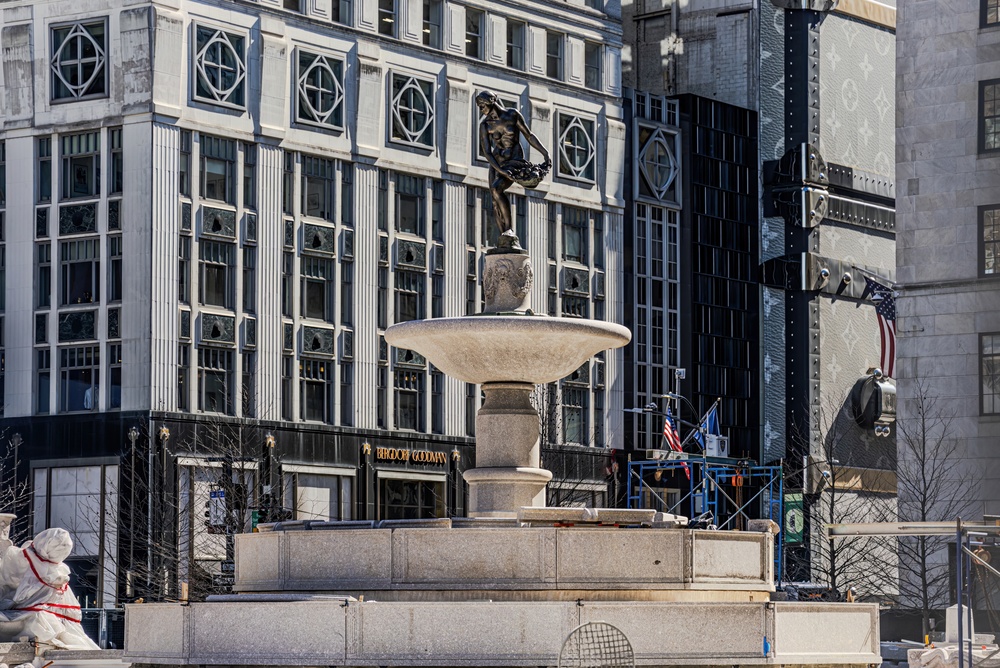
The Pulitzer Fountain is the most recognizable piece of the south. On top there is Pomona, Roman goddess of abundance, represented with a basket of fruit. Under her the water descends from a large cup and crosses a series of superimposed tanks, with a shape reminiscent of a classic European fountain. It is no coincidence, even before the competition, the sculptor Karl Bitter proposed a more monumental treatment for that corner of Central Park, inspired by the French squares. The problem is that the fountain, over time, needed a lot of care. The original materials did not hold the winters of New York well, and in the 1920s it was discussed whether to remove it because it was too damaged.
The comparison with Brooklyn helps to better understand the difference between the two squares. The Grand Army Plaza in Brooklyn is a big urban knot: it measures about five hectares, marks the main entrance of Prospect Park and is dominated by Soldiers’ and Sailors’ Memorial Arch. In recent years the discussion has been mainly about how to remove it at least in part to cars, with a project to close the stretch between Union Street and Eastern Parkway and make more direct the connection between the arch and the park. In Manhattan the theme is different: the square is much smaller and does not work as a big roundabout, but as a kind of outdoor room between Central Park and Fifth Avenue buildings.
This is why Manhattan’s restoration does not radically change the city’s circulation, but it definitely modifies the way you cross that piece of Central Park. The square has been raised to the level of the sidewalks, so as to make it easier to travel also for pedestrians and people in wheelchairs. Internal sinks have been removed, updated the plants of the fountain, improved drainage and restored coherent elements with the historical design. And now you can go back to looking at her as New Yorkers looked at her in the early 20th century.
L’articolo Manhattan also has its new Grand Army Plaza proviene da IlNewyorkese.