



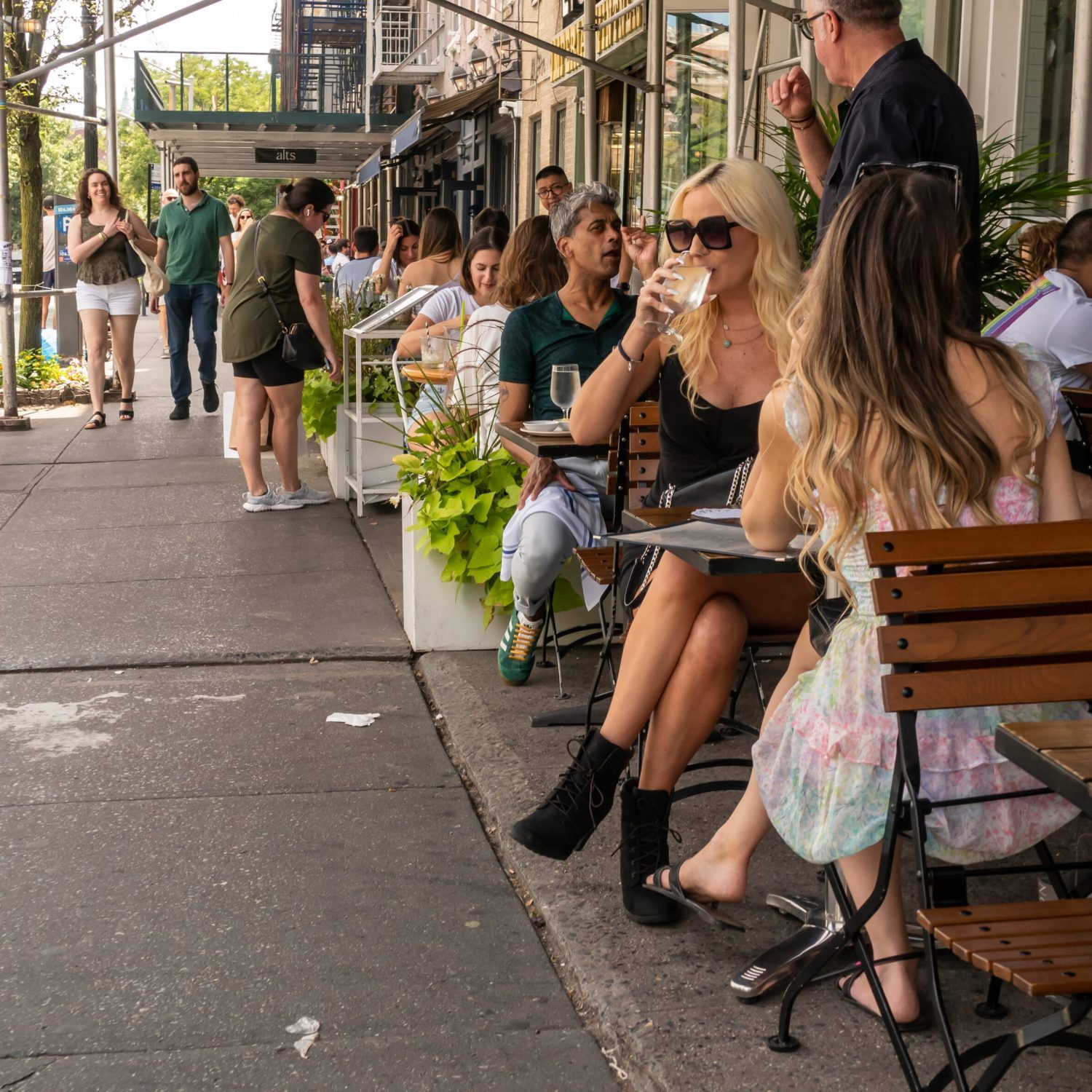
In New York a restaurant can wait more than a year and a half to get permission to fix the outdoor tables. This is what emerges from an investigation published on Tuesday, October 27 by the city’s Comptroller, Mark Levine, who examined the operation of Dining Out NYC, the municipal program that regulates the use of the sidewalks and the spaces along the roadways by the premises. More than half of the restaurants that got authorization from the start of the program, in March 2024, had to wait over 19 months. The Department of Transportation (DOT), the agency responsible for the procedure, indicated an estimated time of about eight months.
The numbers collected by the Comptroller’s office show how much delay has accumulated. Between March 2024 and June 15, 2026 applications were submitted. Only 1.405, equal to 28.6%, had obtained authorization, while 2.115 were still waiting for a DOT decision. Of the 388 requests submitted in the first months of 2026, just one had been approved by 15 June. Less than twenty questions, considering the entire period examined, had been authorized within the eight months indicated by the agency.
The situation has changed partially after the conclusion of the data collection. Between 15 June and 21 October, the DOT sent more 1,022 practices to the Comptroller’s office for final registration, a sign of acceleration in authorisations. The survey takes pictures of the difficulties encountered by restaurateurs in the first two years of the new system.
The Dining Out NYC program replaced the extraordinary authorizations introduced during the pandemic, when thousands of restaurants had been able to arrange temporary tables and structures on the sidewalks and along the streets. The permanent system, which entered into force in 2024, has provided more detailed requirements for the structures, the payment of tariffs and an approval procedure involving several municipal offices. The rules also distinguish sidewalk cafés, located on the sidewalks, roadways cafés, made in spaces normally intended for the circulation or parking of cars.
Getting permission means facing several steps. The refresher must submit a question with the characteristics of the space, the size and the arrangement of the furnishings. The DOT’s technical audits follow, the involvement of the Community Board of the district and, in the foreseen cases, a public hearing. Once this phase has been completed, authorization passes through additional administrative checks before final registration. According to the official instructions of the municipality on the procedure, the premises must also obtain a license and a revoked concession agreement for the use of public space.
One of the problems identified concerns the management of practices. The DOT has not been able to demonstrate that it has a complete system to record how long each question remains in the different stages of the iter or to systematically classify the reasons of the dinieghi. Without this information, see the Comptroller, it becomes difficult to understand where delays are concentrated and what changes could reduce them. The investigation therefore does not attribute all expectations to a single office, but it indicates a deficiency in the ability of the administration to control the whole process.
In the period of maximum spread of the extraordinary program, almost 13 thousand restaurants had joined the initiatives to eat outdoors. Today are just under 2,500, about 27 thousand restaurants in the city. Not all have given up because of the permits: they also affect the costs of the structures, the dimensions of the sidewalks and the characteristics of the individual activities. However, administrative delays are an additional obstacle, especially for smaller premises.
In the meantime, the municipality has modified one of the most contested rules. In August Mayor Zohran Mamdani signed the law that allows restaurants to use the spaces along the road throughout the year, exceeding the obligation to disassemble structures at the end of the season. The measure has reduced the costs related to the assembly, the disassembly and the preservation of the furnishings, but has not automatically eliminated the complexity of the procedure to obtain authorization.
Economic consequences are difficult to quantify for the whole sector, but for a single local can be relevant. A restaurant that submits demand in spring and receives authorization the following year risks losing an entire season of outdoor service. Andrew Rigie, executive director of the NYC Hospitality Alliance, the association that represents restaurants and bars of the city, asked to simplify controls and allow temporary permissions while the practices are completed. The proposal would allow premises that meet certain requirements to start working without waiting for all administrative steps.
Levine recommended the DOT to introduce IT tools to follow questions, periodically publish processing times and establish precise objectives for each stage. Among the proposals there are also simpler modules, able to automatically recover some information on road spaces, and tools that allow refreshers to draw the layout of the tables without having to prepare particularly complex technical elaborates. Another recommendation concerns the possibility of using more flexible and less expensive furniture, maintaining safety requirements.
The question could also be dealt with through a change in city administrative procedures. The Commission on Government Efficiency has proposed to reduce some external passages, including certain public hearings and the publication time of official notices. A proposal submitted to voters in the elections of 3 November also provides for shorter time for authorisations. Any approval would not solve the organizational problems highlighted by the investigation alone, which according to Levine require direct interventions by the DOT.
The result is that while New York has decided to make permanent the possibility of eating outdoors, getting permission remains complicated for many restaurants. The new rules have given stability to a habit born during the health emergency, but they also introduced a procedure that, at least until the middle of 2026, required times much greater than those expected. The increase in the past few months shows that something is changing. In order to understand whether the system really works better, however, they will need updated information on the questions still open and, above all, on the actual time of approval.
L’articolo Outdoor tables, 19 months to get permits are a little too many proviene da IlNewyorkese.