



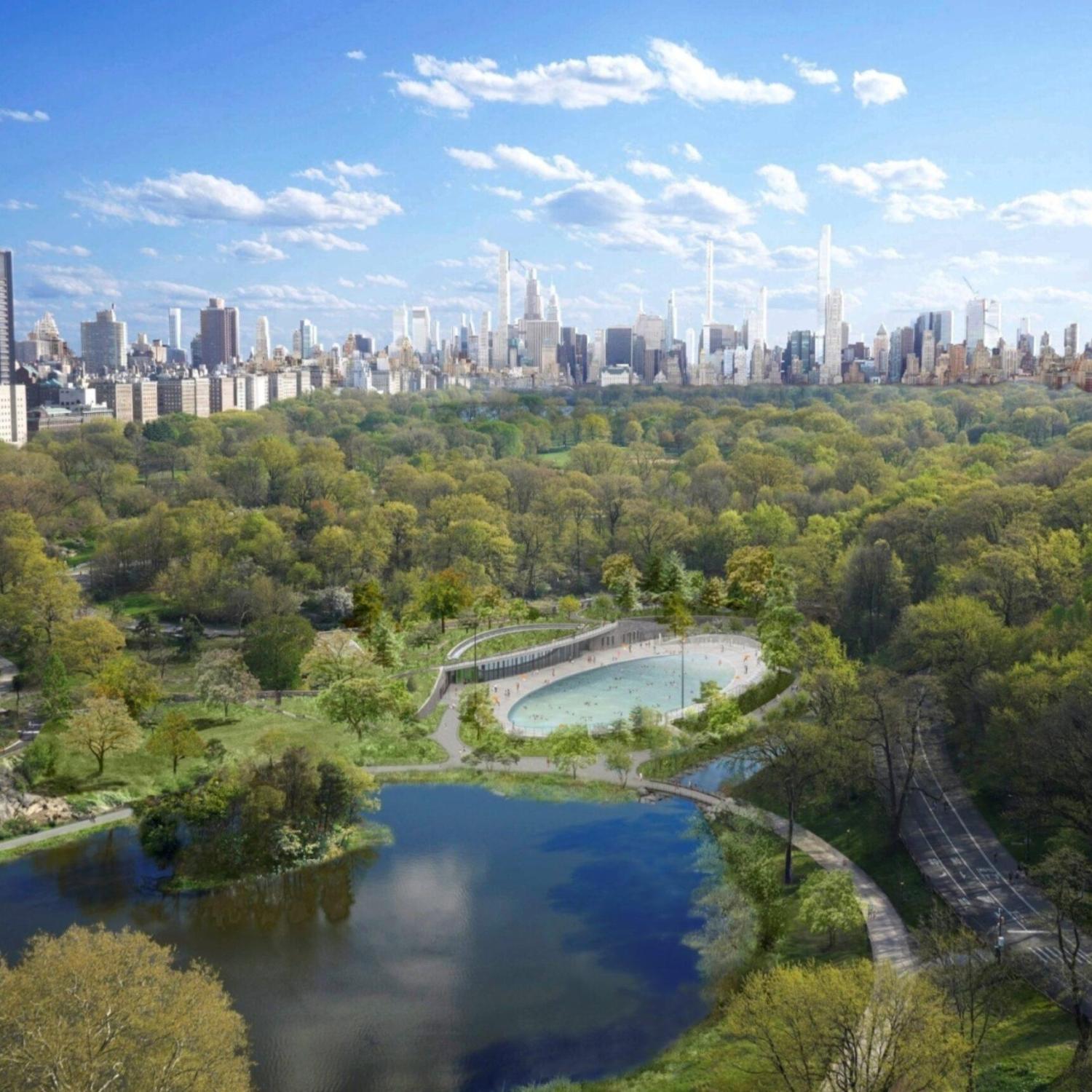
New York will use three Central Park water mirrors to reduce flooding in the streets of Harlem and East Harlem during intense rains. The municipality has started a project of 35.7 million dollars that will allow to regulate the water level in the northern part of the park, creating space to collect the rain before it reaches the sewerage network of the surrounding neighborhoods. The work was announced on Monday, October 26 by Mayor Zohran Mamdani and New York State Governor Kathy Hochul. Completion is planned for autumn 2028.
The intervention, called the North End Recirculation Project, covers three artificial basins in the north of Central Park: the Harlem Meer, the Loch and the Pool. They are connected to each other by a system of water courses designed in the nineteenth century, but today they largely depend on the city water network to maintain the necessary levels. The new plant will allow to circulate and filter water between the three basins, reducing both drinking water consumption and the amount of rain that ends in sewers. According to estimates published by the Municipality, the system will allow to hold every year about 132 million gallons of water, equivalent to almost 500 million liters, which otherwise would reach the sewerage network.
The operation will change depending on weather conditions. In dry periods, the water will be taken from the Harlem Meer and pumped to a point south of the Pool. From there it will return to the other basins using the natural slope of the soil, crossing the filtration system. When the forecasts announce a particularly intense time, the plant will first lower the level of the Harlem Meer, creating an additional collection capacity. During the rain, the basin can fill again, holding part of the water that would otherwise reach the underground pipelines. After the emergency, the system will resume normal circulation.
Map of the three basins (www.centralparknyc.org)
The problem that the project seeks to address is the operation of the sewers in New York. In many areas of the city, especially in the oldest districts, the same underground network collects both the waste water of buildings and the rainy ones. It is the so-called combined sewer system, a mixed sewer system. During the most intense storms, large amounts of rain enter the pipelines simultaneously, which can reach its maximum capacity. When water fails to flow quickly enough, it can accumulate in the streets and contribute to the flooding of semi-trailers and locals on the ground floor.
The northern part of Central Park contributes to this problem because it collects rain from a very large area. The new plant will manage the meteoric waters of a basin of about 204 acres, equivalent to 82.5 hectares. According to the project, the amount of rainwater from this area will reach the city sewers will decrease by 90%.
The other expected benefit concerns drinking water consumption. Currently the city water system is the main source of power for Harlem Meer, Loch and Pool. The recirculation will allow to reuse a consistent part of the already present water, with an estimated savings of 175 million gallons per year, about 662 million liters. It is a quantity greater than that which the project should annually subtract to the sewerage network.
The project should also improve water quality within the park. Continuous circulation and filtration will be used to limit stagnation, one of the conditions that favour the proliferation of algae, including the potentially harmful ones that develop especially during the warmer months. The intervention will therefore have effects not only on the management of storms, but also on the maintenance of water mirrors and on the environmental conditions of the northern part of Central Park.
The funding involves municipal administration, New York State and private donors.
Scheme of the current and future water system (www.centralparknyc.org)
The choice to intervene on Central Park is also linked to the increase in intense rainy episodes. During the presentation, Mamdani reported that during 2026 New York spent about one day out of three in conditions of activation of the protocols for the risk of sudden floods. The mayor has linked this situation to the need to build infrastructure capable of managing rainfall increasingly difficult to absorb with traditional systems. This data relates to emergency protocol activations and does not indicate that the city was actually flooded for a third of the year.
The project also comes from a comparison with East Harlem residents. Through the Municipal Climate Strong Communities program, the administration has collaborated with the environmentalist organisation WE ACT for Environmental Justice and the Community Board 11 to identify the priorities of the district in the management of intense rains. According to Louise Yeung, Head of Climate Policy of the Municipality, this work has contributed to obtain the $10 million of state funding. The project also received support from the five Community Boards around Central Park. The Public Design Commission approved the final project in December 2024.
The network of water mirrors affected by the work dates back to the original design of Central Park. The Pool, the Loch and the Harlem Meer were built between 1862 and 1865 according to the design of landscapers Frederick Law Olmsted and Calvert Vaux, who imagined a system of water streams connected through the natural terrain of the park. The new plant will partially resume its operation, adding pumps, filters and control systems to suit the needs of a city very different from that of the nineteenth century.
The intervention is part of a series of transformations already started in the north of Central Park. In 2025 the Davis Center was inaugurated, the new recreation center built in the area of the former Lasker Rink and Pool, which also allowed to restore a section of the historical water course directed towards the Harlem Meer. There are also works of accommodation on the shores of the lake, to improve accessibility and counter erosion. The Central Park Conservancy considers the new system to recirculate its most ambitious infrastructure project, because it connects landscape conservation to the management of water resources of the entire area.
For residents of Harlem and East Harlem, the expected benefits mainly concern the reduction of pressure on the sewerage network during storms. It will not be a solution to all flooding, which depend on different factors and require interventions also on the roads and pipelines of the individual districts. The project, however, shows how a green space can play a function that goes beyond the recreational space. If the works comply with the calendar announced, the system will come into operation in autumn 2028.
L’articolo New York will spend $35.7 million to reduce flooding in Harlem proviene da IlNewyorkese.