



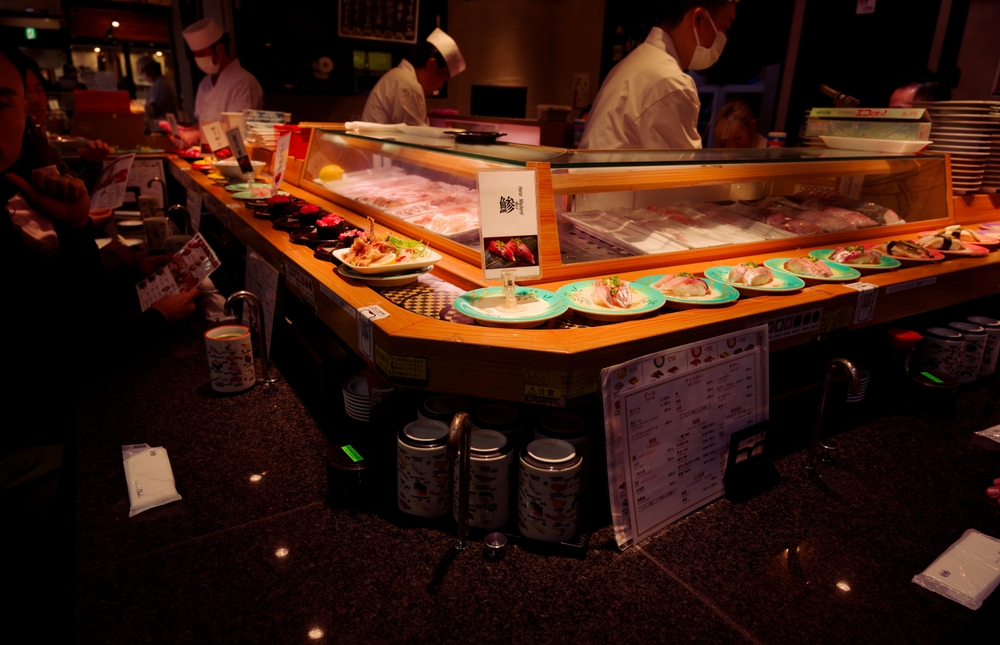
Sushi restaurants with the conveyor belt, known in Japan as kaiten-zushi, have become one of the most famous symbols of contemporary Japanese catering, also thanks to the imagination derived from Japanese anime and movies. They have been successful because they allow to serve large amounts of customers quickly and economically, while at the same time maintaining a ludicrous experience: seeing the dishes flow in front of them and choosing what to take is part of the attraction as much as the food itself.
Sushiro, one of the largest Japanese chains in the industry, in 2025 had 234 restaurants abroad and aims to reach 320 by the end of 2026. Most are located in China, but the chain is also present in Singapore, Thailand, Taiwan and South Korea. This year it will open its first restaurant in the United States, New York, entering for the first time in a non-Asian market.
The New York restaurant should open in the fall of 2026 in Times Square, at the corner of Eighth Avenue and 42nd Street, in a space of about 836 square meters spread over three floors. According to Secret NYC, he will occupy a place that in the past had been a McDonald’s and will be the first permanent home of Sushiro in the United States. The first two floors will have the chain conveyor system and about 150 seats, while the basement floor will be intended for private dinners and a more collected sushi bar.
The menu should include more than one hundred dishes, not only sushi: in addition to nigiri and hand roll, there will also be ramen, somen, egg creams cooked with steam and sweets like Catalan, warabimochi and sorbetto. The orders will be made via digital kiosks and then sent directly from the kitchen to the room through the conveyor belt.
The country that is pushing the growth of Sushiro out of Japan, however, remains China. The first Chinese restaurant was opened in 2021 in Guangzhou, but the moment when the chain became famous arrived last year, with the opening of the Shanghai headquarters. Thousands of people lined up to prove it, and according to Chinese media, the interest did not last after the inauguration. On weekends, in front of Guangzhou, Shenzhen and other major cities, long queues continue to form.
The success was mainly fed by young people, who shared photos and videos of meals on Xiaohongshu and Douyin, two social platforms widely used in China. Sushiro has become popular because it offers a quite spectacular experience, but at low prices. Customers sit at the table, consult the menu on a tablet and order directly from there. When the dish is ready, it arrives at the table passing on the conveyor belt: it is a different operation than that of the Japanese tradition.
In the most traditional restaurants of kaiten-zushi, customers take the dishes that pass in front of them without ordering them first. The Sushiro model works differently: the dishes are prepared after the order and sent to the table. This allows the chain to reduce waste, because it should not continue to circulate sushi in the hope that someone takes it, and also responds to the growing attention to hygiene that has burst in recent years after the pandemic. A few years ago in Japan a viral video showed a boy licking his fingers and then touching the sushi on a conveyor belt, apparently to make a joke to other customers. The episode took place in a Sushiro restaurant and helped push the chain to change its system, keeping the tape but limiting the exposure of the dishes.
The theme of hygiene has recently returned to China. In March, a client said he had found parasite eggs in a tuna dish served in a Sushiro restaurant in Beijing. The company responded that no contamination had been detected and that the product respected food safety standards. The case does not seem to have significantly damaged the popularity of the chain, at least for now.
The invention of sushi on conveyor belt is generally attributed to Yoshiaki Shiraishi, owner of a small Japanese restaurant looking for a way to serve more customers with less personal. He came up with an idea of bottling the Asahi beer, where the bottles flowed automatically along the production chain. He worked five years to adapt that principle to a restaurant and in 1958 he installed the first plant in his local Higashiosaka. At first, customers sat along a counter and took the dishes that passed in front of them; then tables were introduced perpendicularly to the tape, more suitable for groups and families. The system had several successes: after the 1970 Osaka International Exhibition, in the 1980s with the growing habit of eating out of the house, and then in the late 1990s, when the economic crisis made economic restaurants more popular. In recent years that model seemed less central, also because many customers demanded more quality and sushi prepared at the moment. Sushiro is trying to keep the two things together: the tape as an attraction and the dish made on request. Cancel
L’articolo The most famous sushi restaurant on conveyor belt arrives in New York proviene da IlNewyorkese.