

The decision to speak of Greece in this torrid month of New York July was born, without doubt, from the desire of white beaches, crystal clear seas and souvlaki at breakfast. There is also a hint of healthy envy towards those beaches in these days if it is really enjoying them and the secret hope that writing it can provide the illusion of a teleport that cannot, at least for now, transform reality.
Here I am, therefore, looking for Greece in New York, aware that in the East River I will not find the Mediterranean, but curious to discover a new fragment of our World Tour in the city, between addresses, stories, curiosity and authentic flavors. And to embark on this journey, there is only one possible starting point: Astoria, the beating heart of Greek immigration, which since the 1960s has earned the nickname “Little Greece” and has become a true reference point, in the heart of Queens, for the Greek community in New York.
The first waves of migration date back to the beginning of the twentieth century, when young Greeks left their homeland in search of work and opportunities, often with the idea of returning, but finishing to settle in the United States. Initially, many settled in Manhattan as workers or small traders, but already with the subsequent diaspora was preferred astoria that offered a more economical and similar alternative to a European village, remaining well connected to Manhattan. The great boom came after the Immigration and Nationality Act of 1965, the U.S. law that abolished restrictions based on national origins and allowed many more non-North European citizens to immigrate in the United States. In the next decade almost 150,000 Greeks arrived in New York, attracted by the promise of work, by existing family networks and the possibility of building a new life while maintaining strong cultural links with the origins. Many of these immigrants chose Astoria, which became a real Greek village destined to become the largest community outside Greece and Cyprus. In the 1970s it is estimated that Astoria housed up to 70,000 residents of Greek origin, including many who spoke exclusively Greek at home, a sign of a population that could preserve language and traditions even thousands of kilometers from the Aegean.
Around this community, as always happens, schools were born (such as the Saint Demetrios Preparatory founded in 1956 and still a reference point for education in the neighborhood), Greek Orthodox churches, shops and associations such as and the Federation of Hellenic Society. All this has created an authentic microcosm, a sort of second homeland, where habits, traditions and language lived. In recent decades, while part of the Greek community has chosen to move to quieter neighborhoods or suburbs, new arrivals have continued to fuel the link with roots, especially during the economic crisis in Greece in the years 2010. Despite the evolution of the district, between gentrification and fusion with other communities, the Greek soul of Astoria remained firmly alive. You can breathe it in traditional taverns, street festivals, white and blue flags that wind up proud and coffee along Ditmars Boulevard and Steinway Street, where you still speak Greek and play tavli as in a square in Athens.
Practically every excursion to Astoria aims for a lunch or dinner based on traditional dishes and in this the picturesque Taverna Kyclades, open every day of the week until 22.00, is a real institution. The flagship of Ditmars Boulevard, Taverna Kyclades opened its doors in Astoria in 1996, becoming an icon of Greek cuisine in the city. In 2013 a second seat was opened in Manhattan (East Village), then finally closed in 2024, when the local underwent a renovation and later changed its name. The tavern of Astoria, instead, remains faithful to the convivial environment of the Cyclades: the walls are decorated with stuffed fishes, strictly blue and white tables, and the waiters – all of Greek origin – reflect in the kind service, pride and authenticity. There is nothing that makes me feel more on holiday than an outdoor lunch based on polipo and grilled fish in this restaurant!
Authentic alternatives in the neighborhood obviously do not miss! To Loukoumi is a cozy and informal tavern, perfect to share mezes in a convivivial atmosphere that really looks like a village square. Stamatis, present since 1990, is a beloved address for traditional dishes prepared as at home — from octopus to grill to smoking moussaka. Bahari Estiatorio, is famous for generous portions in a simple but always animated environment. Three alternatives that, like Taverna Kyclades, can make us feel in Greece also in New York, between a cold glass of assyrtiko and a plate of squid.
In full belly, we start exploring the district and its historical heritage better.
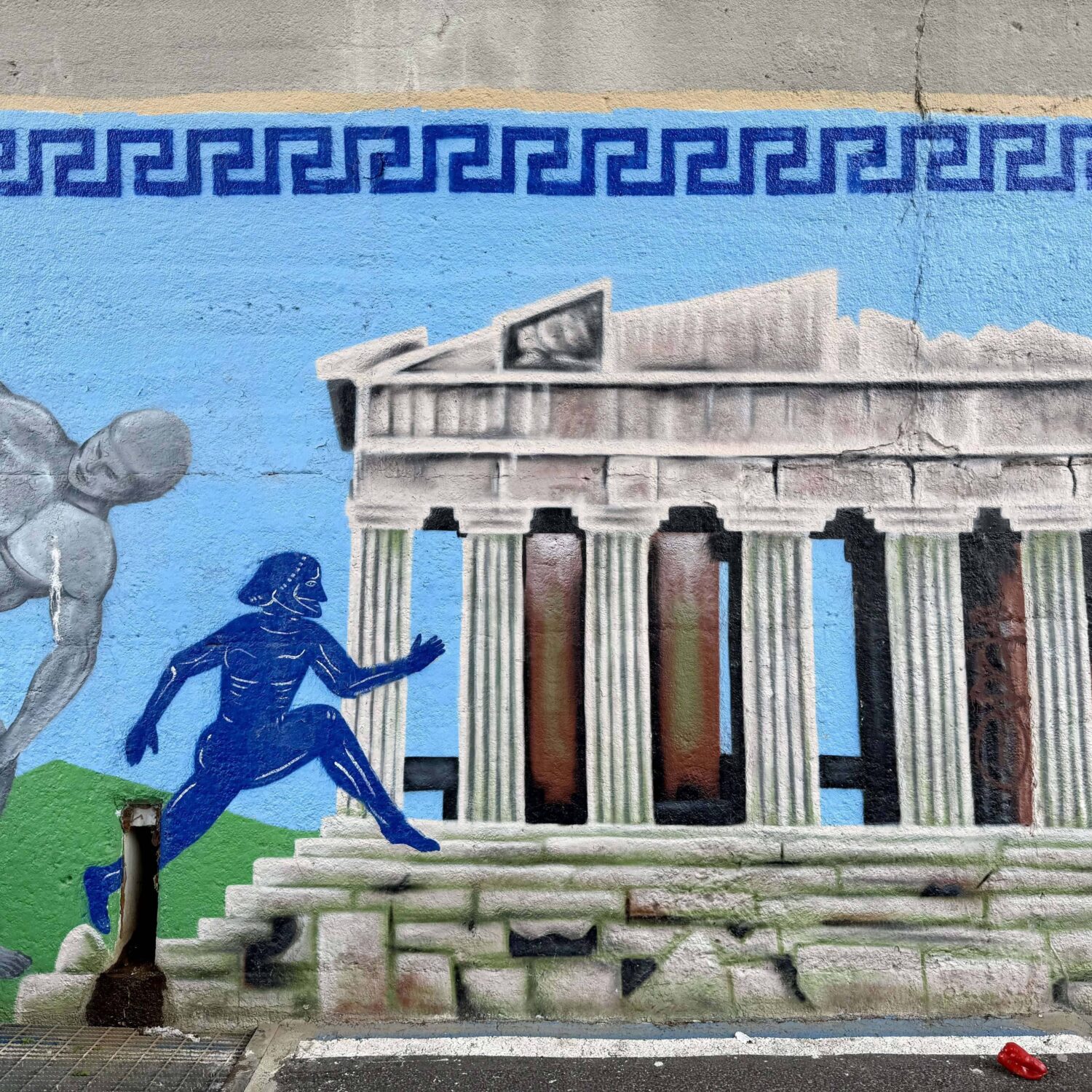
A symbol of the Greek presence in Astoria is the small and well-kept Athens Square, the small square that looks like a small corner of Athens nestled in the streets of Queens. Inaugurated in 1990 and completed in 1998, Athens Square was designed to celebrate the Greek cultural heritage and the contribution of the Greek community to the city. Here, between Doric columns and benches that welcome the chatter of a summer Saturday afternoon, the statues of Socrates and Aristotle stand out, a reproduction of the statue of Athena and a small amphitheatre where in summer concerts, shows and outdoor events are held that animate the evenings of the neighborhood. The skyline of Manhattan skyscrapers is just outside the boundaries of the park but the feeling here is to be catapulted in time and space. While I take a few photos, including those that accompany this article, I am approached by a distinguished gentleman, curious by my own curiosity that, discovering my intentions, does not pray to tell me the story of these roads. In his voice and confidentiality in speaking of himself I see an almost detached pride towards the motherland that I do not know if to attribute to the awareness that nostalgia could hurt or pride in knowing to belong to another land and another life: they are two feelings that live in the heart of every immigrant (or expat that I will say) and that I learned to respect for having known them well in person. I therefore do not insist on asking personal aspects to my improvised guide, which I still see turning on in my face when I pronounce the few Greek words available to my little vocabulary: thank you, please, good-bye. Efharistò, parakalò, kalimera. Five years of classical high school and having, if nothing else, learned the basics of education! However achieved objective: interlocutor hit and sunk.
We split up in pain, and left the park in the direction of 30th avenue, I am about to make another interesting encounter: the one with the owner of the Akropolis Meat Market. Founded in 1975 by John Gatzonis and his father Gus, who arrived from Athens in 1956, this butcher shop has been an institution in Astoria for almost fifty years. Gus believed that everyone should be able to buy high quality meat at honest prices, in a familiar and welcoming environment and still today the butcher shop assures his legacy between historical photographs and authentic relics, including his old knife. At the Akropolis every cut is prepared to measure, and the visit immediately turns into a moment of sociality: not only does John want to tell himself but also historical customers willingly stop to greet, while the famous leg of lamb and the kid for the barbecue go to steal on weekends. In front of a map of Greece hanging on the wall, we talk about holidays at the sea – here it returns to close the circle of my research – of acropolis and of Partenone, of the etymologies of words, which I can recognize thanks to my classical studies, and of his satisfactions obtained thanks to many years of passion for his work. I promise to send John a copy of this article translated into English before greeting him and reaching a new stage.
The imposing Saint Demetrios Cathedral, the center of the religious life of the Greek Orthodox community of Astoria, immediately hits by the size and the great Greek flag that stands alongside the American one with stars and stripes. Built in 1942 and expanded with an opulent neo-Byzantine structure in 1975, the church mainly affects its interior. Dawn, gilded and decorated with imposing columns, stained glass, huge chandeliers that illuminate the carved iconostasis, in a space filled with frescoes and sacred mosaics that narrate the Orthodox spirituality. When I say that New York is a journey in the journey I refer to the magic that places like these can convey and the unique learning opportunity this city offers.
At least two other churches, among the numerous Greek Orthodox churches of Astoria, are to be mentioned here and deserve a visit: the Cathedral of Saint Markella, which dates back to 1954, whose interior mixes Byzantine art with rich work on wood, votive lamps and an elaborate episcopal throne, and the St. Irene Chrysovalantou Monastery which houses an authentic relic: the hand of Saint Irene, object of veneration and pilgrimage. Here too the interiors are decorated with sacred portraits in an almost mystical atmosphere, between devotion and legends. Visiting these churches means diving into the Greek soul of Astoria: every fresco, every chandelier, every icon tells a story of faith, migration and community, immersed in a triple of golden colors and solemn atmospheres.
These churches are not only places of worship, but real hearts that are the buttons of the community, especially during the great religious holidays. Orthodox Easter is the most important event for the Greeks and Astoria is celebrated with great devotion. The Greek Orthodox churches organize solemn functions, processions with candles lit on Saturday night and large community lunches on Sunday with traditional dishes such as roasted lamb, grill soup and typical red eggs. Another special moment is Apokries, the Greek carnival that precedes Orthodox Lent, celebrated with masked parties, music and dishes rich in typical dishes, in a climate of contagious joy. During the summer, finally, many churches organize festivals open to all, where food, music and dances become a perfect opportunity to feel part, even for a day, of the great Hellenic family in the heart of New York. All information about these and other initiatives, as well as Greek language courses, artistic workshops and cultural events, are available at the Greek Cultural Center, a valuable reference point for those who want to deepen the Greek culture and really feel part of the community.
At the end of this journey, I would leave readers with an appointment for the next year: on March 25, the day of Greek Independence, which commemorates the beginning of the revolution against the Ottoman Empire in 1821, Astoria colored white and blue. It is the ideal day to join the local community between flags that thrive everywhere, churches that celebrate solemn masses, parades, cultural events and convivial gatherings. It is a feast that combines spirituality and national pride, where traditional music, folkloric costumes and popular dances tell the story of a proud people, even far from the motherland. Participating in this celebration means immersing yourself completely in the Greek soul of New York and discovering how strong the link with its roots is today.
With this stage between the flavors and stories of Astoria, we add a new stamp to our passport of the “World Day in New York”. If you missed your previous bets, you can recover them to continue traveling among the thousand souls of this city. There are also many new destinations to discover together, a metro stop (and a bite) at a time! Thank you for coming here and the next adventure!
L’articolo Greece at two stops from Manhattan: the Greek face of New York proviene da IlNewyorkese.